Transcript
Click to reveal
Among the many theories explaining the oddities of our recent past, one of the most persistent and widely circulated
0:07
concerns the technical limitations of early photography. Skeptics and defenders of the official
0:12
historical narrative invariably claim that the emptiness of giant 19th century metropolises is merely an optical
0:20
illusion caused by the long exposure times of early cameras. They argue that the equipment of that
0:26
era required subjects to remain motionless for tens of minutes. So, the bustling city crowds simply didn't stay
0:33
still long enough to be captured, turning into invisible ghosts. However, upon detailed analysis, this
0:40
argument collapses like a house of cards the moment we compare facts with the timeline of technical progress.
0:49
By the 1880s, technology was already capable of capturing motion with sufficient clarity. Let's remember that
0:56
the first motion pictures were already being demonstrated around this time where people, carriages, and city bustle
1:03
were perfectly visible. The claim that a highquality photo required one to freeze
1:08
for half an hour had already lost its relevance by this period. Moreover, on
1:13
the very photographs used as examples, one can often spot distinct figures of horses or solitary pedestrians.
1:21
A logical paradox arises. How could a camera with a supposed hour-long
1:27
exposure capture an animal that by definition cannot stand absolutely still
1:32
for a long time, yet completely erase thousands of people who should have been filling the main avenues of the
1:39
capitals? The selectivity of this technical error raises too many questions.
1:47
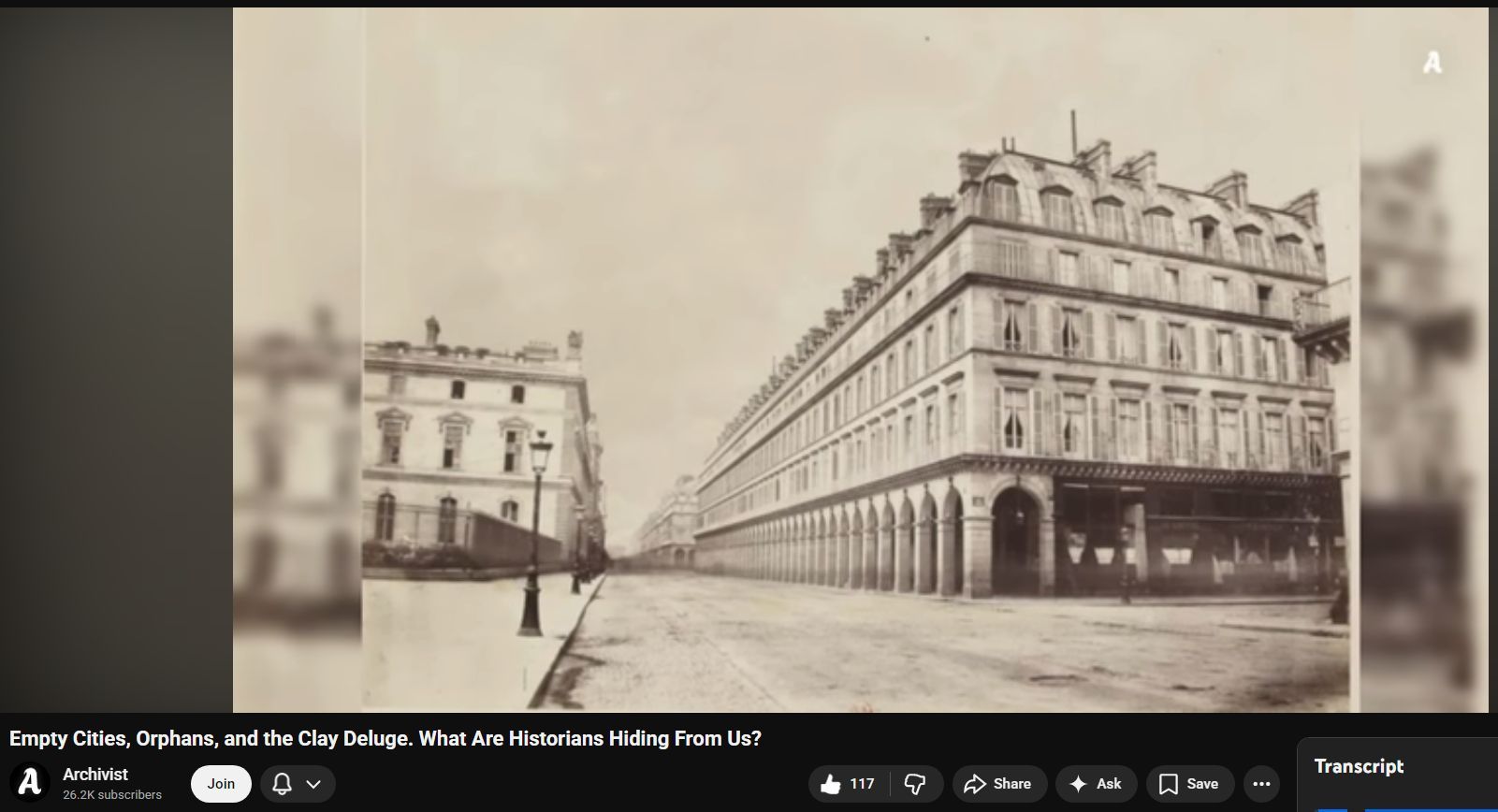
If we discard the convenient exposure excuse, a picture opens up before us
1:52
that causes deep cognitive dissonance. We see majestic cities with grand
1:57
architecture, wide avenues, and complex infrastructure that look absolutely
2:02
extinct. This isn't just a lack of pedestrians. It is an absence of life itself.
2:09
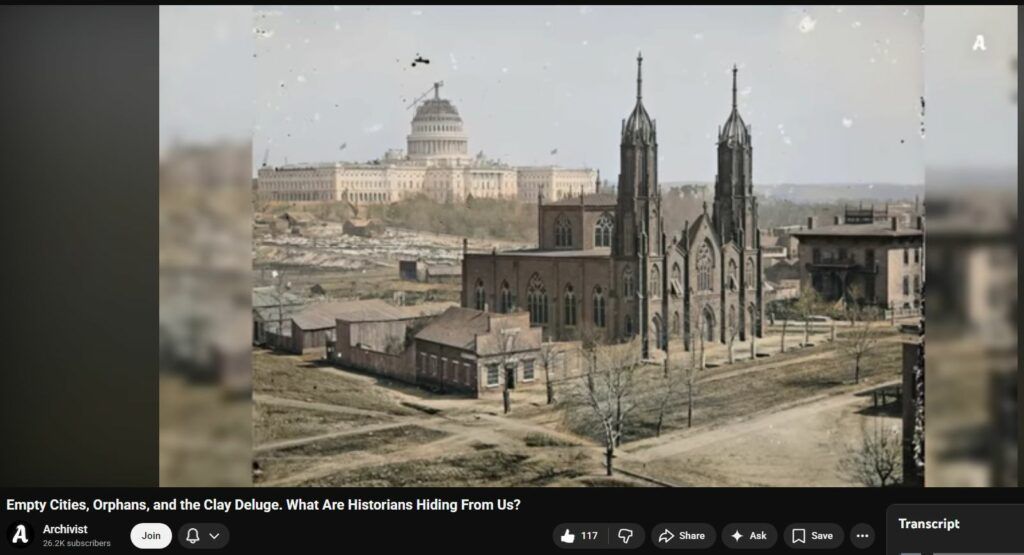
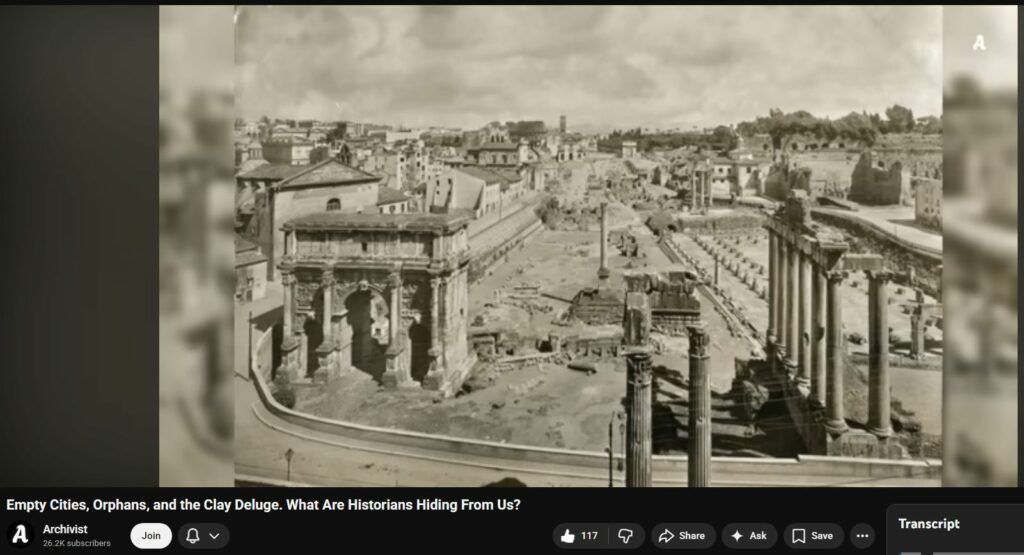
On panoramic views of huge settlements, there are no signs of the daily activity typical of that era. Of the thousands of
2:17
chimneys clearly visible on rooftops, not one is smoking, as if the heating in the entire city was turned off
2:24
simultaneously. There are no street vendors, no stalls with goods, no laundry, which in those
2:31
times was traditionally dried in courtyards and on streets. The cities look sterile like movie sets from which
2:37
all the actors have just been removed. This emptiness resembles modern
2:44
exclusion zones like Pryat where the architecture remains untouched but biological life has been evacuated.
2:51
The buildings stand. They are magnificent and monumental but they are cold. Another disturbing detail is the
2:59
vegetation. Against the backdrop of structures we are told are ancient. We see only thin young saplings no more
3:06
than a few years old. Where are the centuries old trees that should be growing in these old cities? One gets
3:13
the impression that all vegetation was destroyed and nature had only just begun to recover a new on the ruins of
3:20
civilization. Our perception blocks the obvious
3:26
because from an early age we have been trained to trust only authorities and official sources. The education system
3:33
and scientific institutions are built so that any deviation from the approved chronology is perceived as absurdity.
3:41
The presence of titles, medals, and awards among experts is considered a guarantee of truth. Although history
3:47
knows many examples where generally accepted facts turned out to be delusions,
3:53
it is easier for us to believe in the technical limitations of old cameras than to admit the thought that the
3:59
photographs capture reality. empty cities left by an unknown civilization
4:04
in which for some reason there were almost no people at that moment.
4:11
Thus, the argument about long exposure serves merely as a screen hiding an uncomfortable truth. If these cities
4:18
were not inhabited by the builders of these structures, then who built them? How could it be that the few people
4:25
caught in the frame look like alien elements against the backdrop of cyclopian structures that clearly exceed
4:32
their technical capabilities? The answers to these questions force us
4:37
to reconsider not only the history of photography but the history of technological development as a whole.
4:44
Because the discrepancy between the complexity of the architecture and the primitive tools available to our
4:49
official ancestors becomes increasingly obvious.
4:55
The silence enveloping the urban landscapes of the 19th century evokes not just bewilderment but an instinctive
5:01
sense of anxiety similar to what visitors feel in modern exclusion zones.
5:07
If one carefully analyzes the atmosphere of these places, it becomes obvious that we are observing not just a quiet
5:14
weekend morning, but the aftermath of a total exodus or a global purge. This
5:19
phenomenon can be called the Pryyat syndrome. The scenery of civilization remains untouched. The majestic stone
5:26
boxes stand in their places, but the soul of the city, its biological content
5:31
has vanished. The most screaming sign of this
5:36
lifelessness is the chimneys. In an era when electric and gas heating did not
5:42
yet exist in the form we know, the life of any large settlement depended directly on stoves and fireplaces.
5:49
Hundreds, thousands of pipes on the roofs of dense developments should have been spewing clouds of smoke around the
5:56
clock, especially in the cold season, to heat huge halls and living quarters. An
6:02
industrial city of that time by definition could not be transparent. It
6:07
should have been shrouded in smog and soot. Yet crystalclear horizons appear
6:13
before us. The chimneys are cold and dormant, as if vast residential areas
6:19
stand mothballled, disconnected from life support systems. This does not look
6:24
like a temporary pause. It looks like a complete absence of inhabitants who required warmth.
6:32
Descending from the roofs to the pavement level, we encounter another inexplicable sterility. Historical
6:38
chronicles describe the cities of that time as antills full of chaos, noise, and filth. Trade was conducted
6:45
everywhere from trays, carts, right on the ground. Narrow streets should be
6:51
draped with drying laundry, an invariable attribute of life without dryers. Everywhere there should be
6:57
traces of the activity of thousands of people and animals, trash, straw, goods,
7:03
barrels. But there is none of this. The streets are swept to an unnatural shine
7:09
or conversely covered in strange unclaimed mud, but devoid of signs of
7:15
active immediate life. There are no merchants, no buyers, no bustle. The
7:21
city looks as if it had been prepared for settlement, but the tenants themselves haven't arrived yet or they
7:27
left in a hurry, taking with them everything that created a sense of living presence.
7:33
Particular attention is drawn to the vegetation, or rather its strange disproportion to the architecture.
7:41
Next to buildings that official history attributes to hundreds of years, we see only thin stunted saplings.
7:49
The trees in the alleys and parks are at most a few years old. Their trunks are
7:54
thin and their crowns are barely formed. If these cities had developed
8:00
continuously over centuries, we would observe powerful ancient oaks and plain trees whose roots would go deep into
8:07
history. The absence of old trees suggests that the soil layer was
8:12
completely destroyed or renewed quite recently. The landscape seems to have
8:18
been rebooted. The old flora disappeared along with the people and nature is only
8:23
beginning to timidly reclaim its space against the backdrop of cyclopian ruins.
8:31
Comparing these pictures with modern photographs of abandoned territories, it is impossible to shake the feeling of
8:37
deja vu. Pryet today looks the same. empty eye sockets of windows, overgrown
8:44
courtyards, and oppressive silence. The only difference is that tourists go
8:50
to the exclusion zone to tickle their nerves with the sight of an abandoned world, while we are asked to believe
8:56
that the empty cities of the 19th century are thriving centers of civilization.
9:02
This substitution of concepts becomes obvious if you stop listening to interpretations and trust your own eyes.
9:09
We see a world that has survived an event that stopped the usual course of things.
9:16
However, the most striking thing in this picture is not even the emptiness, but the contrast between the scale of the
9:22
structures and those rare figures that are still found on the streets. Solitary passers by and primitive carts drawn by
9:29
horses look pathetic and out of place against the backdrop of grandiose cathedrals, palaces, and endless rows of
9:36
buildings with antique geometry. These people seem not like creators, but like random passers by, ants crawling
9:44
among the ruins of titans. And here arises the main question that destroys
9:49
the familiar picture of the world. Could these creatures, armed only with shovels, pickaxes, and wooden carts,
9:56
design and erect such perfect architectural complexes? The technical abyss between the complexity of the
10:02
structures and the primitive means of production available to our official ancestors becomes insurmountable,
10:08
forcing us to doubt the very possibility of such construction.
10:14
The official history of technical progress represents a linear scale where humanity slowly step by step moved from
10:21
primitive hand tools to steam engines and then to electricity and complex mechanics. We are told that the first
10:28
handheld power tool was invented only at the very end of the 19th century and it
10:33
became affordable and mass-roduced only in the midentth. This means that all the grandio
10:39
structures dating back to the 18th and 19th centuries were allegedly built exclusively using muscle power, chisels,
10:47
hammers, and the simplest lever mechanisms. However, when we compare these claims
10:53
with actually existing objects, an insurmountable chasm arises between the official capabilities of our ancestors
11:00
and their actual legacy. The brightest example of this technical
11:06
inconsistency is the history of the construction of the Eerie Canal in North America. Official sources claim that
11:13
this gigantic waterway, 585 km long, 12 m wide, and 4 m deep, was built in just
11:21
8 years between 1817 and 1825.
11:26
We are asked to believe that at a time when by the admission of historians themselves, there was not a single
11:33
professional engineer in the US, a group of Irish immigrants performed an engineering miracle surpassing many
11:39
modern projects. They had to not just dig soft soil, but cut through dense
11:45
virgin forests, build complex lock systems and aqueducts, and most importantly, overcome the Niagara
11:52
escarment consisting of the hardest limestone.
11:57
Mathematical analysis of this construction leads to a dead end. To finish the project in such a time frame,
12:04
the workers would have had to lay an average of 1 and 12 km of canal every 8
12:10
days. working without weekends, sleep breaks or stops for winter cold. And
12:16
this is provided that dynamite had not yet been invented and only capricious and inefficient black powder was used
12:22
for blasting. Such a pace of work using only shovels and wheelbarrows is
12:27
impossible even theoretically. This leads to the assumption that the so-called builders did not create the
12:34
canal from scratch, but merely cleared and restored an already existing ancient transport artery left over from a more
12:41
advanced civilization. Similar questions are raised by stone
12:47
processing in the architecture of that period. All over the world, we see buildings clad in granite blocks
12:54
weighing several tons with perfectly fitted joints into which it is impossible to insert a knife blade.
13:01
Columns of solid stone have the perfect geometry of a body of revolution which is impossible to obtain by manual
13:07
hewing. Creating such forms requires industrial scale lathes and carbide
13:13
tools capable of cutting granite like butter. The official version insists that
13:19
masters spent decades polishing stone with sand and water. But if you look at
13:24
the number of such buildings in St. Petersburg or Paris alone, it becomes clear to build this by hand would
13:32
require a population many times larger than the real one and time frames measured in centuries, not years.
13:41
Even more mysterious are the so-called star forts scattered across all continents. Their complex geometric
13:48
shape resembling snowflakes or crystals possesses perfect symmetry that can only
13:54
be appreciated from a great height. We are told that these bastions were built for protection against cannon fire and
14:00
the angles of the walls allegedly facilitated the ricochet of cannonballs.
14:06
However, the complexity of their design is excessive for fortification. Building such sophisticated figures
14:13
requiring incredible geodetic calculations just so they could be shot at is illogical. Furthermore, how could
14:20
the architects of the past mark out these giant fractals on the terrain without the ability to look at them from
14:26
the air? The precision of these objects suggests that their original purpose lay
14:31
not in the military plane at all, but was perhaps related to energy or wave processes about which we know nothing
14:38
today. All these facts, the eerie canal,
14:43
impossible granite processing, the geometry of star fors indicate that we
14:49
are suffering from collective amnesia. We attribute to ourselves achievements
14:54
the creation technology of which we do not understand. The people of the 19th century captured
15:00
in old photos on horseback look like inhabitants of a post-apocalypse who settled the ruins of a highly developed
15:07
world, adapted palaces into stables and power stations into temples, and
15:12
invented legends about how their greatgrandfathers built it all with a chisel and prayer.
15:18
But if a civilization capable of such miracles existed, where did it disappear to? Why was its knowledge lost and the
15:26
cities emptied? The answer to this question lies literally beneath our feet, hidden by
15:32
layers of earth that we are accustomed to overlooking. Walking through the historic centers of
15:39
old cities, whether in Europe, Russia, or America, an attentive observer
15:44
inevitably encounters an architectural anomaly that official science calls by the harmless term cultural layer. We are
15:52
explained that over centuries, the ground level rises due to the accumulation of dust, dirt, construction
15:59
debris, and successive layers of asphalt. However, one only has to look closely at
16:05
the ground floors of ancient buildings for this theory to begin contradicting common sense. We see full-sized windows
16:12
half or completely submerged underground. They are not bricked up. They often have glass behind which
16:18
basement walls are visible or they butt right up against the paving stones. A logical question arises, what architect
16:26
in their right mind would design a window located below ground level?
16:32
Window openings are created with a single purpose. To let in sunlight and fresh air, placing them in the ground
16:40
only to then build special pits in front of them or bury them altogether is the height of engineering absurdity.
16:47
Moreover, often found underground are not just windows, but full-sized
16:52
doorways, grand entrances with arches and moldings that now lead nowhere,
16:58
abuing a dense layer of soil. When asphalt is removed near the walls
17:03
of such houses during modern repair work or utility laying, entire floors are
17:08
revealed, the existence of which no one suspected. These are not basements or
17:14
technical rooms. These are former first floors with high aesthetic execution
17:19
which for some reason ended up buried to a depth of 2, three, and sometimes more
17:25
meters. The official version of the gradual accumulation of the cultural layer does
17:32
not hold water if we consider the speed of this process. To accumulate 3 m of
17:38
soil naturally, millennia are required, not a couple of centuries.
17:43
Furthermore, if the street level rose slowly, building owners would remodel entrances and windows, raising them
17:50
higher rather than allowing dirt to block light sources. What we observe looks more like the
17:56
consequences of an instant catastrophe associated with a colossal release of soil or a change in soil structure.
18:04
Geologists and researchers point to the phenomenon of soil liquefaction which occurs during powerful earthquakes or
18:10
planetary scale vibrational impacts. At such moments, solid ground
18:16
temporarily acquires the properties of a liquid and heavy stone structures literally sink, drowning in it while
18:22
maintaining their integrity but losing height. Similar processes have been observed in
18:29
our time, for example, during earthquakes in Japan or New Zealand where buildings sank into the soil while
18:35
remaining vertical. If we extrapolate this phenomenon to a global scale, the strange appearance of 19th century
18:42
cities becomes understandable. In old engravings and photographs of that period, we often see not just dirty
18:49
streets, but real mountains of earth piled up against the facades of palaces and cathedrals.
18:55
People with shovels and wheelbarrows in these photos are busy not with construction, as is commonly believed,
19:00
but with excavation. They are digging out structures that survived the cataclysm, trying to bring
19:06
them back to life. That is why in many old images, entrances to grandiose
19:12
buildings are accessed via temporary wooden walkways thrown over the mud or through secondstory windows that have
19:18
become the first. The global nature of this phenomenon is
19:23
staggering. Buried floors are found in Rome, London, Moscow, New York, and
19:29
Melbourne. Everywhere is the same picture. Magnificent antique or colonial
19:35
architecture, the lower part of which is hidden under a thickness of clay and sedimentary rocks. This testifies that
19:42
the catastrophe, which alternative researchers often call the mud flood or the great burying, was not a local
19:49
event. It was a disaster of planetary scale that changed the landscape of all
19:54
continents. the level of the land ocean, so to speak, rose, hiding the true history of
20:01
the previous era beneath it. Realizing the reality of this cataclysm
20:07
leads to a frightening conclusion. If cities were buried several meters deep within a short period, then this event
20:14
must inevitably have entailed colossal human casualties. The mud covering the first floors could not have left a
20:20
chance for those who were below, and it destroyed the usual life support systems. The survivors would have faced
20:27
hunger, cold, and the total collapse of infrastructure. And here the puzzle begins to fit
20:33
together. The empty cities we discussed earlier are not a photographers's error, but the direct consequences of the
20:40
catastrophe. The population was practically wiped out. But the cities did not remain empty forever. Soon after
20:47
the event, new inhabitants appeared in them, whose origin raises even more questions than the buried windows. Who
20:54
were these people who settled the ruins of a great civilization? And where did they come from in such numbers if the
21:00
world lay in ruins? If we accept the hypothesis of a global
21:05
cataclysm that buried cities and destroyed a significant part of the adult population, we are faced with a
21:11
frightening demographic question. Who filled these empty metropolises just a few decades later? At the turn of the
21:19
19th and 20th centuries, we observe an explosive population growth in major industrial centers. But the structure of
21:26
this society looks extremely unnatural. This is not organic generational
21:31
recovery, but rather an artificial repopulation resembling a special operation to inject a new workforce.
21:39
The key to solving this mystery lies in one of the most common and simultaneously ignored themes of that
21:45
time. The phenomenon of mass orphanhood.
21:51
The cultural code of the 19th century is literally saturated with the image of a child left without parents. Classic
21:59
literature which we are used to perceiving as fiction can actually serve as documentary evidence of the era.
22:06
Oliver Twist, Jane Heir, characters of Hugo and Dostfki. They are all orphans.
22:13
This is not just a popular plot trope designed to evoke pity from the reader. It is a reflection of a terrible reality
22:20
that became the norm. The society of that time was overflowing with children
22:25
who did not know their lineage, deprived of roots and family memory. It was this
22:31
generation of Ivans remembering no kinship that became the foundation for building a new world on the ruins of the
22:38
old. They were ideally suited for this role. They had no grandparents who could
22:43
tell the truth about what happened to the world, who built the majestic buildings and how people lived before
22:49
the catastrophe. Their history began with a clean slate in a state institution under government
22:56
supervision. Statistical data from those years, if looked at from this angle, appears
23:02
shocking. In London, Paris, Moscow, New York, and other major cities, giant
23:09
founding hospitals and orphanages open, the scale of which resembles industrial factories.
23:15
These were not cozy abodess of mercy, but real assembly lines for receiving and processing human material. In Moscow
23:22
alone, the founding home accepted tens of thousands of infants annually. In New
23:27
York and London, the figures were comparable. Where did such a colossal number of
23:32
children come from? In cities that had recently looked extinct. The official
23:37
version sites poverty, low morals, and high birth rates. But these factors cannot explain the appearance of
23:44
hundreds of thousands of homeless infants almost simultaneously in all corners of the world. It looks like a
23:50
centralized harvesting of a new human population.
23:56
Moreover, the legislative framework of that time seemed to be specifically restructured to destroy the traditional
24:02
family and alienate children. Harsh laws regarding the poor were introduced,
24:08
making it impossible for a single mother or an impoverished family to support a child. Social norms stigmatized single
24:16
mothers, forcing them to give up newborns to state institutions to avoid starvation and public centure. There was
24:23
an entire industry of baby farming and secret births where children were seized
24:29
immediately after entering the world. One gets the impression that the state machine intentionally severed ties
24:35
between parents and children to gain full control over the upbringing of the new generation.
24:41
Children became property of the system, a resource that could be moved, taught necessary skills, and used at will.
24:51
These huge armies of orphans dressed in identical uniforms living in the barrack
24:56
conditions of workhouses became the main driving force of industrialization.
25:01
It was their small hands that operated the machines in factories. It was they who cleaned the very chimneys that
25:08
suddenly began smoking again over the cities. And it was they who became the new residents of empty apartments with
25:14
buried windows. But the scariest thing in this story is not even the conditions of their
25:20
detention, but the logistics of their distribution. The concentration of children in
25:26
metropolises was only the first stage. Soon a need arose to transport this
25:32
living resource over vast distances to settle empty territories on other continents.
25:39
The scale of this operation to move children is mind-boggling. It was not a chaotic movement of refugees. It was a
25:47
clearly organized transport system operating with ruthless efficiency.
25:52
We are approaching one of the darkest and least known pages in the history of the reset of humanity where the fates of
26:00
hundreds of thousands of children were decided by the stroke of a pen on cargo manifests.
26:06
They were loaded into wagons and sent into the unknown, forever erasing their past and giving them new names.
26:14
Thus began the era of orphan trains and strange cultivation technologies that
26:20
resembled laboratory experiments more than child care.
26:26
The logistics of repopulating the empty world required not only the concentration of human resources in
26:32
orphanages, but also their redistribution across vast empty territories.
26:38
It is here that the history of the reset opens one of its darkest and most massive chapters, the era of the orphan
26:46
trains. This phenomenon, which official historioggraphy tries to present as a
26:51
noble act of charity, upon closer inspection, looks like a cold, calculated transport operation to
26:58
deliver a workforce. Starting from the mid 19th century and up to the 1930s, railway trains packed
27:05
to the brim with children regularly departed from the overcrowded east coast of the US deep into the continent to the
27:12
Midwest. The process of distributing these children at stations resembled not
27:18
adoption in the modern sense, but rather a cattle market or an auction. Children
27:24
were lined up on platforms or in local meeting halls where farmers and locals inspected them, checking their teeth and
27:30
muscles. Brothers and sisters were ruthlessly separated. Strong boys were taken for hard fieldwork, girls for
27:37
domestic help. Those who looked weak or sick were sent further to the next station until someone was found who was
27:45
willing to take them. It was a mass deportation of minors deprived of a past
27:50
surnames and family ties. But this process was not limited to America. Similar programs operated in
27:58
the British Empire where over a 100,000 children were forcibly transported to Canada, Australia, New Zealand, and
28:05
South Africa. Huge territories where those same empty cities with antique
28:10
architecture stood needed a population and the empire supplied them with its most disenfranchised subjects, children.
28:20
However, if the origin of the children on the trains can still be attributed to the consequences of social upheavalss,
28:27
the phenomenon of incubators in amusement parks causes genuine shock and baffles any researcher.
28:34
At the beginning of the 20th century, when official medicine was allegedly only taking its first steps in
28:39
neoatlogy, high-tech pavilions with live infants appeared at fairs and lunar parks. The most famous operator of these
28:46
shows was Martin Cooney, a man with no confirmed medical degree who turned the nursing of premature babies into an
28:53
attraction. People paid money, bought tickets to look at tiny infants lying in
28:58
glass boxes like exotic animals in a zoo. Official statistics claim that about
29:06
80,000 babies passed through Cooney's incubators. This figure staggers the
29:11
imagination. Where at that time, with a much lower population density, did such
29:17
a quantity of premature babies in need of artificial life support come from?
29:22
And most importantly, where were their parents? We are told that desperate
29:27
mothers brought children to the fairs themselves because hospitals refused to take them. But to believe that thousands
29:33
of women were ready to give their newborns to a sideshow for the amusement of the public is extremely difficult.
29:40
The terminology itself, incubator, is borrowed from poultry farming and implies artificial hatching. Combined
29:48
with the huge number of children of unknown origin, this leads to a terrifying thought. Perhaps these
29:55
institutions did not save foundlings, but were part of a technological process of their ripening or growing.
30:04
It is no coincidence that these exhibitions often neighbored pavilions dedicated to eugenics, a popular
30:10
teaching at the time about improving the human breed. At the same fairs, better
30:16
baby contests were held where children were evaluated by anthropometric data like breeding animals. All this adds up
30:23
to a single picture of a global project to create a new man. The old population
30:30
which remembered the previous era disappeared or was destroyed by the cataclysm. It was replaced by a
30:36
generation of incubators and orphan trains. People without roots, without ancestral memory, standardized and ready
30:44
to accept any history written for them in textbooks.
30:49
The connection between empty cities, buried ground floors, and the sudden appearance of huge masses of homeless
30:56
children is obvious. These are links in one chain. Incubators and trains were
31:01
logistical tools for populating a cleansed planet. We see not chaotic events, but a clearly planned coverup
31:09
operation. New people were distributed across ready-made but empty sets, given
31:14
new names, and taught to live in a world they did not build. And it was this
31:20
generation of orphans that became our greatgrandfathers and greatg grandmothers, passing down to us the
31:26
version of reality created for them by the curators of the great reset. Now
31:31
that the mosaic has come together, we have one last step to take and realize exactly what kind of world we live in
31:39
and why its true form and history are so carefully hidden.
31:45
piecing together the scattered fragments of this mosaic. From the strange silence and old photos to the ground floors
31:52
buried in clay and the appearance of millions of children out of nowhere, we arrive at a frightening but inevitable
31:59
synthesis. We do not live in an era of sequential and continuous development as school
32:05
textbooks instill in us, but in a post-apocalyptic world that has appropriated the legacy of a destroyed
32:11
civilization. Modern humanity resembles a group of squatters who have moved into an
32:16
abandoned luxury mansion, having not the slightest idea how its life support systems work, who erected these walls,
32:24
and where the previous owners went. We have only learned to paint facades, lay
32:29
wires over ancient moldings, and call other people's architectural masterpieces our achievements.
32:38
The chain of events lines up in a logical sequence that is impossible to ignore. First, a global cataclysm
32:44
occurred. An event accompanied by a massive release of soil, the flooding of cities with mud flows, and a change in
32:50
the landscape. This event, which we call the flood or the great mud, wiped the
32:56
adult population possessing knowledge and technology off the face of the earth. Cities plunged into silence and
33:03
desolation, their lower levels buried under meters of dense clay. Then, a
33:08
short time later, new curators of reality took the stage. They organized the collection and redistribution of the
33:15
surviving or artificially bred biological resource, children. Deprived
33:20
of ancestral memory, raised in state houses and incubators, these new people became the ideal material for building a
33:27
new society from a clean slate. They were given a fictional history, attributed the construction of antique
33:33
palaces to people with hammers and chisels, and convinced that they were the pinnacle of evolution.
33:41
But why is such a grandiose lie needed? Why do the authorities of all countries
33:46
hide the fact of a catastrophe in the recent past with such persistence?
33:51
The answer to this question takes us beyond history into the realm of the structure of the universe itself.
33:58
If they lied to us about time, it means they lied to us about space.
34:03
Hiding the true chronology is necessary so that we do not ask questions about the nature of our habitat. The previous
34:11
civilization by all appearances understood perfectly well where it was.
34:16
Their architecture oriented to the cardinal points, their star forts and cathedrals working as resonators speak
34:23
of deep knowledge of physics and ether technologies that are impossible in the chaotic universe of an accidental
34:30
explosion. Here we approach the main barrier of perception. Official science paints us a
34:38
picture of an infinite cosmos where the earth is a tiny ball rushing through a vacuum at tremendous speed. This model
34:45
of helioentrism is ideally suited to make a person feel like an insignificant speck of dust, an accident of evolution.
34:54
But what if the catastrophe was not a natural accident but a systemic reboot of a closed system?
35:01
If our world is not a spinning ball but a stationary plane under a protective dome, then everything changes.
35:09
In such a world, history becomes a managed process and catastrophes become
35:15
the pressing of a reset button by those who control this terrarium.
35:22
The connection between distorted history and the shape of the earth is inseparable. To admit the existence of a
35:29
highly developed civilization before us means to admit that they knew the truth about the firmament and the boundaries
35:34
of our world. Those who rewrote books and created new science after the catastrophe did everything to lock our
35:42
consciousness in the prison of infinite space. They gave us a globe so that we
35:47
would stop looking for the edges. And they gave us the theory of evolution so that we would stop looking for creators.
35:54
We live in an artificially constructed reality where the scenery is authentic but the script is a fake.
36:02
Realizing this fact is painful. It destroys the foundation on which the personality of a modern person is built.
36:10
It is hard to accept that your ancestors are not great conquerors and builders,
36:15
but orphans brought on trains to settle other people's ruins. But it is this
36:21
understanding that gives freedom. As soon as you see cracks in the official version of history, you begin to notice
36:28
them in the physical picture of the world as well. The mud that buried the cities hid not
36:34
only the first floors. It hid the truth that our world is an artificial construct. A complex mechanism that is
36:41
periodically restarted. And we are just the next shift of inhabitants who have
36:47
to either wake up and see the lattice of the dome overhead or continue sleeping believing in the fairy tales of
36:53
textbooks until the time comes for the next purge.
Visited 13 times, 1 visit(s) today