It was a technical intuition coupled with doodling, a gift I have enjoyed my entire life. I remember thinking how it was ‘so important’ that I get the idea written down, and so it flowed out mixed with my sci-fi musings. At 31:00 into another of Bob Greenyer’s inspiring videos, he reminded me off-hand of my drawing from so long ago. This is more personal proof that ideas come about at their approximate ‘proper time’ in the aether and await being stumbled onto, delved into, and divine crafted by in-sync minds and kindred spirits.
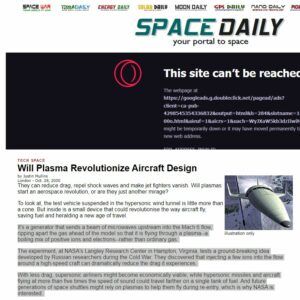
It’s a generator that sends a beam of microwaves upstream into the Mach 6 flow, ripping apart the gas ahead of the model so that it is flying [much faster] through a plasma–a boiling mix of positive ions and electrons–rather than ordinary gas.
The experiment, at NASA’s Langley Research Center in Hampton, Virginia, tests a ground-breaking idea developed by Russian researchers during the Cold War. They discovered that injecting a few ions into the flow around a high-speed craft can dramatically reduce the drag it experiences.
With less drag, supersonic airliners might become economically viable, while hypersonic missiles and aircraft flying at more than five times the speed of sound could travel farther on a single tank of fuel. And future generations of space shuttles might rely on plasmas to help them fly during re-entry, which is why NASA is interested.
But there are more clandestine applications. The way plasmas interact with radio waves around aircraft is causing more than a little excitement in the secret world of military aerospace research. Could they provide the ultimate invisibility shield for stealth aircraft? Other researchers have found that plasmas can dissipate shock waves from supersonic aircraft, stifling troublesome sonic booms.
A numerical study is made of the structure of a swirling argon flow with atmospheric pressure in a closed tube duct with an asymmetric gas outlet, a localized heat source simulating gas heating by a longitudinal pulse repetitive HF discharge, and the source of an acoustic field simulating sound generation by discharge pulses. It is shown that, at supercritical amplitudes of the acoustic field, helical gas-dynamic and thermal flows capable of inducing the formation of a discharge channel with a structure that is close to the shape of a helical flow can form. The results are shown to qualitatively agree with the known experimental data.
Anatoly Klimov
Anatoly Klimov (often transliterated Klimov), a researcher affiliated with the Russian Academy of Sciences at the Joint Institute for High Temperatures (Moscow). ResearchGate
What Klimov is known for (in open sources)
Klimov appears as a co-author on work in plasma aerodynamics / hypersonic flow control, especially using gas discharges (corona, glow, HF discharge, pulsed discharge) to modify shock waves and potentially reduce wave drag / heating at high Mach numbers. NASA Technical Reports Server+1
A NASA-hosted AIAA paper surveying drag-reduction concepts cites multiple Klimov coauthored works in this area (e.g., corona discharge influence on supersonic drag; plasma wind-tunnel tests), placing him within that research community. NASA Technical Reports Server+1
How this relates to the “laser atmospheric disruption” idea
There is a documented aerodynamic concept—usually described as upstream energy deposition—where depositing energy ahead of a supersonic/hypersonic body can create a low-density channel that interacts with the bow shock and can reduce wave drag (and potentially heating). physics-math.com+1
In the open literature, lasers are discussed as one possible way to deposit energy in front of a vehicle (alongside microwave discharges and high-voltage discharges). Semantic Scholar