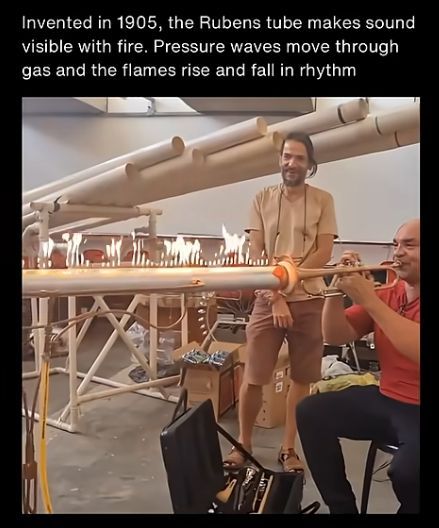
A Rubens’ tube is one of the most elegant pieces of physics ever invented — a device that visualizes sound waves using fire. It turns invisible pressure fluctuations into a glowing, dancing flame pattern you can literally see in real time.
Here’s the essential breakdown:
What a Rubens’ Tube Is
A Rubens’ tube (invented by German physicist Heinrich Rubens in 1905) is:
- A long metal tube, sealed at both ends
- With many small holes drilled evenly along the top
- One end connected to a propane or natural gas source
- The other end attached to a speaker or frequency generator
- The tube is filled with gas, ignited through the holes
- A standing wave forms inside when driven with sound, and the flame heights change accordingly
It is often called a “flame oscilloscope.”
How It Works (Simple Version)
Sound waves inside the tube create alternating regions of:
- High pressure → gas exits holes faster → taller flames
- Low pressure → gas exits slower → shorter flames
Since a standing wave forms inside the tube when a tone is played, the flame pattern becomes a visual representation of the wave — peaks and nodes appear in fire.
How It Works (Technical Version)
A tube of length L driven at frequency f produces a standing wave with wavelength:
[
\lambda = \frac{2L}{n}
]
Where n is the mode number (1, 2, 3, …)
Pressure variation inside the tube obeys the standing-wave pattern:
[
P(x) = P_0 \cos(kx)
]
where ( k = \frac{2\pi}{\lambda} ).
The gas flow rate (\dot{m}) through each hole is proportional to pressure differential:
[
\dot{m} \propto \Delta P
]
Thus flame height approximates:
[
h(x) \propto \dot{m}(x) \propto |\Delta P(x)|
]
So the flame pattern directly visualizes the pressure antinodes.
What You See
When you play:
1. A single pure tone
The flames form a clean sine-wave-like shape:
- Tall flames at pressure antinodes
- Short flames at nodes
2. Multiple tones or complex music
The flame pattern becomes turbulent and wild — spectacular — but less precisely interpretable.
3. Changing frequency
The flame pattern dynamically shifts as the standing wave reshapes and different modes appear.
Educational and Experimental Uses
Rubens’ tubes are used to teach:
- Wave physics
- Pressure nodes and antinodes
- Resonance modes
- Gas dynamics
- Acoustic standing waves
- Visualization of Fourier components (qualitatively)
They show very clearly how sound is pressure, not just vibration, and how pressure varies spatially within a medium.
Modern Extensions
1. 2D Rubens’ Surfaces (Pyro Boards)
A flat plate with hundreds of holes shows planar standing waves—the flames form geometric patterns like:
- Circles
- Grids
- Interference fringes
- Chladni-like modes
2. High-speed imaging
Researchers use digital analysis to correlate flame behavior with pressure curves in real time.
3. Laser Schlieren hybrids
Combine flame visualization with Schlieren imaging to get ultra-high-resolution views of acoustic fields.
Safety Notes
A Rubens’ tube involves:
- Open flame
- Pressurized gas
- Metal tube reaching high temperatures
- Potential flashback if improperly built
Experts typically use flashback arrestors and fire-safe enclosures.