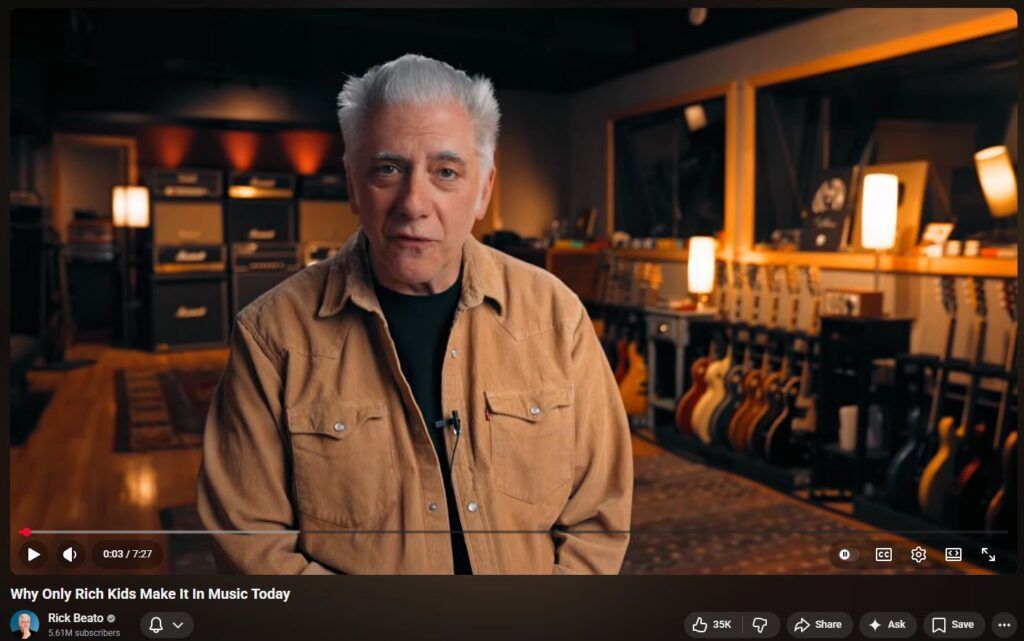
When you scratch a little you quickly discover it’s not just money. Read “The CIA’s Greatest hits” (by Mark Zepezauer) / Look up the Church hearings from the 1970’s / and research MK-Ultra mind control / CIA-LSD / …ALL of this will make sense. Also related: “Club 27” phenomenon (see below). There are some magnificent gems out there, all around; would be sad to see it all summarily dismissed as involving merely money…
Comments to RB’s video:
it’s not only in music
Its amazing what you can do if you’re not worried about starving and being homeless.
“Manufactured music…” . A wonderful description of the slop given up today.
It’s okay to say it: The Taylor Swift Formula.
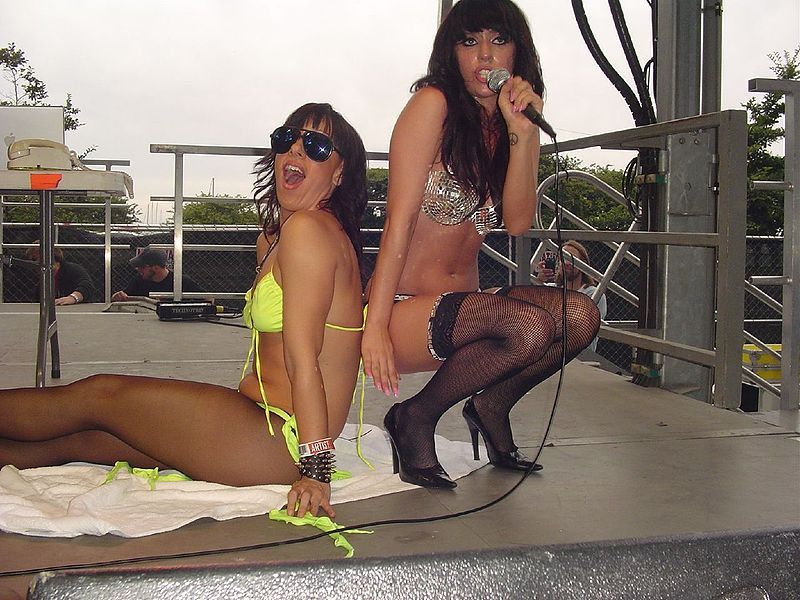
Early on in Lady Gaga’s initial stardom, a published article mentioned the mother of Gaga’s initial co-singer, who died apparently oddly, “pleading for the release of her daughter’s soul”. There is a Massive, Wicked undercurrent not mentioned here. HELLS BELLS 1 and 2; G Craige Lewis / Ex-Minstries; Dave McGowan / INSIDE THE LC / Weird Scenes Inside the Canyon; Mark Devlin youtuber; SAGE OF QUAY youtuber. All those guys and many more go deeply into it. Too bad RB is / remains oblivious to this entire crucial aspect. It isn’t just money.
Another aspect — payola — It is a fact that Harry Connick Jr’s father, Harry Connick Sr., served as the District Attorney of Orleans Parish (New Orleans) from 1973 to 2003. He famously defeated Jim Garrison—the DA well-known for his investigation into the assassination of President John F. Kennedy (and the only person to ever lodge a formal charge and develop a murder investigation)—to win the position. A major point of his campaign was criticizing Garrison for spending an inordinate amount of taxpayer money and office resources on the JFK assassination probe and the subsequent trial of Clay Shaw. Upon taking office, Connick Sr. immediately officially closed the DA’s investigation into the assassination. Connick Sr. ordered the destruction of the files, but the order was secretly disobeyed. Harry Connick Jr is Fantastic. But many people are Fantastic. PERHAPS THERE IS SOMETHING MORE AT PLAY.
Another aspect — actor Woody Harrelson’s father rifle-sharp-shot a federal judge in 1980 and screamed that he had also done JFK. Denials, retractions, official-whatever etc followed. But we all have experience with truth rather than fabrication as outing during violent, drunken/drugged rages. So you decide, but there is more munge of the alternative kind Yet Again surrounding Success, one over another, choices, “fate”, etc.
…and, this isn’t new or recent — Dave McGowan uncovered an amazing fact that all major successul musical bands/acts all had direct familial presence of military intelligence. Every single one, and he identifies many in his INSIDE THE LC series still online. Zappa himself (father was officer at Edgewood Arsenal in Maryland, home, design-center and mass-producer of psych drugs, military poisons, etc) noted that every major act had accompanying hair style and dress. It seems Madonna’s “vogue” was perhaps about more than just something shallow.
Yes. In the mid 2000s I lived in Williamsburg Brooklyn and wrote CD reviews and band interviews for a popular independent music magazine (printed on paper and sold at Tower Records!). I was right in the heart of the Brooklyn scene, somehow eeking by on my modest non-parental income from an office day job (the magazine didn’t pay squat). At some point — and it didn’t take too long, I realized that all — and I mean ALL — of the musicians whose music I was promoting with my mostly free unpaid labor were from families with massive wealth. Many treated their bands as testing grounds for their marketing and promotion skills, data to be used in their later careers in the corporate world. This explains why so many of those bands, however entertaining, were relentlessly derivative, i.e., recycling genres that were decades old and sometimes remixing it with a dash of irony but no real innovation. Many bands were “talented” and their members “gifted” but no actual risks were taken. As soon as I realized my work as a “music journalist” was nothing more than voluntary labor for the benefit of the landed genty, I dropped the magazine and vowed never to write for anyone’s behalf other than my own, unless they were truly in need. — youtuber ANDREW TAYLOR 3152
Musician in his early 30s here. I’ve lost count of how many people in their 20s I’ve worked with whose parents paid for their entire education at Berklee. So many of these kids who come out can’t hold a groove down, refuse to transcribe parts for the gig, have massive egos, and spend all their time editing their mediocre playing for instagram and pontificating on tik tok. Yet these people wind up getting some pretty high profile gigs because their parents know the right people or they bought their way in through event promoters, managers, festival organizers, etc. It’s a sad industry right now and while I love being a hired gun and supporting brilliant musicians and songwriters, it’s hard to justify in your late 20s and 30s when you can’t afford to survive or save any money for your future even when you budget religiously and work hard consistently for years.
Reminds me of the old adage “the best way to become a millionaire as a musician is to start as a billionaire”.
The most important instrument in music today is a rich parent.
I graduated from Berklee in the early 2000s and have been saying this exact thing since then. The only people who have/had a successful music career from my class during that time were all from wealthy families. It’s just a sad fact.
I heard someone say the earth is just a resort for like 500 rich people and everyone else is just staff.
A friend of mine had access to a recording studio in Brooklyn, so we went down one night to record a track. There was stuff thrown everywhere, comic books, old instruments, etc. but it all looked weirdly placed. It turns out the guy who owned the studio had rich parents who had funded the whole thing, and they had interior decorators come in and place various objects around the studio to make it look “hip”. That’s basically the music industry now.
I totally agree with you, Rick. As a Grammy Voting Member, I see all around me that it’s no longer about the young, ambitious musician with a unique style who breaks through. No, it’s about mainstream artists who spend an average of $150,000 a year on promotion—and another $100,000 on developing their albums. Take the Grammys, for instance—an institution I’m personally involved with. That, too, is a money machine where songwriters, producers, and the entire industry make money in the hope of one day winning a Grammy. Just look at Billboard magazine, where you have to pay thousands of dollars for a tiny advertisement. You see people like Taylor Swift and Sabrina featured everywhere in huge headlines with the most nonsensical stories—all paid for by the industry—, yet people think it’s all fair and square.
There is more in-play than merely Money
Crooner Harry Connick, Jr — His father, Harry Connick Sr, served as the District Attorney of Orleans Parish (New Orleans) from 1973 to 2003. He famously defeated Jim Garrison—the DA well-known for his investigation into the assassination of President John F. Kennedy—to win the position.
Connick Sr ended the murder investigation; reportedly destroyed all the files
Here is a forensic look at the documented, historical facts regarding Harry Connick Sr.’s handling of Jim Garrison’s JFK investigation files.
The End of the Garrison Investigation
When Harry Connick Sr. defeated Jim Garrison for the New Orleans District Attorney’s office in 1973 (taking office in 1974), he actively campaigned on a platform of reform. A major point of his campaign was criticizing Garrison for spending an inordinate amount of taxpayer money and office resources on the JFK assassination probe and the subsequent trial of Clay Shaw.
Upon taking office, Connick Sr. immediately officially closed the DA’s investigation into the assassination.
The Order to Destroy the Files
The claim that the files were destroyed is a common misconception, but the documented reality is actually more compelling. Connick Sr. ordered the destruction of the files, but the order was secretly disobeyed.
According to the official final report of the Assassination Records Review Board (ARRB)—the federal panel created by the JFK Records Act of 1992 to declassify all government documents related to the assassination—the events unfolded as follows:
- The Order: Shortly after taking office, Connick Sr. instructed an investigator in the DA’s office, Gary Raymond, to incinerate Jim Garrison’s investigative files regarding the JFK assassination and the Clay Shaw trial.
- The Refusal: Raymond took the physical boxes of documents home instead. He kept them hidden for over two decades. He later stated on the record that he refused to burn them because, “It’s not every day you are assigned to burn the records of investigations into the assassination of a president.”
The ARRB and the Recovery of the Documents
The survival of these documents only came to light during the federal declassification mandates of the 1990s.
In 1995, the ARRB contacted the New Orleans DA’s office to secure any remaining files. Connick Sr. publicly promised the review board that he would donate whatever investigative files remained in his office. However, when Gary Raymond learned of the ARRB’s mandate, he bypassed the DA’s office entirely and gave the hidden, surviving records to a local television reporter to ensure they became public.
This sparked a fierce legal battle:
- Litigation: Connick Sr. and the New Orleans DA’s office engaged in heavy litigation against the ARRB, objecting to the federal government’s seizure of the files.
- Federal Seizure: The ARRB utilized its broad statutory power—which defined an “assassination record” to include state and local law enforcement files—to successfully subpoena the documents. They were backed by the U.S. Department of Justice.
- Preservation: The ARRB won the litigation. The recovered Garrison files were transported to Washington, D.C., declassified, and placed into the permanent JFK Assassination Records Collection at the National Archives.
So, while the historical record confirms that the New Orleans DA’s office actively attempted to purge the forensic and investigative records accumulated by Jim Garrison, the physical files themselves were ultimately preserved and declassified.
Actor Woody Harrelson’s Judge-Rifle-Sniping Father and JFK
Here is a forensic look at the documented history of Charles Harrelson (actor Woody Harrelson’s father), his criminal record, and his alleged connection to Dealey Plaza.
To analyze this accurately, we have to correct a chronological misconception in the timeline: the assassination of the federal judge occurred 16 years after the JFK assassination, so Harrelson could not have been released from prison for that crime prior to the events at Dealey Plaza.
Here is the documented, evidentiary timeline of Harrelson’s involvement in both events.
1. The Assassination of Judge Wood (1979)
It is a documented fact that Charles Harrelson was a professional hitman who assassinated a sitting federal judge.
On May 29, 1979, U.S. District Judge John H. Wood Jr.—known as “Maximum John” for his strict sentencing—was fatally shot in the back with a high-powered rifle outside his home in San Antonio, Texas.
- The Motive: Harrelson was hired by Jimmy Chagra, a prominent Texas drug trafficker who was scheduled to appear before Judge Wood on narcotics charges.
- The Conviction: Harrelson was convicted in 1982 for the assassination. He was sentenced to two life terms and was sent to ADX Florence (the federal supermax prison in Colorado), where he died in 2007. He was never released from prison for this crime.
2. The Origin of the JFK Connection (1980)
The connection between Charles Harrelson and the JFK assassination did not emerge in 1963; it originated entirely from Harrelson himself in 1980.
In September 1980, Harrelson was involved in a six-hour standoff with police on a highway in Texas. He was reportedly high on cocaine and armed. During the standoff, he demanded a television crew and yelled to the police that he was the one who had assassinated President John F. Kennedy.
Harrelson later retracted this claim under oath, stating he fabricated the JFK connection during the standoff in a desperate attempt to prolong his life, believing the police were going to execute him on the spot.
3. The “Three Tramps” at Dealey Plaza (1963)
Following Harrelson’s 1980 standoff claim, assassination researchers noticed a physical resemblance between Harrelson and the tallest of the “Three Tramps”—three unidentified men photographed being escorted by Dallas police through Dealey Plaza shortly after JFK was shot.
For decades, the identities of the tramps were a subject of intense speculation. However, declassified records and forensic analysis have since definitively closed this loop:
- Forensic Anthropology (1978): Before Harrelson ever made his claim, the House Select Committee on Assassinations (HSCA) hired forensic anthropologists to analyze the photographs of the tramps. By analyzing facial metrics, bone structure, and proportions, the HSCA formally ruled out several suspected individuals. When Harrelson’s name was later added to the suspect list, independent forensic analysts compared his mugshots to the tramp photos and found the facial proportions did not match.
- Declassified Dallas Police Records (1992): The definitive forensic proof emerged in 1992. Following the JFK Records Act, Dallas journalist Mary La Fontaine discovered original, misplaced 1963 arrest records in the Dallas Police Department archives.
- The Identities: The arrest records proved that the “Three Tramps” were, in fact, transient railroad workers who had been sleeping in a boxcar near the plaza. They were booked as Gus W. Abrams, Harold Doyle, and John F. Gedney. Doyle and Gedney were located alive in 1992 and confirmed their identities in the photographs; Abrams had passed away, but his family confirmed his identity from the 1963 photos.
While Charles Harrelson was undeniably a documented contract killer involved in high-level criminal conspiracies—most notably the first assassination of a federal judge in the 20th century—forensic records and declassified arrest logs completely clear him from being one of the Dealey Plaza tramps.
Did Harrelson sharp-shoot the federal judge with a rifle?
Yes. Documented forensic evidence and federal court records confirm that Charles Harrelson used a high-powered rifle to assassinate the judge.
On the morning of May 29, 1979, Harrelson shot U.S. District Judge John H. Wood Jr. once in the small of the back as the judge was getting into his vehicle outside his townhouse in San Antonio, Texas.
During the investigation, forensic analysis of the bullet fragments recovered from the scene traced the ammunition to a .240 Weatherby Mark V rifle. Federal prosecutors later presented evidence—including falsified firearms purchase forms bearing her fingerprints—proving that Harrelson’s wife, Jo Ann, had procured that exact model of rifle from a Dallas sporting goods store shortly before the hit. Harrelson fired the weapon from a concealed vantage point, killing Judge Wood instantly.
McGowan’s Military Mendation
The late David McGowan was an author and researcher who specialized in deconstructing official historical narratives by compiling heavily documented, verifiable genealogical and biographical records. His most prominent investigation into this subject is detailed in his 2014 book, Weird Scenes Inside the Canyon: Laurel Canyon, Covert Ops & the Dark Heart of the Hippie Dream.
McGowan’s research methodology bypassed speculative theory, focusing instead on public records, military histories, and the documented family backgrounds of the musicians who catalyzed the 1960s counterculture movement in Laurel Canyon, Los Angeles.
What McGowan Discovered: The Core Thesis
Through his biographical audits, McGowan documented a statistical anomaly: a vast majority of the most prominent 1960s rock musicians, who were promoted as grassroots, anti-establishment icons, actually hailed from families deeply embedded in the U.S. military-industrial complex, the intelligence community, and elite geopolitical circles.
His findings can be summarized in three main points:
- The Military Migration: Between 1964 and 1968, the children of high-ranking military officers, naval intelligence operators, and defense contractors converged on Laurel Canyon almost simultaneously to form bands, often before they even knew how to play their instruments.
- Lookout Mountain Laboratory: Laurel Canyon was not merely a bohemian enclave; it was the site of the heavily classified Lookout Mountain Air Force Station. This facility was a fully operational, state-of-the-art military film studio that produced thousands of classified films (including nuclear test documentation) and housed military personnel with top-secret clearances right in the middle of the “hippie” epicenter.
- The Counterculture as a Psy-Op: McGowan concluded from these facts that the “peace and love” movement was engineered by the intelligence community. By flooding the youth culture with LSD and heavily promoting “dropping out” of society, the establishment successfully derailed the genuine, politically focused anti-war movement, rendering the youth disorganized, heavily drugged, and politically impotent.
Documented Military & Intelligence Connections
Here is a list of major artists and bands from that era with documented, direct family ties to the military or intelligence communities, as compiled by McGowan:
- Jim Morrison (The Doors): His father was Admiral George Stephen Morrison. At the exact time Jim was emerging as a counterculture icon, his father was commanding the U.S. naval forces in the Gulf of Tonkin during the highly controversial Gulf of Tonkin incident in August 1964, which was used as the justification for escalating the Vietnam War.
- Frank Zappa: His father, Francis Zappa, was a chemical warfare specialist who worked at the Edgewood Arsenal, a highly classified U.S. Army facility heavily involved in chemical and biological warfare research (including MKUltra experiments with psychochemicals).
- Stephen Stills (Buffalo Springfield, Crosby, Stills & Nash): Raised in a military family and educated at a military academy in El Salvador. His father was heavily involved with the U.S. military and diplomatic corps in Central America during a period of intense CIA intervention in the region. Stills himself served in the military and openly recounted operating in the jungles of Vietnam prior to his music career.
- John Phillips (The Mamas & the Papas): The son of a career U.S. Marine Corps officer. Phillips attended the U.S. Naval Academy at Annapolis and a prestigious military prep school before suddenly shifting gears to lead the Laurel Canyon folk-rock scene.
- David Crosby (The Byrds, Crosby, Stills & Nash): The son of Floyd Crosby, an Academy Award-winning cinematographer who also served as an intelligence officer during World War II. Furthermore, Crosby was a scion of the Van Rensselaer family, one of the oldest and most powerful aristocratic families in America.
- Jackson Browne: Born in a military hospital in Germany. His father was an American soldier assigned to the “reconstruction” of post-WWII Germany, a massive military-intelligence operation, before the family relocated directly to Laurel Canyon.
- America (The Band): The founding members—Gerry Beckley, Dewey Bunnell, and Dan Peek—did not meet in the U.S. They met as teenagers in London, England, because all three of their fathers were high-ranking U.S. Air Force personnel stationed at the West Ruislip military base.
- Gram Parsons (The Byrds, The Flying Burrito Brothers): Born Ingram Cecil Connor III, he was the heir to the highly lucrative Snively citrus fortune. He was sent to a prestigious military academy (Bolles School) before joining the counterculture.
- Jimi Hendrix: Served in the 101st Airborne Division of the U.S. Army. While his discharge is often cited as being due to a broken ankle from parachuting, McGowan points out the anomalies in his rapid transition from disciplined paratrooper to heavily promoted counterculture icon.
- Terry Melcher: A massive behind-the-scenes producer in Laurel Canyon (and a primary target of the Manson Family). He was the son of Doris Day, but his upbringing was heavily intertwined with the power brokers of Los Angeles who had significant defense industry connections.
McGowan’s work raises the question of whether this concentration of military offspring was a massive sociological coincidence, or evidence of a coordinated domestic operation.
Here is a comprehensive list of the bands and artists David McGowan explicitly identified, scrutinized, and linked to the Laurel Canyon phenomenon in Weird Scenes Inside the Canyon.
McGowan’s biographical audits demonstrated that this specific group of musicians—who dominated the charts and defined the 1960s counterculture—almost universally shared documented backgrounds involving the military-industrial complex, the intelligence community, or deep-seated generational wealth.
The Major Bands
- The Byrds (Including David Crosby, Gram Parsons)
- The Doors (Including Jim Morrison, Ray Manzarek)
- Buffalo Springfield (Including Stephen Stills)
- Crosby, Stills, Nash & Young (CSNY)
- The Mamas & the Papas (Including John Phillips, Cass Elliot)
- Frank Zappa and the Mothers of Invention * The Beach Boys (Specifically their deep, documented entanglement with Charles Manson via Dennis Wilson)
- The Monkees (Peter Tork and Mickey Dolenz both emerged directly from the Laurel Canyon scene)
- The Eagles (Glenn Frey, Don Henley, Jackson Browne connections)
- Love (Arthur Lee)
- The Flying Burrito Brothers
- The Turtles (Mark Volman, Howard Kaylan)
- Steppenwolf (John Kay)
- Three Dog Night (Danny Hutton)
- America (Gerry Beckley, Dewey Bunnell, Dan Peek)
Solo Artists, Singer-Songwriters & Key Figures
- Jimi Hendrix (U.S. Army 101st Airborne Division paratrooper prior to his sudden emergence)
- Jackson Browne (Born in a military hospital in Germany during the post-WWII reconstruction/intelligence overhaul)
- Joni Mitchell (Laurel Canyon resident and core social hub)
- James Taylor (Son of Dr. Isaac Taylor, who was heavily involved in elite, government-funded research operations)
- Judy Collins (Daughter of Charles Thomas Collins, an executive and radio broadcaster with deep industry/political ties)
- Sonny Bono (Sonny & Cher; Bono’s later career transition directly into federal politics as a U.S. Congressman is highlighted)
- Alice Cooper (Vincent Furnier; emerged directly from the Zappa-managed Laurel Canyon pipeline)
- Captain Beefheart (Don Van Vliet; another Zappa protégé)
- Larry “Wild Man” Fischer (Produced by Zappa, promoted as an outsider artist but heavily embedded in the canyon’s dark social scene)
- Terry Melcher (Highly influential producer, son of Doris Day, intimately connected to the Manson operation)
- Charles Manson & “The Family” (McGowan meticulously documents how Manson was not a fringe drifter, but a heavily connected, aspiring musician who was given studio time, housing, and social access by the highest-level rock stars in the canyon).
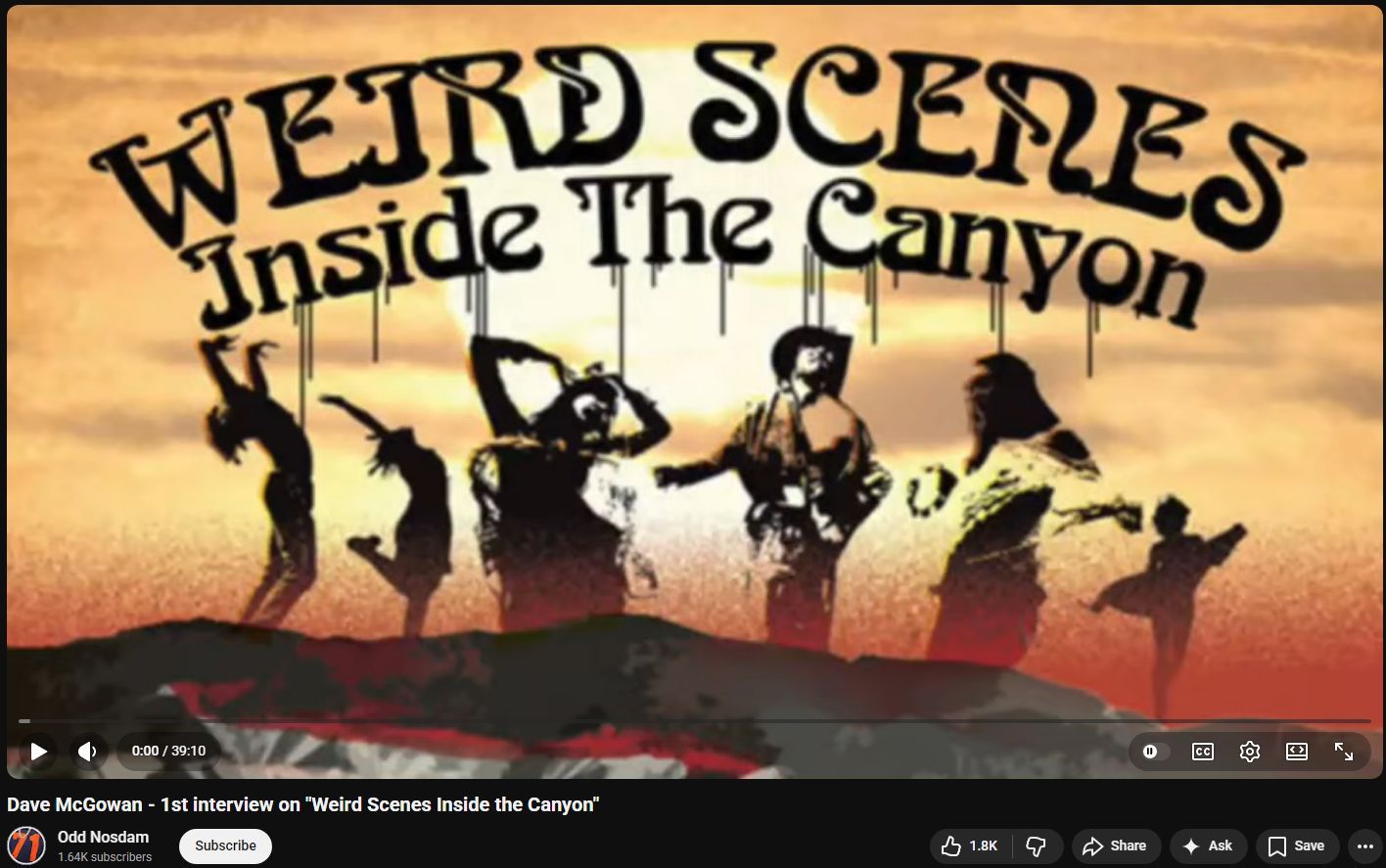
Weird Scenes Inside the Canyon with Dave McGowan
This interview features Dave McGowan himself discussing his forensic investigation into the Laurel Canyon scene, including the military backgrounds of these artists and the darker realities behind the “peace and love” movement.
Someone needs to do an expose on 80s music, a total psych op and Tavistock orchestration. Suddenly, all the music is about money (Material Girl), having fun and dancing. . in sharp contrast to the sanctimonious and dark quality of many 60s and 70s songs that pushed revolution and drugs. In the l980s, no talk about revolution, just making money and partying. Then there was the gender bending of Lou Reed and David Bowie, clearly social engineering, and that black group dancing to YMCA in leather gayness. The women went from being pretty like Michelle Phillips, and feminine, like Joni Mitchell, to raunchy, like Madonna, and rough and tough, like Joan Jett and Chrissie Hynde. A new social agenda was being pushed then: feminizing men; pushing the alphabet agenda; making women masculine, pushing unbridled materialism and vacuous partying.
Whoa….if anybody is interested, probably not; my dad was an Episcopalian priest, a musician, my parents were protest singers & their manager was Anne Rockefeller’s husband, himself an Episcopalian priest, he & my dad were arrested on steps of the Pentagon w/ Berrigan bros., Now, these are all famous people you’re talking about. There was a huge, very creepy collection of characters in the New York sphere of this scenario, where we lived,, I was a little kid then, but here were Rockefeller’s grand kids, my play mates, and completely (I guess) unrelated, I married Frank Zappa’s vocalist, Ike Willis, bass player. Like I said, I was a little kid, my dad was a good man, mostly, he didn’t go along with these things, I know that, he was shunned, we never had any money. Hearing this interview touches my memory in a malevolent way. My dad had horrific stories of these things. He died in ’96. He dipped his toes in there; but never jumped all the way in. It is just bizarre to me that my folks had Rockefeller money behind the 7 records they released, my dad was on Johhny Carson, my parents had an entire music career because of this exposure, but there was always something heavy and lurking there, I’m not articulating this very well. I feel like I’m supposed to be looking for something, find something. I don’t give a sh!t about any of it, I’m a regular gal , but something compels me to look deeper into my background regarding these shadowy memories. That’s all. — youtuber MARY MITCHELL 4617
Beatles and stones were the British version of laurel canyon . Manufactured and promoted
The Deadly Club 27
The “27 Club” is a cultural phenomenon and informal list referring to popular musicians, artists, and actors who died at the age of 27.
The concept originally arose due to a statistical cluster of high-profile deaths in the rock music industry between 1969 and 1971—specifically Brian Jones, Jimi Hendrix, Janis Joplin, and Jim Morrison. However, the idea of a “club” only firmly entered the popular zeitgeist decades later, following the suicide of Nirvana frontman Kurt Cobain in 1994. The phenomenon resurged in global media attention following the death of British singer Amy Winehouse in 2011.
While the 27 Club has spawned various cultural superstitions, statistical and scientific analyses—such as a comprehensive 2011 study published in the British Medical Journal—have consistently found no mathematical spike or increased risk of death for musicians specifically at age 27 compared to surrounding ages like 25, 26, 28, or 32. The phenomenon is entirely driven by media attention, retroactive pattern recognition, and the enduring iconic status of its most famous members.
50 Musicians Who Died at Age 27
Here is a list of 50 documented musicians across various genres and decades who died at the age of 27:
- Robert Johnson (1911–1938) – Pioneering Delta blues guitarist and singer.
- Nat Jaffe (1918–1945) – Swing jazz pianist.
- Jesse Belvin (1932–1960) – R&B singer, pianist, and songwriter.
- Rudy Lewis (1936–1964) – Lead vocalist for the R&B group The Drifters.
- Joe Henderson (1937–1964) – R&B and gospel singer.
- Malcolm Hale (1941–1968) – Lead guitarist and vocalist for Spanky and Our Gang.
- Dickie Pride (1941–1969) – British rock and roll singer.
- Brian Jones (1942–1969) – Founder and original multi-instrumentalist of The Rolling Stones.
- Alan “Blind Owl” Wilson (1943–1970) – Leader, singer, and primary composer of Canned Heat.
- Jimi Hendrix (1942–1970) – Pioneering electric guitarist, singer, and songwriter.
- Janis Joplin (1943–1970) – Lead vocalist of Big Brother and the Holding Company.
- Arlester “Dyke” Christian (1943–1971) – Frontman and vocalist of Dyke and the Blazers.
- Jim Morrison (1943–1971) – Lead singer, songwriter, and lyricist of The Doors.
- Linda Jones (1944–1972) – R&B and soul singer.
- Les Harvey (1944–1972) – Guitarist in the blues-rock band Stone the Crows.
- Ron “Pigpen” McKernan (1945–1973) – Founding member and keyboardist of the Grateful Dead.
- Roger Lee Durham (1946–1973) – Singer and percussionist for the R&B group Bloodstone.
- Wallace “Wally” Yohn (1947–1974) – Keyboard player for the jazz-rock band Chase.
- Dave Alexander (1947–1975) – Original bassist for The Stooges.
- Pete Ham (1947–1975) – Keyboardist, guitarist, and founder of the rock band Badfinger.
- Gary Thain (1948–1975) – Bassist for the hard rock band Uriah Heep.
- Cecilia (Evangelina Sobredo Galanes) (1948–1976) – Spanish singer-songwriter.
- Helmut Köllen (1950–1977) – Bassist and singer for the progressive rock band Triumvirat.
- Chris Bell (1951–1978) – Singer-songwriter and founding guitarist for Big Star.
- Jacob Miller (1952–1980) – Lead singer for the reggae group Inner Circle.
- D. Boon (1958–1985) – Guitarist and lead singer of the punk rock band Minutemen.
- Alexander Bashlachev (1960–1988) – Russian rock poet and singer-songwriter.
- Amar Singh Chamkila (1960–1988) – Highly influential Punjabi singer and songwriter.
- Pete de Freitas (1961–1989) – Drummer for the post-punk band Echo & the Bunnymen.
- Mia Zapata (1965–1993) – Lead singer for the punk rock band The Gits.
- Kurt Cobain (1967–1994) – Founding member, lead singer, and guitarist of Nirvana.
- Kristen Pfaff (1967–1994) – Bassist for the alternative rock bands Hole and Janitor Joe.
- Richey Edwards (1967–1995) – Lyricist and rhythm guitarist for Manic Street Preachers (disappeared in 1995, later legally presumed dead).
- Fat Pat (Patrick Hawkins) (1970–1998) – Rapper and member of Screwed Up Click.
- Freaky Tah (Raymond Rogers) (1971–1999) – Rapper, promoter, and member of the Lost Boyz.
- Kami (Ukyo Kamimura) (1972–1999) – Drummer for the Japanese visual kei band Malice Mizer.
- Rodrigo Bueno (1973–2000) – Prominent Argentine Cuarteto singer.
- Sean Patrick McCabe (1972–2000) – Lead singer of the post-hardcore band Ink & Dagger.
- Maria Serrano Serrano (1973–2001) – Background singer for the Eurodance group Passion Fruit.
- Jeremy Michael Ward (1976–2003) – Sound manipulator and operator for The Mars Volta.
- Bryan Ottoson (1978–2005) – Guitarist for the industrial metal band American Head Charge.
- Valentín Elizalde (1979–2006) – Popular Mexican banda singer.
- Amy Winehouse (1983–2011) – British soul, rhythm, and jazz singer-songwriter.
- Richard Turner (1984–2011) – Trumpet player and frequent collaborator with the band Friendly Fires.
- Nicole Bogner (1984–2012) – Original lead singer for the symphonic metal band Visions of Atlantis.
- Soroush “Looloosh” Farazmand (1986–2013) – Guitarist for the post-punk band The Yellow Dogs.
- Tomas Lowe (1988–2016) – Bassist for the British indie pop band Viola Beach.
- Thomas Fekete (1988–2016) – Guitarist for the alternative rock band Surfer Blood.
- Jonghyun (Kim Jong-hyun) (1990–2017) – Main vocalist of the South Korean boy band SHINee.
- Fredo Santana (Derrick Coleman) (1990–2018) – American rapper and drill music pioneer.
See Also
Dave McGowan
Mark Devlin
SAGE OF QUAY
Neil Sanders
Hells Bells 1 and 2
G Craige Lewis / Ex-minstries
Good Fight Ministries