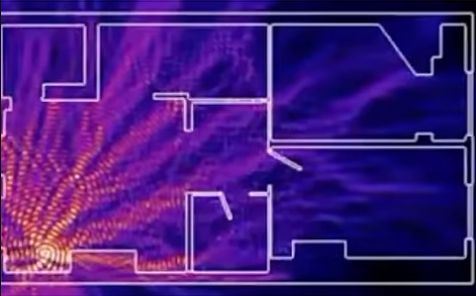
Affected by every obstacle and self-imposed interference, WiFi is cagey and unpredictable.
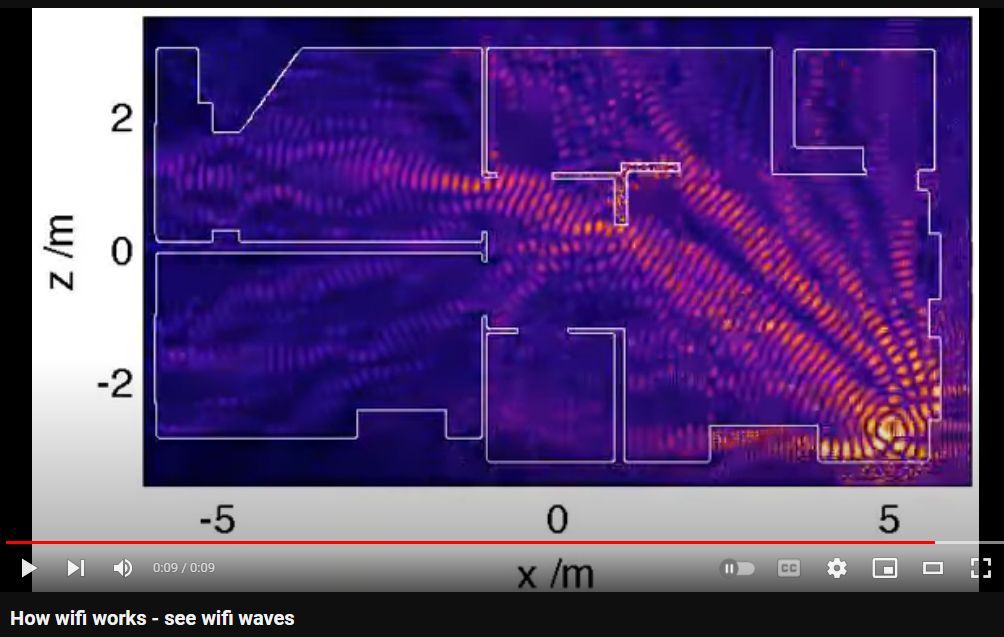
Wi-Fi propagation is far stranger and less deterministic than most people realize. Unlike a wire, where energy is largely confined to a conductor, Wi-Fi radiates into a chaotic three-dimensional environment where the signal is constantly being reflected, absorbed, delayed, refracted, scattered, polarized, and even interfered with by itself. The result is that small environmental changes can radically alter speed, latency, stability, and range.
The Core Reality: Wi-Fi Is RF Energy in a Resonant Environment
Wi-Fi is microwave radio energy, typically:
- 2.4 GHz
- 5 GHz
- 6 GHz (Wi-Fi 6E / 7)
At these frequencies:
- Wavelengths are only a few centimeters long.
- Ordinary household objects become electrically significant.
- Walls, pipes, studs, bodies, wiring, appliances, windows, mirrors, ducts, and even plants interact with the field.
This creates an extremely complex electromagnetic environment.
1. Multipath Propagation
One of the most important and peculiar aspects of Wi-Fi is multipath.
The signal does not travel in one straight line.
Instead:
- One portion travels directly.
- Other portions reflect off:
- walls
- floors
- ceilings
- metal appliances
- wiring
- HVAC ducts
- windows
- furniture
These multiple delayed copies arrive at the receiver at slightly different times.
Sometimes they:
- reinforce each other (constructive interference)
- cancel each other (destructive interference)
This causes:
- dead spots
- mysterious strong spots
- fluctuating speed
- random packet loss
- unstable latency
2. Self-Interference Patterns
Wi-Fi often interferes with itself.
This creates standing-wave-like patterns throughout a building.
A device moved:
- 1 inch
- 3 inches
- 6 inches
can suddenly:
- gain 20 dB
- lose connection entirely
- double throughput
- halve throughput
because it moved from:
- an interference null
to - a reinforcement zone
This is why:
- rotating a laptop
- opening a door
- moving a metal chair
- walking through a room
can alter Wi-Fi performance dramatically.
At 5 GHz especially, wavelength is so short that tiny movements matter enormously.
3. Human Bodies Absorb Wi-Fi Strongly
Humans are mostly water.
Microwave frequencies interact strongly with water molecules.
Thus:
- people absorb RF
- crowds attenuate Wi-Fi
- a human body can create a major RF shadow
This is why:
- conference room Wi-Fi collapses during meetings
- stadium Wi-Fi is difficult
- signal changes when someone walks between AP and client
A person standing near an antenna can radically alter propagation.
4. Material Effects Are Extremely Nonlinear
Different materials behave radically differently.
Drywall
Usually moderate attenuation.
Brick / concrete
Can heavily attenuate or reflect.
Metal
Acts almost like a mirror to RF.
Low-E glass
Modern energy-efficient windows often contain metallic coatings that strongly block Wi-Fi.
Water
Strong absorber.
Mirrors
Can reflect RF substantially due to conductive backing.
5. Polarization Effects
Wi-Fi signals have polarization:
- vertical
- horizontal
- circular mixtures
Antenna orientation matters.
Rotating:
- a phone
- laptop
- AP antenna
can alter signal dramatically.
MIMO systems exploit this intentionally.
6. MIMO and Beamforming Add Complexity
Modern Wi-Fi uses:
- MIMO
- MU-MIMO
- OFDM
- beamforming
These systems intentionally use multipath reflections to increase throughput.
Ironically:
- the chaos becomes part of the communication method.
The router continuously:
- measures reflections
- estimates channel conditions
- adjusts phase
- changes modulation
- changes coding rates
Thus Wi-Fi is adaptive and dynamic.
This is why:
- speeds fluctuate second to second
- rebooting sometimes helps
- firmware changes matter enormously
7. Frequency Determines Behavior
2.4 GHz
- longer range
- penetrates walls better
- slower
- crowded
- more interference
5 GHz
- shorter range
- more bandwidth
- worse penetration
- more reflection sensitivity
6 GHz
- extremely fast
- highly line-of-sight dependent
- poor obstacle penetration
8. Environmental Resonances
Buildings themselves can behave like giant resonant cavities.
RF energy:
- bounces
- accumulates
- creates nulls
- creates hot zones
Particularly:
- apartments
- steel buildings
- ships
- datacenters
- hospitals
can exhibit bizarre RF behavior.
A signal may:
- disappear behind one wall
- reappear stronger two rooms away
due to reflection paths.
9. Wi-Fi Is Shared Medium Chaos
Unlike switched Ethernet:
- all nearby Wi-Fi shares airtime.
Performance depends on:
- neighbor APs
- channel overlap
- retries
- hidden nodes
- Bluetooth
- microwaves
- cordless phones
- baby monitors
- Zigbee
- radar avoidance (DFS)
Thus a network can collapse from invisible neighboring interference.
10. Why Wi-Fi Feels “Random”
The environment changes continuously:
- humidity
- doors opening
- people moving
- neighboring routers
- reflections
- antenna orientation
- furniture
- weather
- nearby devices
All alter propagation.
Wi-Fi is therefore:
- probabilistic
- adaptive
- highly installation-dependent
rather than deterministic.
Two identical routers in:
- different houses
- different wall materials
- different furniture layouts
can perform completely differently.
11. Enterprise RF Engineering Exists Because of This
Large deployments use:
- spectrum analyzers
- heat mapping
- predictive modeling
- directional antennas
- channel planning
- power shaping
because naive placement causes severe unpredictability.
Professional Wi-Fi design is essentially applied microwave physics.
12. The Microwave Oven Example
Microwave ovens operate near:
- 2.45 GHz
very close to 2.4 GHz Wi-Fi.
Leakage from a microwave can:
- obliterate Wi-Fi
- create packet storms
- collapse throughput
because the frequencies overlap.
This demonstrates how delicate and interference-prone Wi-Fi really is.