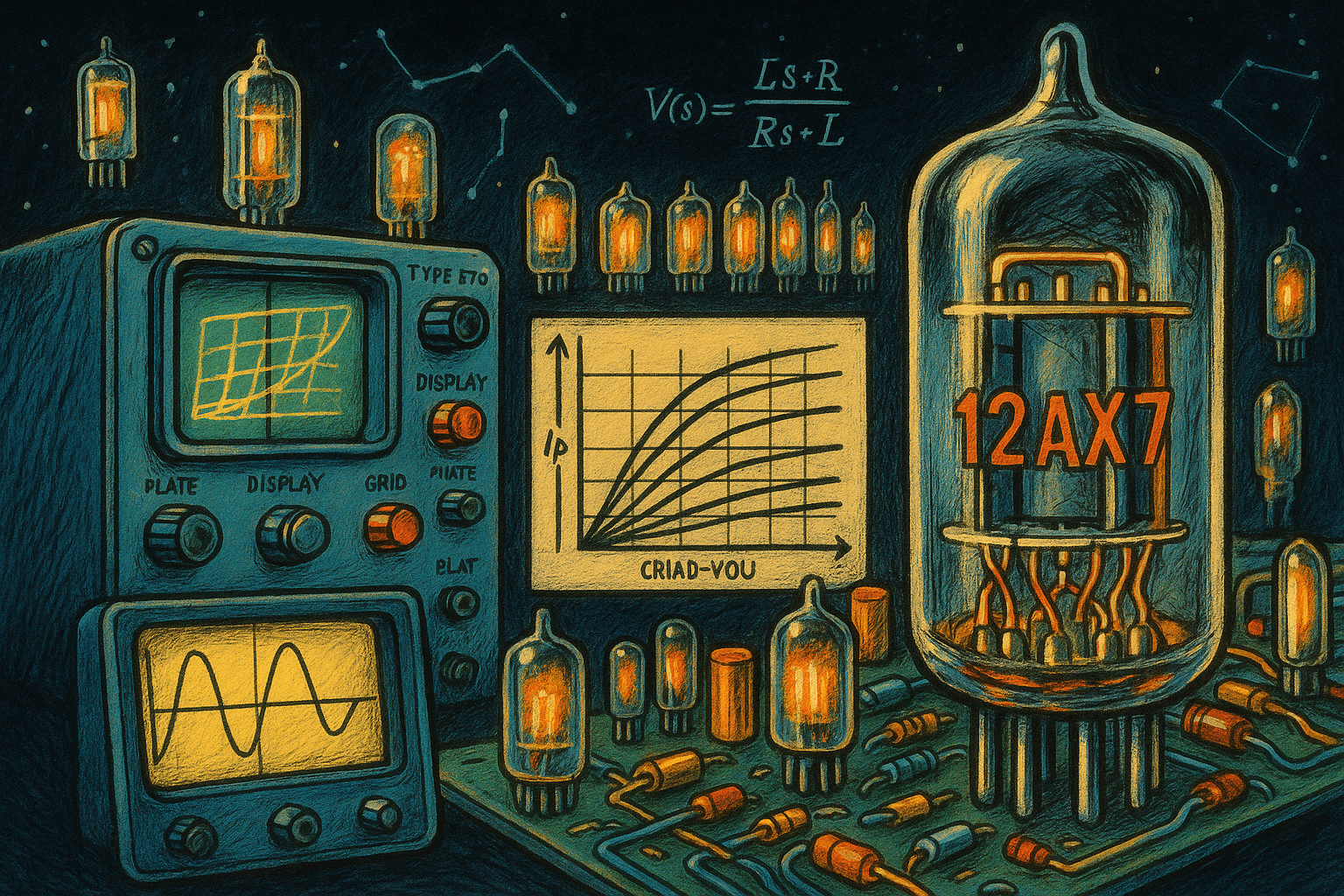
Vacuum Tube (Electron Valve) Comparison Tests
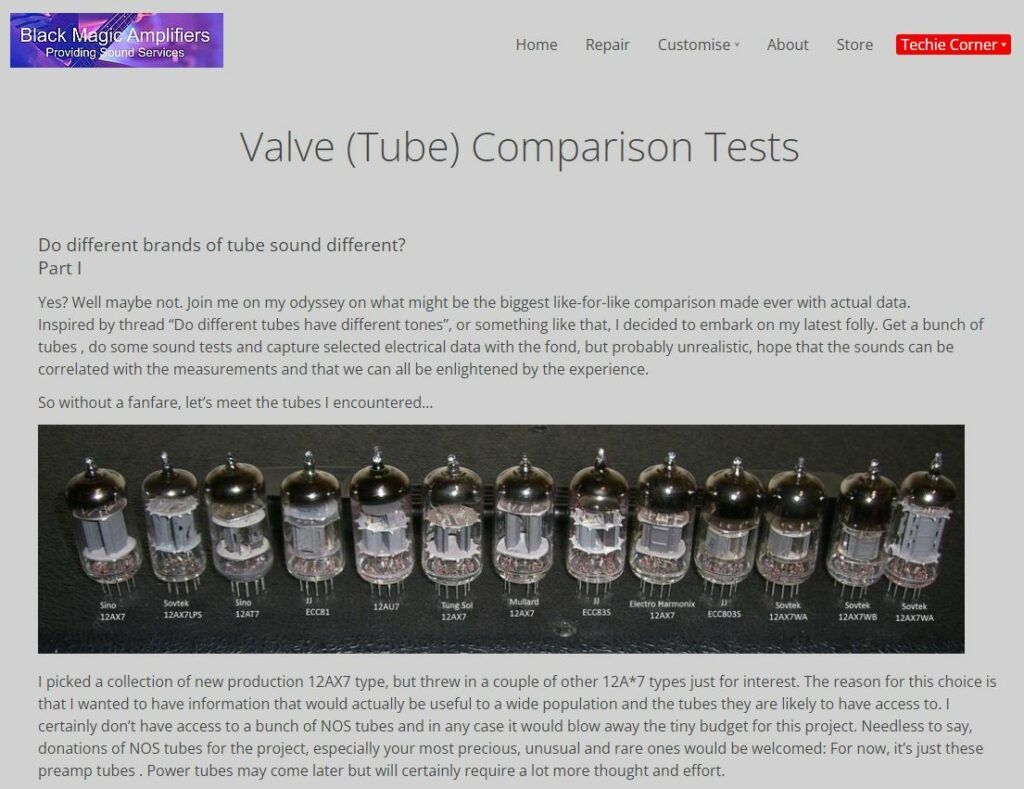
The BM Amps “Valve (Tube) Comparison Tests” page presents a detailed, objective analysis of various 12AX7 vacuum tubes used in audio amplifiers. Using controlled signal testing, waveform analysis, and spectral measurements, the author compares tube brands across metrics like gain, noise, distortion (THD/IMD), and microphonics. Despite common beliefs about tube “tone,” the study finds minimal measurable or audible differences between brands, attributing most perceived sound variation to circuit design rather than tube choice. The page emphasizes data over marketing hype and offers listening samples, charts, and rankings, ultimately recommending reliability and low noise over brand mystique.
SOURCE: https://bmamps.com/v01/home/techie-corner/valve-tube-comparison-tests/
Here’s a concise summary of the Valve (Tube) Comparison Tests on Black Magic Amplifiers’ Techie Corner:
Test Overview
- Methodology
- Played a suite of audio tests—including a 440 Hz tone, silence, intermodulation (“A” chords), and guitar-rich music—through a consistent amplifier setup (“The Chump”).
- Captured results in 32-bit PCM WAV files, maintaining a consistent output level (<0.5 dB variance).
- Analyzed frequency spectra, noise, THD/IMD, and microphonics using tools like Audacity, Audition, and Right Mark Audio Analyzer. (bmamps.com)
- Noise & Hum Reduction
- Implemented DC powering for heaters to reduce hum to –60 dB.
- Reconfigured grounding loops for optimal noise performance. (bmamps.com)
Tests Conducted
- Electrical Characterization: DC voltage, gain, noise, frequency response, THD, IMD measured via analyzer.
- Microphonics: Stimulated tubes mechanically to observe acoustic sensitivity.
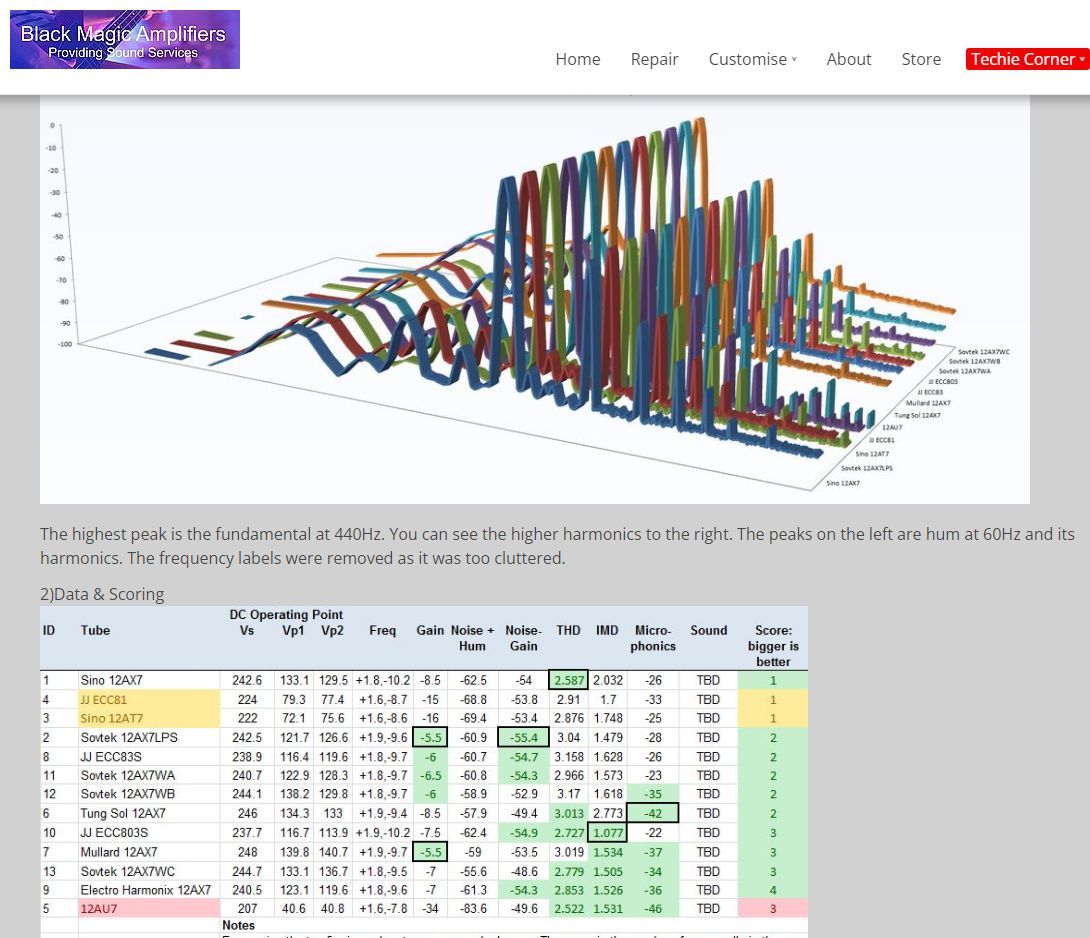
- Spectrum Analysis: FFT plots up to 5 kHz to compare harmonic content.
- Critical Listening: Personal evaluation of noise, tone, and musical clips. (bmamps.com)
Key Findings
- DC Operating Point: Consistent across tube brands.
- Noise Variation: ~6 dB difference among tubes of the same type.
- Gain Spread: ~3 dB total (≈1.5 dB per stage).
- Frequency Response: Nearly identical.
- Microphonics: Significant variation in amplitude and character.
- Tone/Listening Perception: Differences minor; no one tube stood out dramatically. (bmamps.com)
Ranked Highlights:
- Top Overall: Electro-Harmonix 12AX7
- Lowest THD: Sino 12AX7 (but has a bright glow on startup)
- Highest Gain: Sovtek 12AX7LPS & Mullard 12AX7
- Lowest Microphonics: Tung-Sol 12AX7
- Lowest IMD: JJ ECC803S (though watch for microphonics)
- Best for first-stage use: EH 12AX7 (balanced noise & microphonics) (bmamps.com)
Conclusions
- Measurable differences between tubes are very small.
- Common audio buzzwords (“rich,” “lush,” “detailed”) are largely marketing hype.
- The biggest sonic impact comes from the circuit design, not the tube brand.
- After data review and listening tests, the author couldn’t perceptibly distinguish tube brands in real music contexts. (YouTube, bmamps.com)
Bottom Line
If you’re choosing tubes, prioritize circuit design and build quality. Tube-brand claims rarely translate into audible differences. For typical use, inexpensive yet high-performing tubes like Electro‑Harmonix, Tung‑Sol, and Sovtek are excellent choices—matched tubes and clean circuit design will yield more impact than swapping brands.