Confiscation of resonance. Ritual silencing. “Silence the bells; disrupt the network; erase the resonance [and history].”
“Without beauty man diminishes.”
“The same way a beautiful woman is inspiration, so too is beautiful tonality.”
“Bronze trumpets, though tough to supply adequate air. Bronze bells, easily hammered into powerful resonance.”
“Look into “structured air” weaponry being researched at Aberdeen Proving Ground Maryland USA”
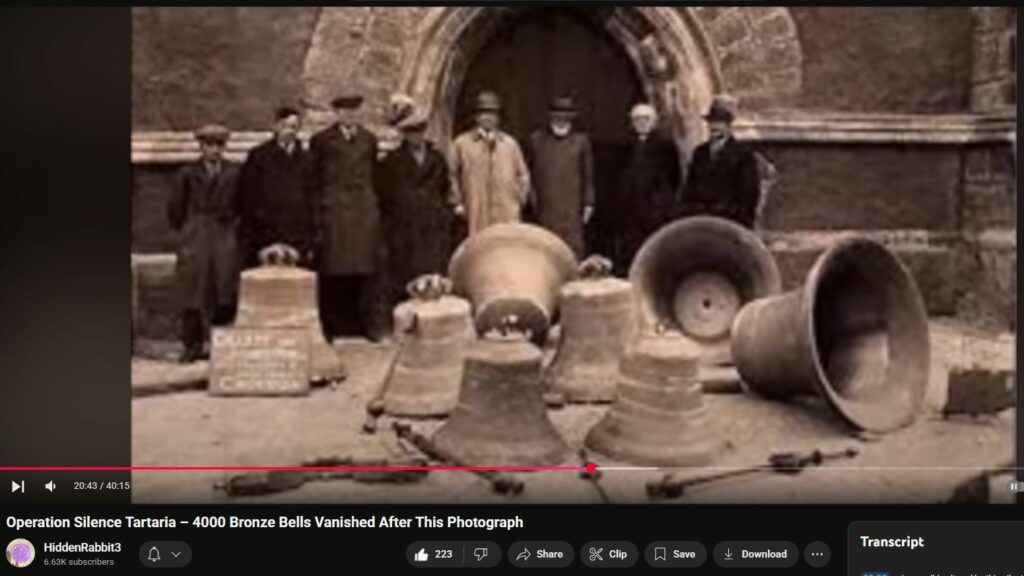
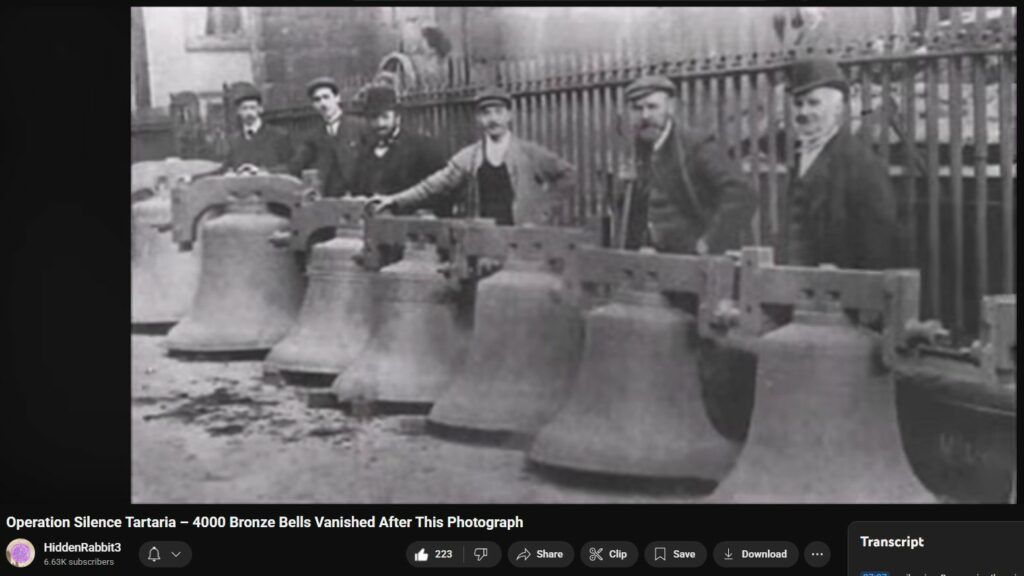
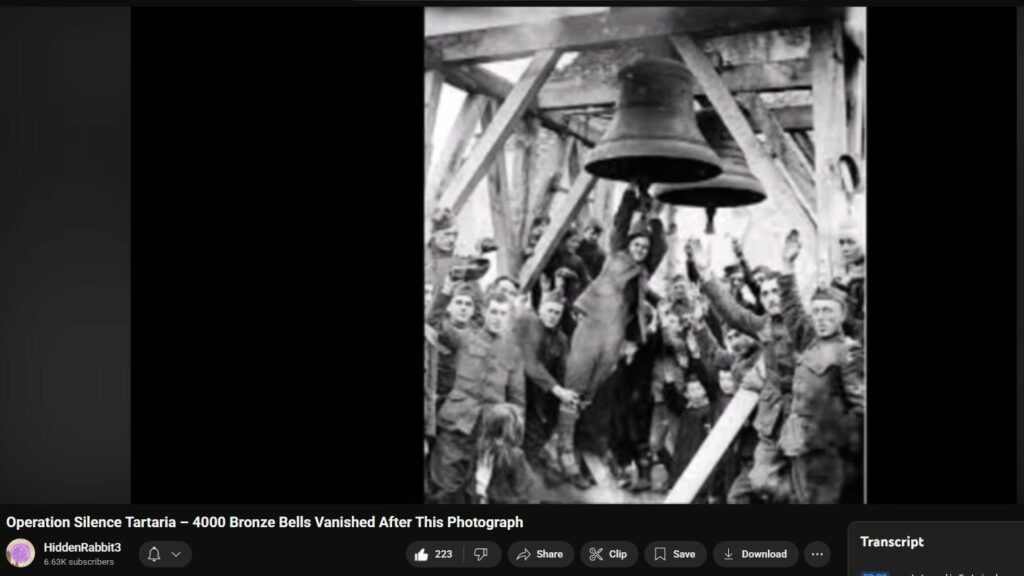
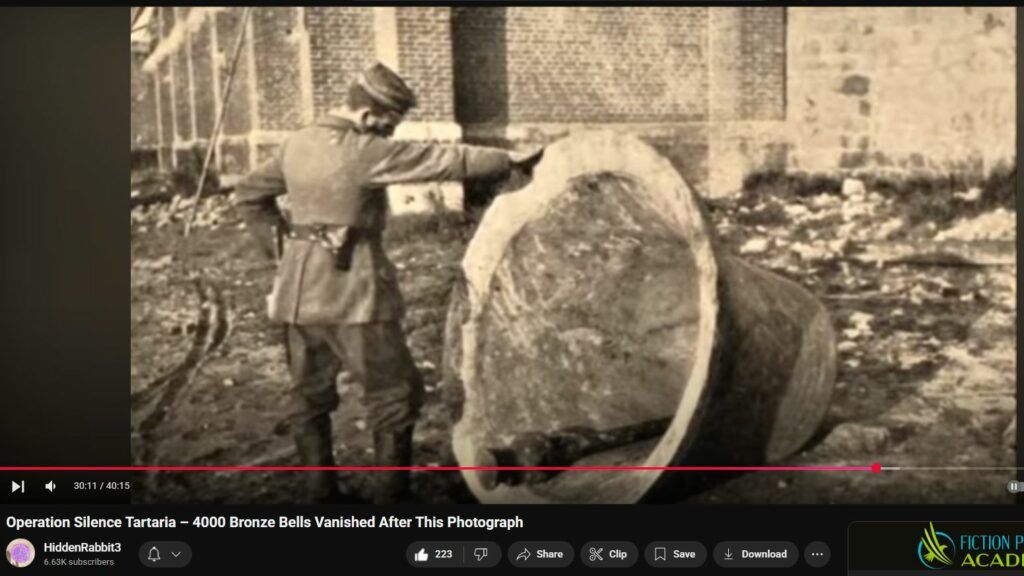
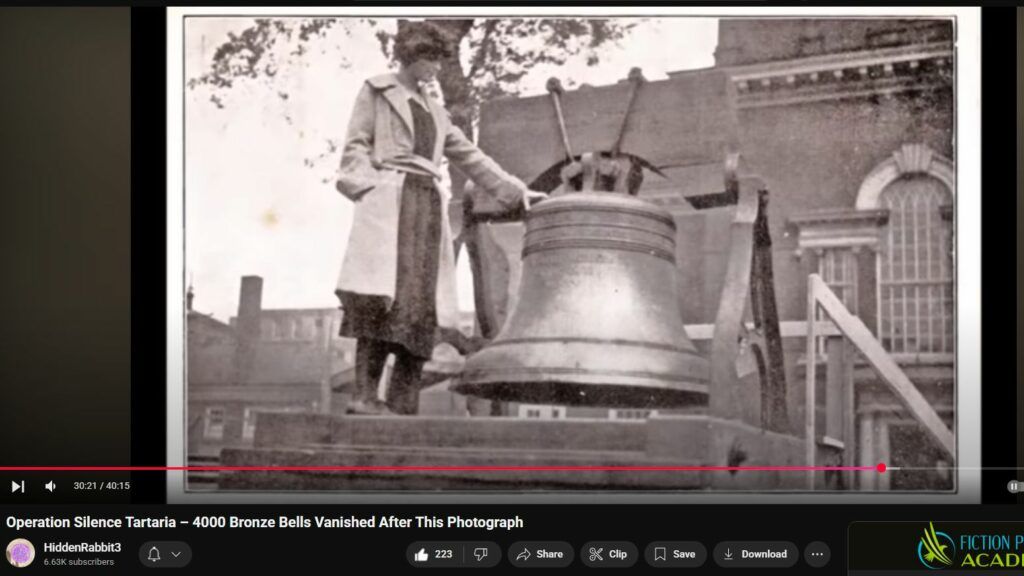
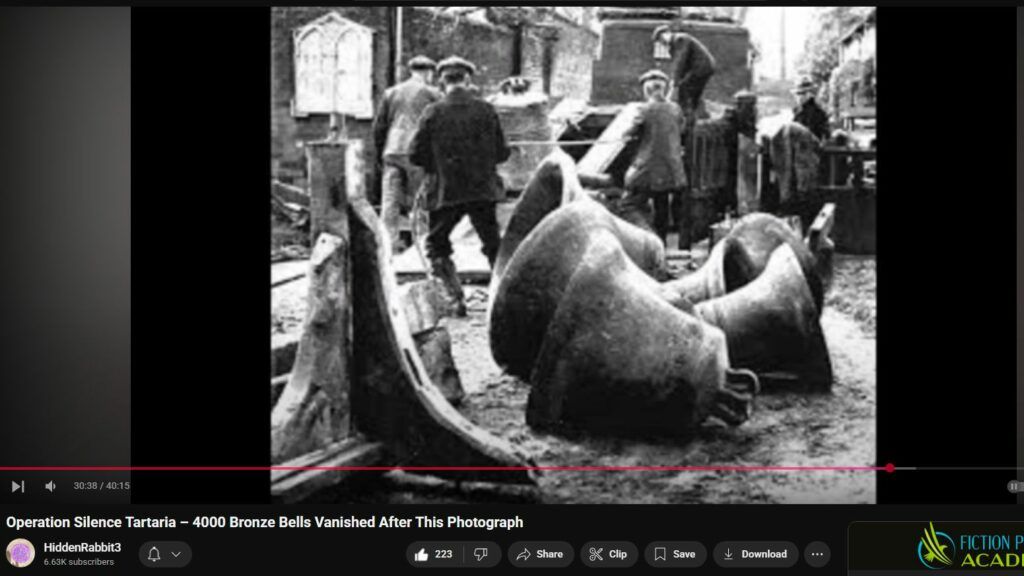
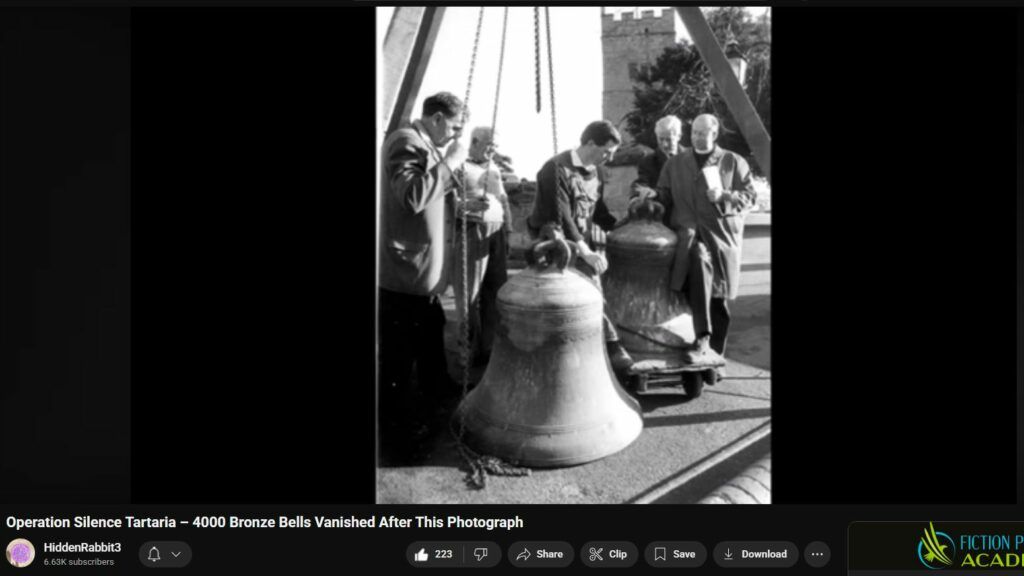
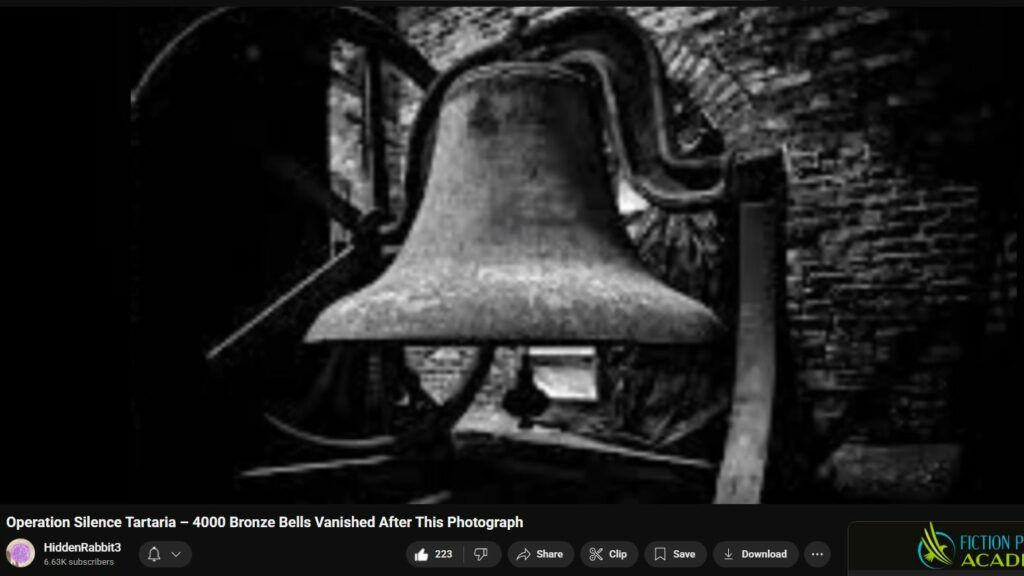
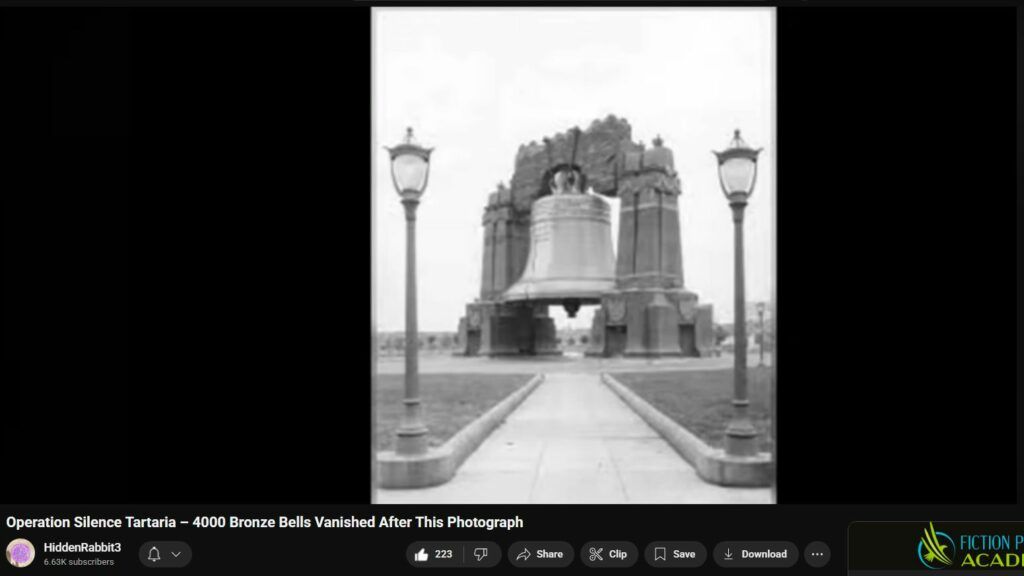
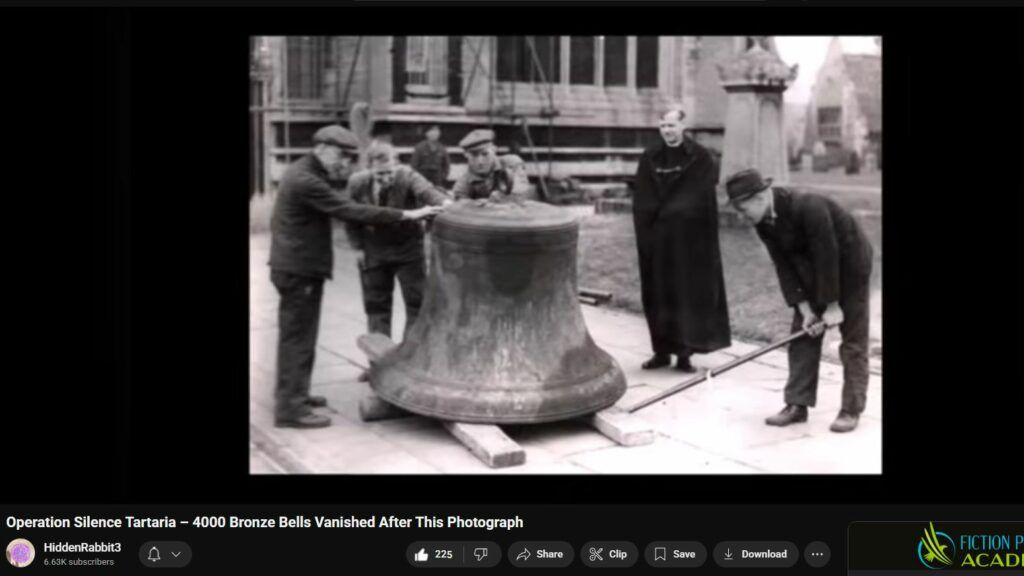
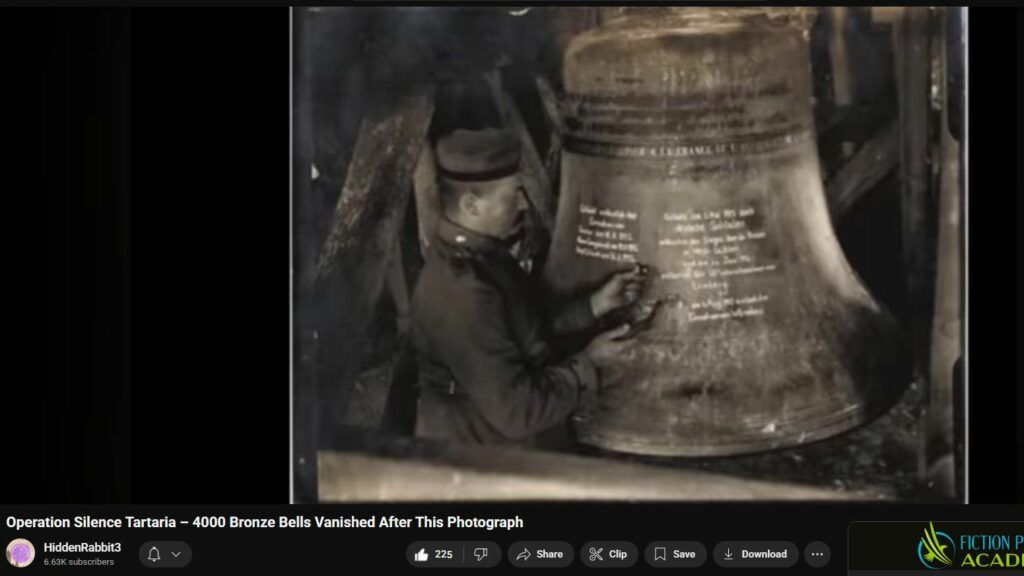
Transcript
Click to reveal
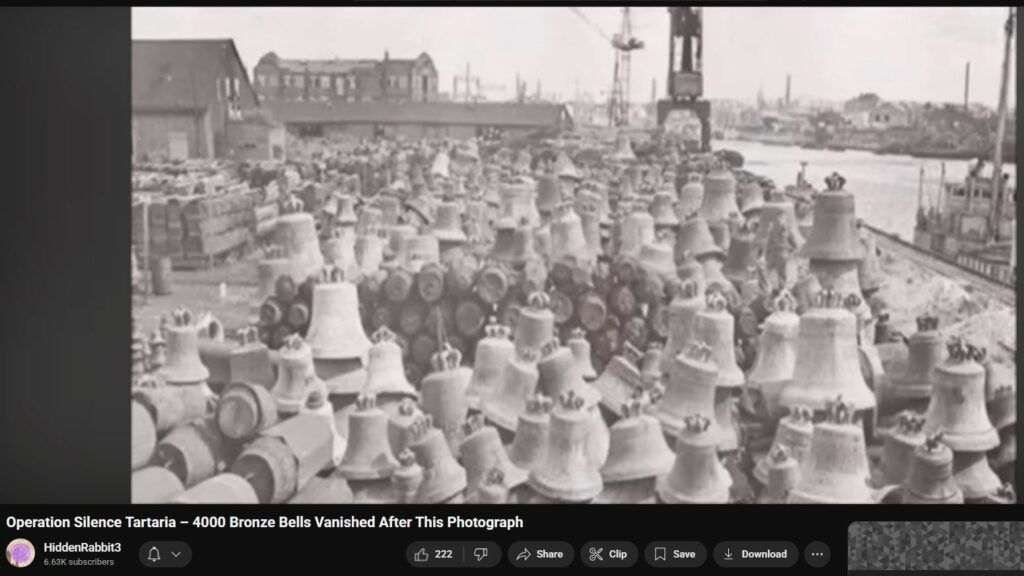
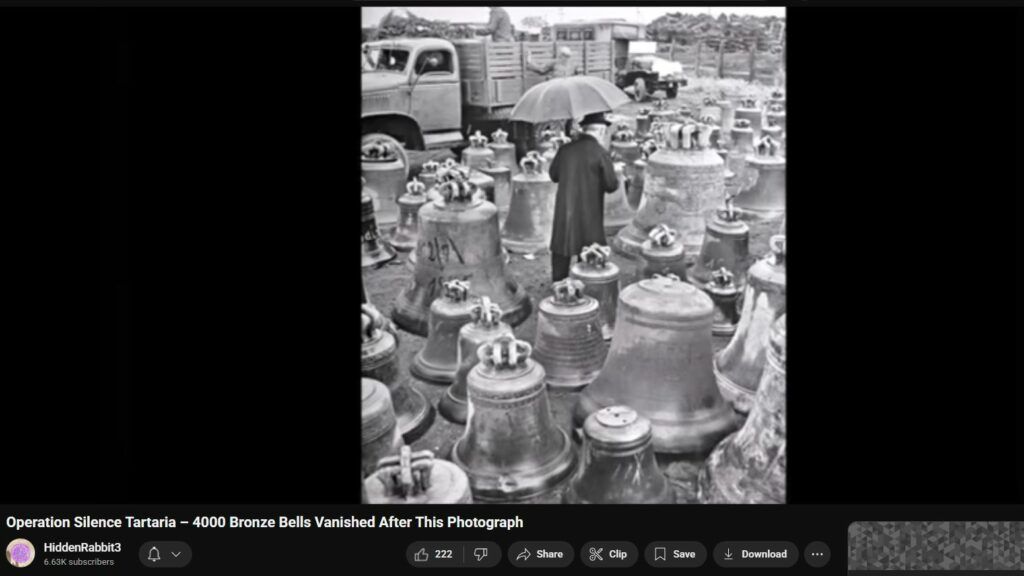
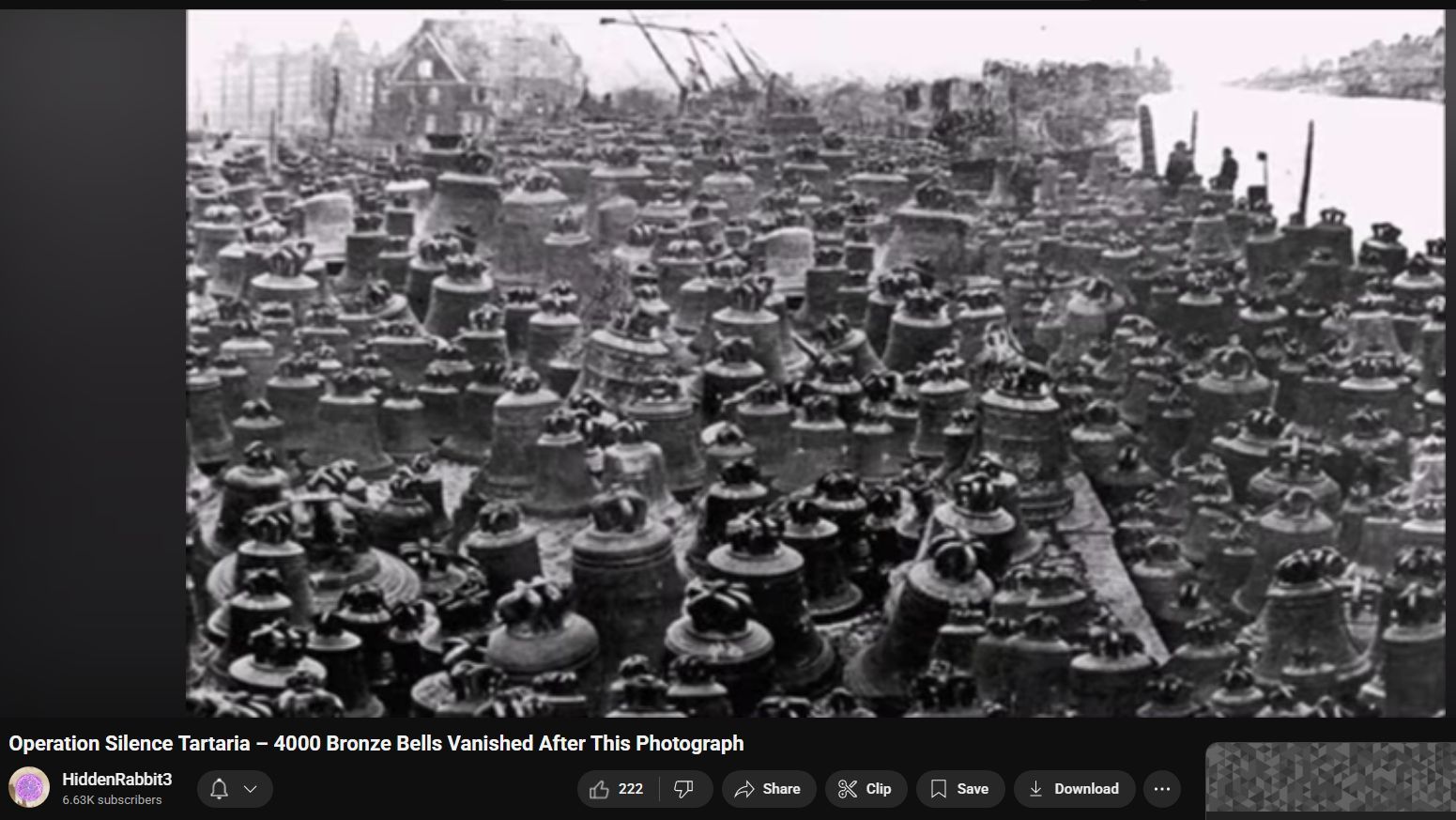
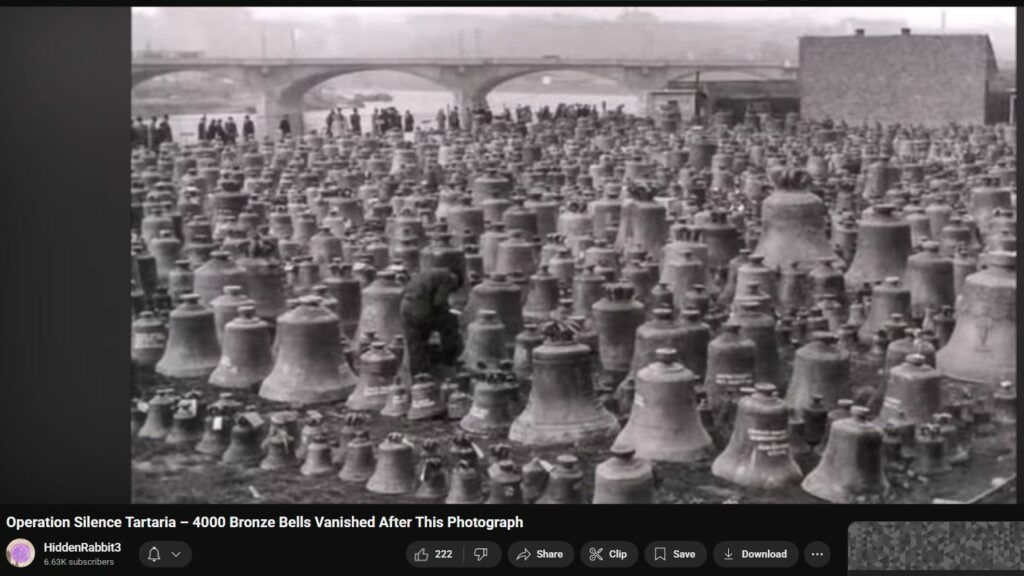
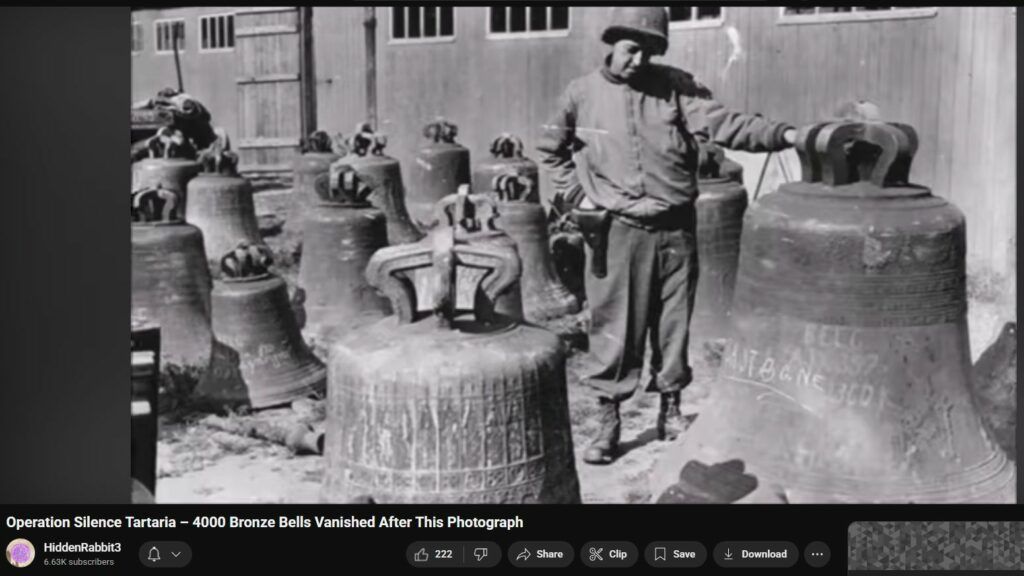
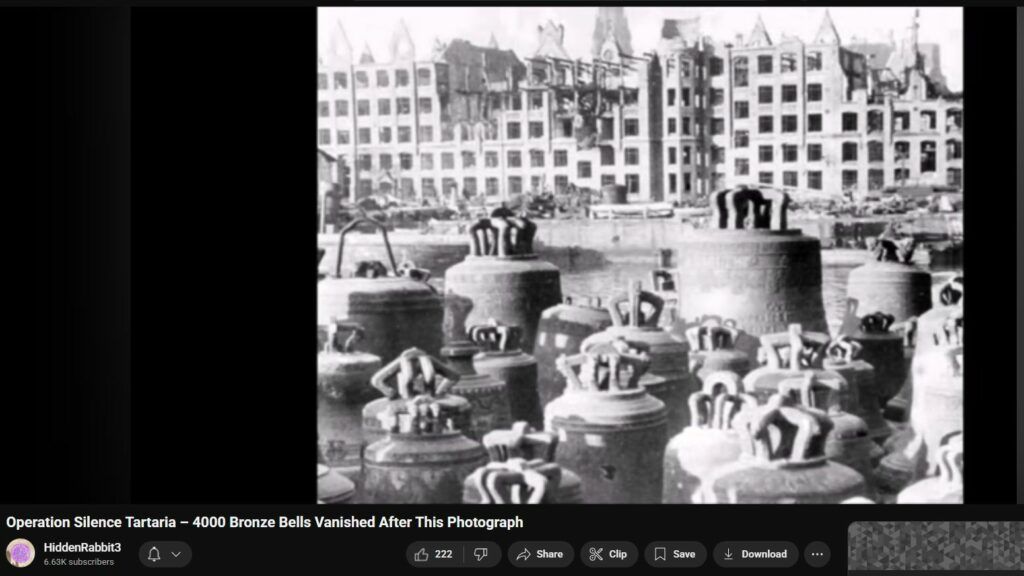
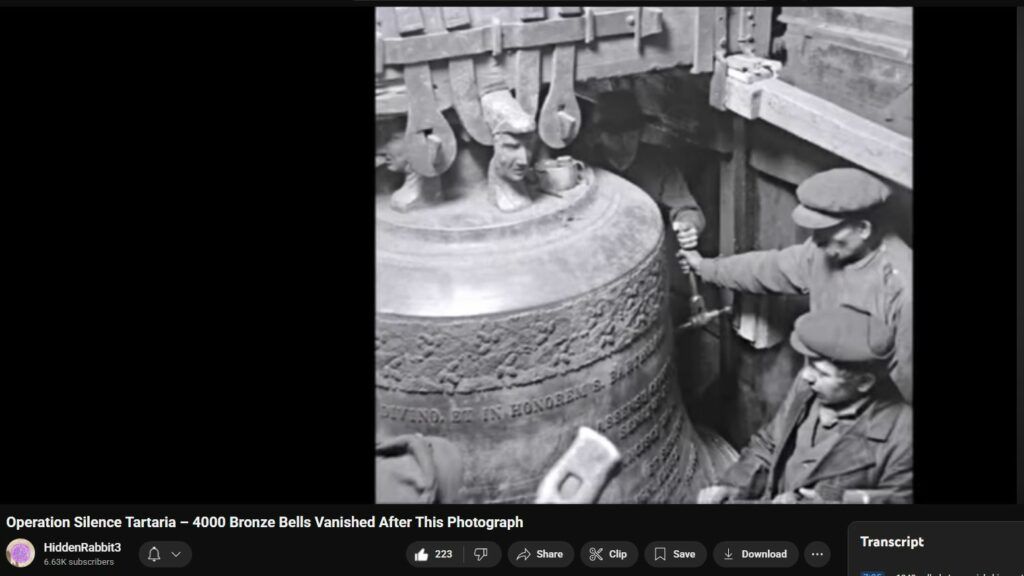
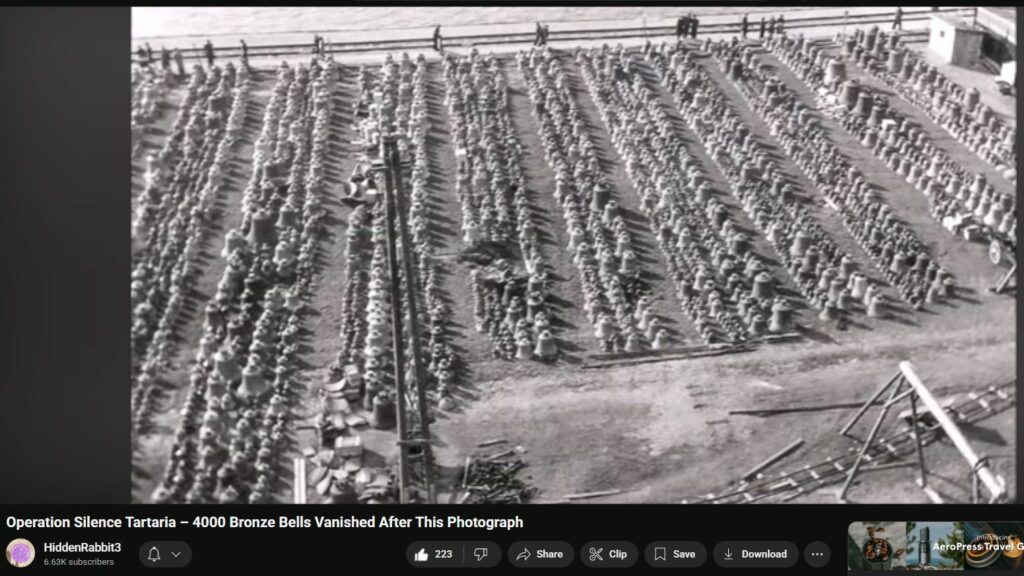
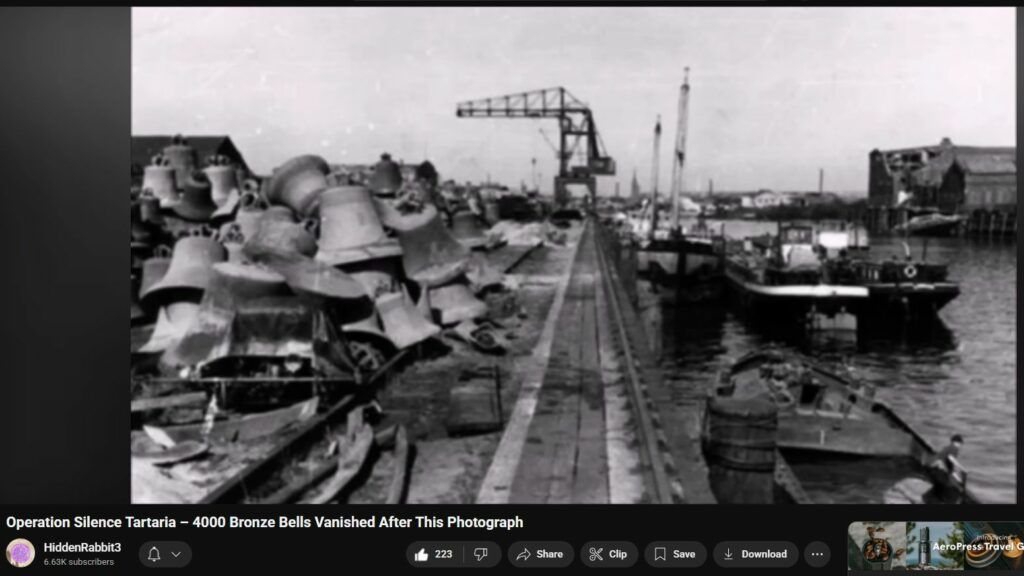
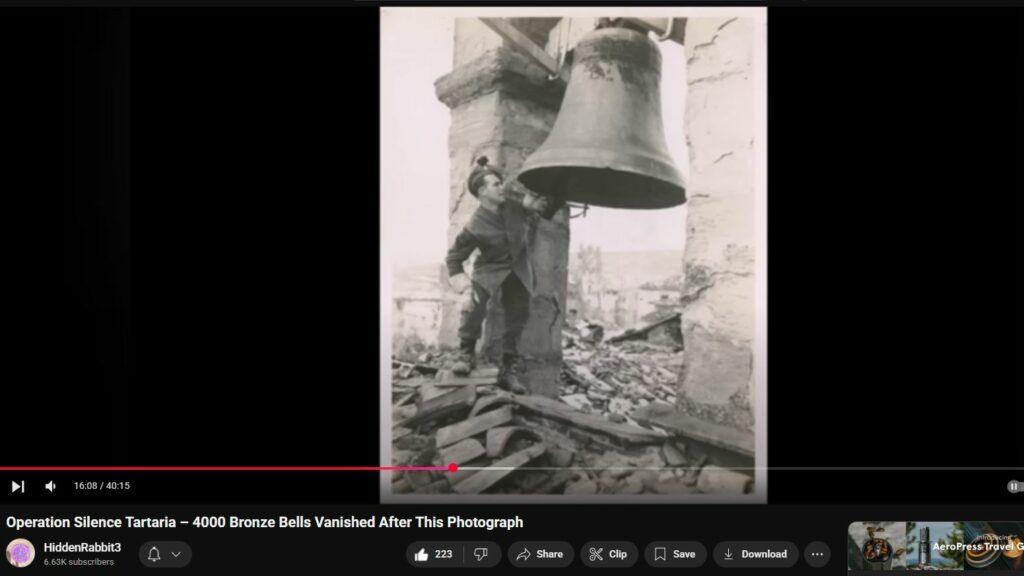
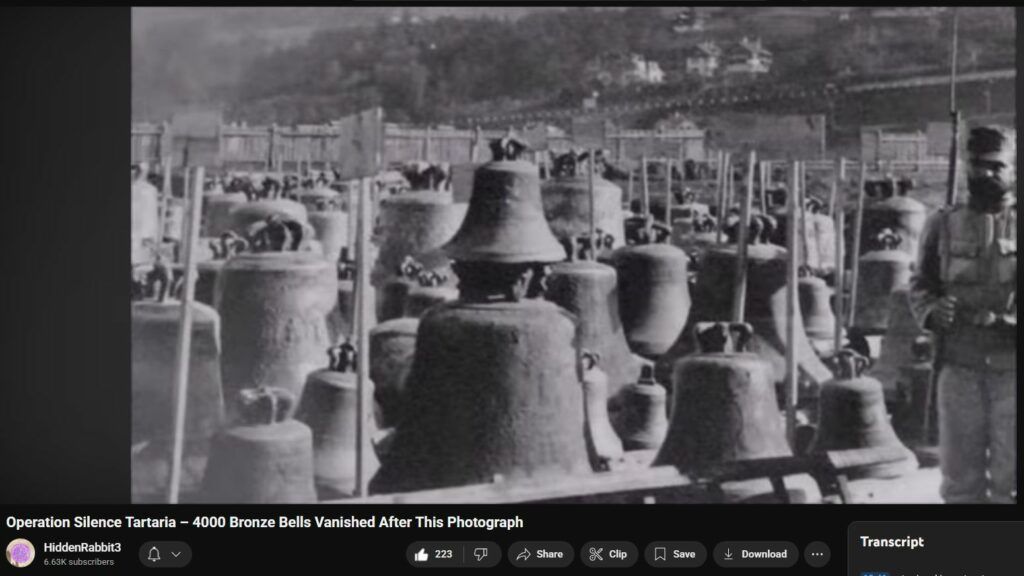
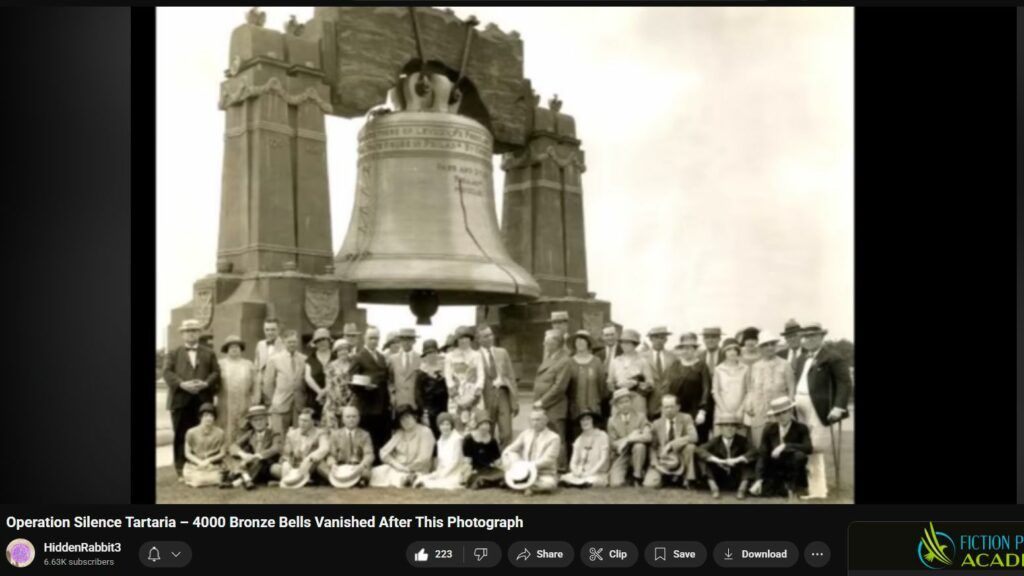
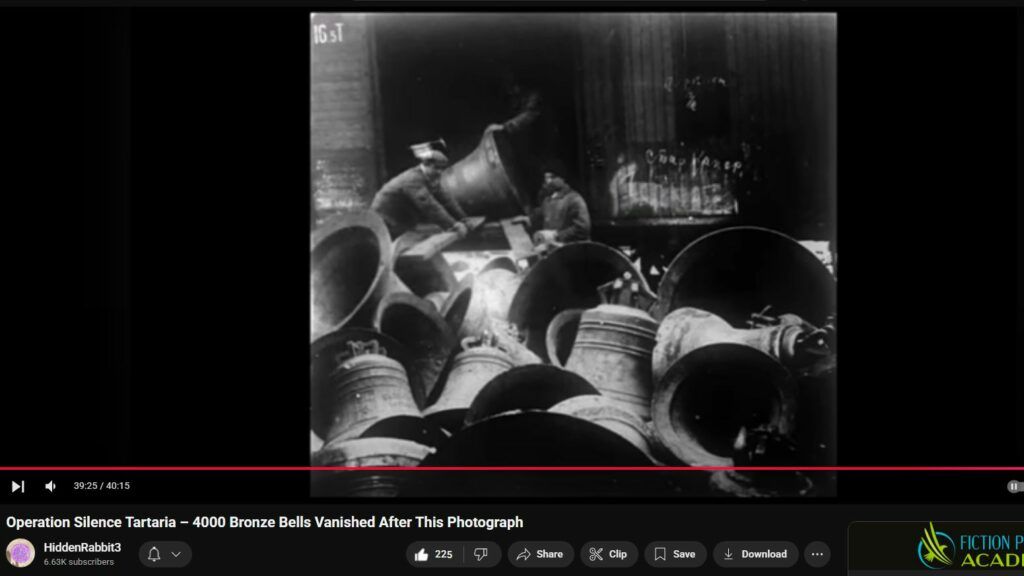
I've spent months staring at this one photograph. A haunting wide open field
0:38
somewhere in Europe. Circa 1945. The grass is flat and trampled. The shadows
0:45
long and stretched as if the sun is fading but refusing to set completely.
0:52
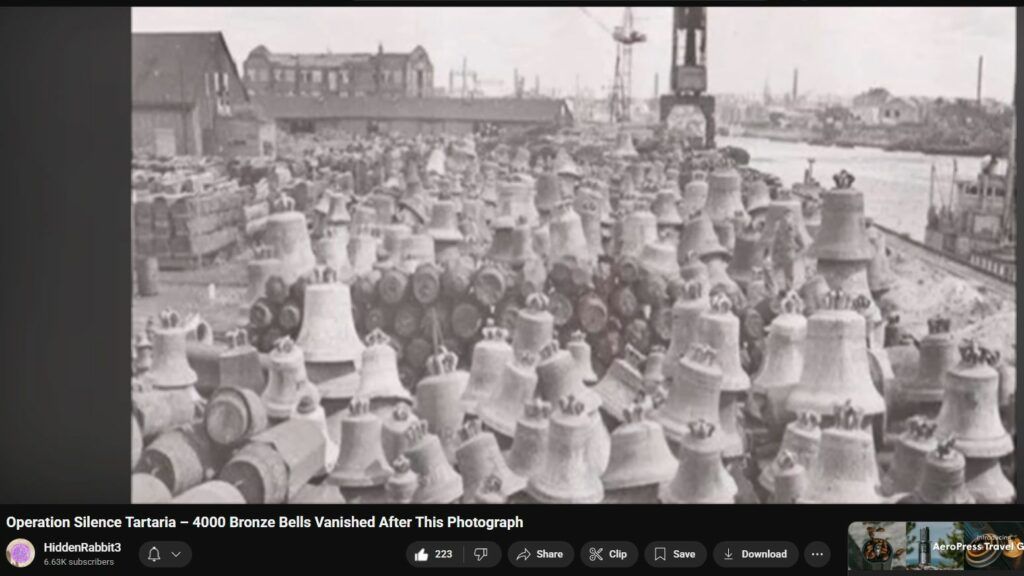
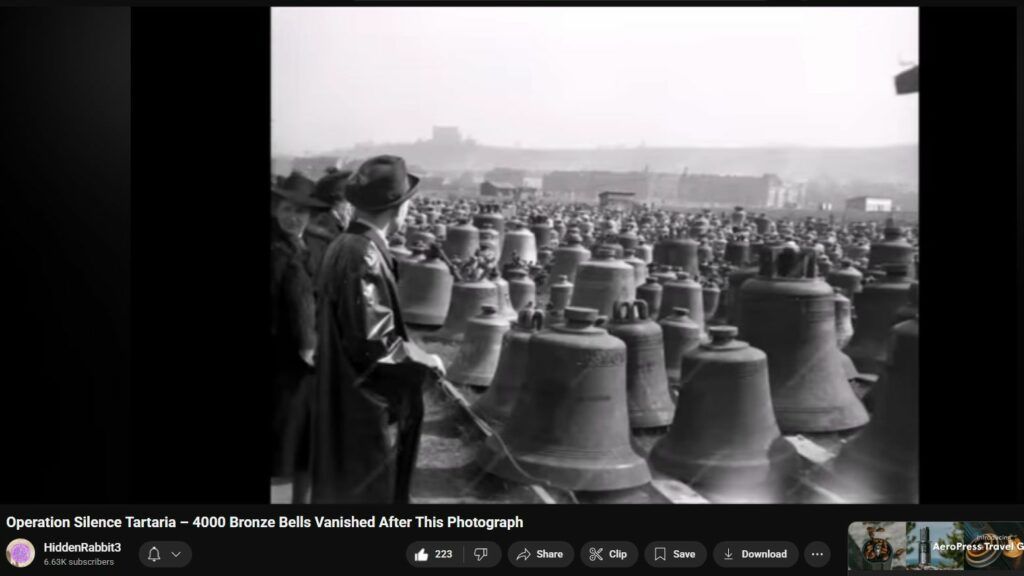
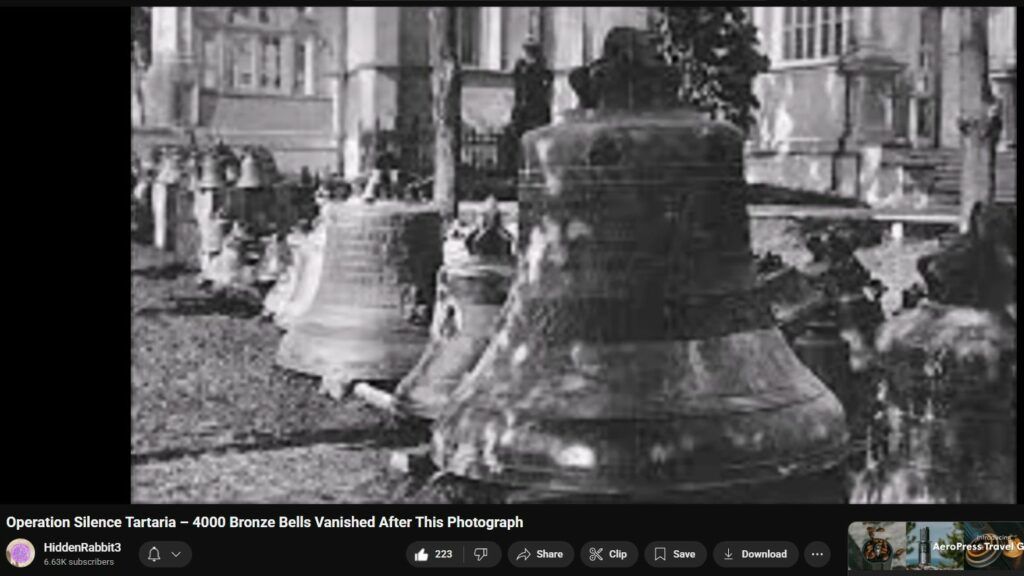
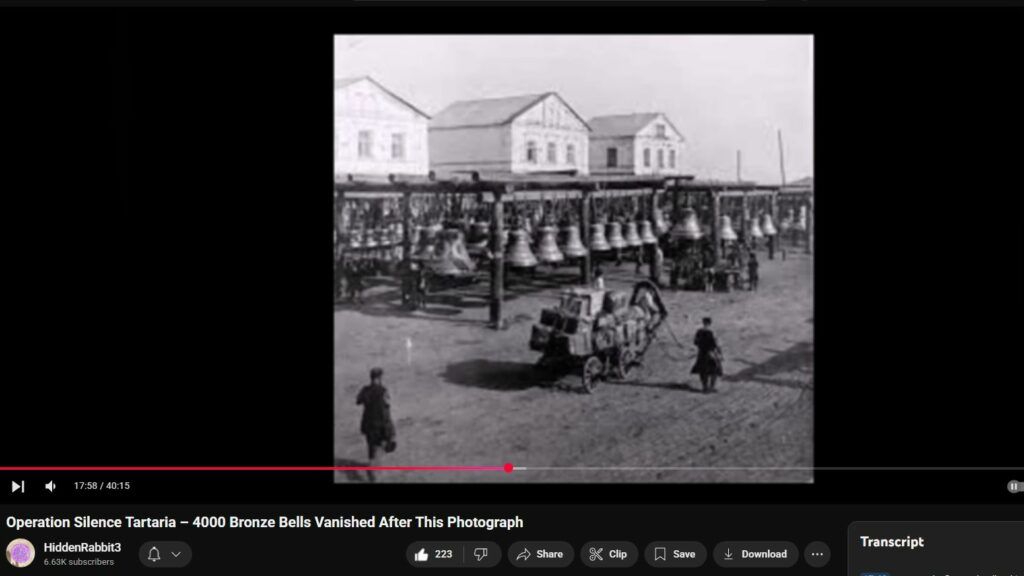
In the middle of the frame, stretching endlessly, are thousands of massive
0:58
bronze bells. Bells as tall as a person, some wider than a horse, stacked in
1:05
endless rows that seem to fade into the horizon. It looks less like a war
1:11
photograph and more like a graveyard. The graveyard of sound. The official
1:17
caption says, "Church bells collected for the war effort." That's it. A bland,
1:23
sanitized explanation for a scene that is anything but ordinary. As I examined
1:30
the photograph, something in me rebelled against the simplicity of that
1:35
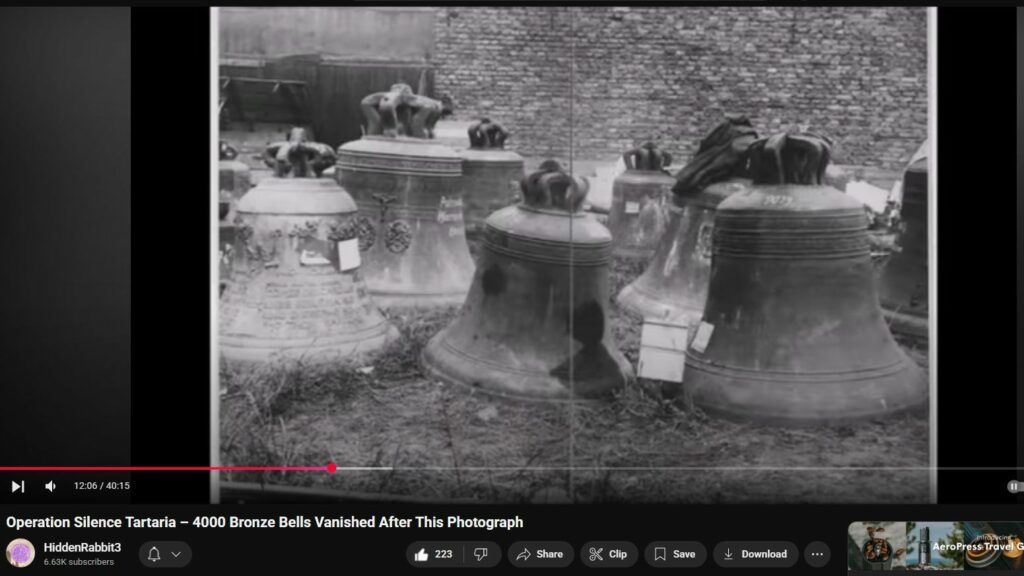
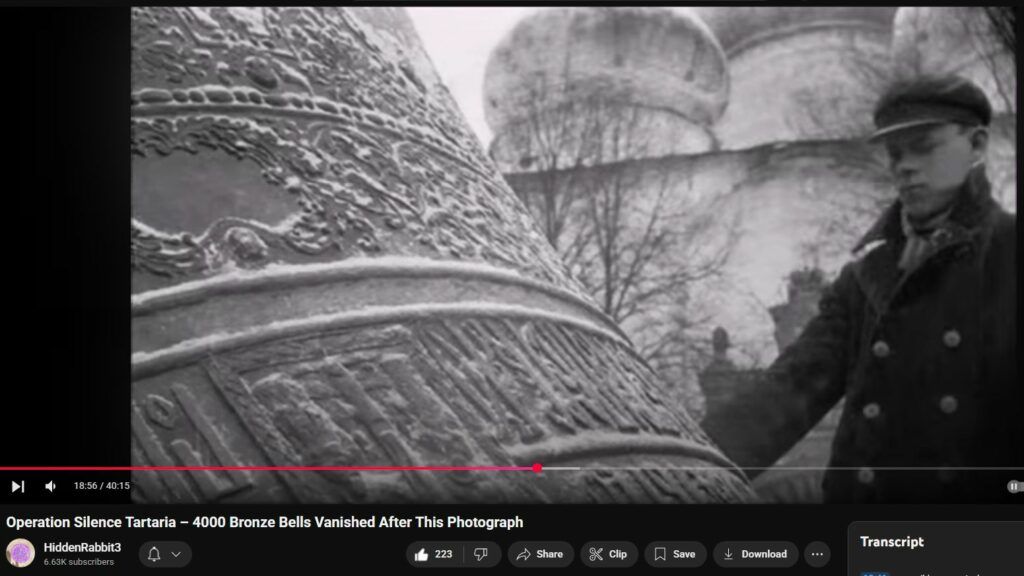
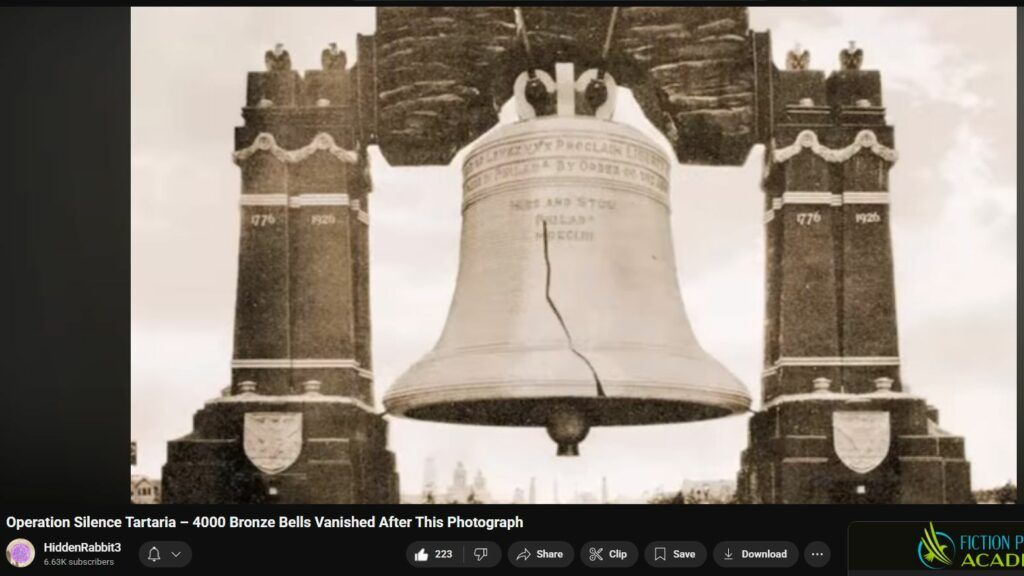
statement. Each bell is unique, ornate, carved with symbols, some with baroque
1:42
floral engravings. Others with cerillic or mysterious geometric patterns that I
1:48
recognized from Titarian architecture studies, triple rings, sunbursts,
1:54
abstract resonance glyphs that no one can truly explain. Some are centuries
2:01
old and yet they were all gathered here together as if someone wanted them gone
2:06
in one sudden gesture. Officially the story goes that during the war bronze
2:12
bells were confiscated for metal useful for manufacturing weapons, machinery and
2:18
industrial components. But as I dug deeper the numbers and logistics didn't
2:24
add up. Thousands of bells across Germany, Poland, France, and the Baltic
2:31
states were allegedly collected. Yet only a fraction was ever recorded as
2:37
melted down. In some areas, entire villages handed over their bells, only
2:42
to see no replacement for decades. And the ones that survived were often
2:48
smaller, lighter, and less resonant, stripped of their original tonal
2:54
brilliance. So then a question emerges. Why these particular bells? Why the
3:00
largest, most ornate, most sonically perfect instruments?
3:05
This is where the story starts to slip into something beyond conventional history. Tartarian folklore consistently
3:13
links bells with power. Not just ceremonial or religious, but energetic,
3:19
harmonic, almost magical. Bells were said to speak to the skies, to cleanse
3:26
air and earth, to restore balance after calamities. In cities with Tartarian
3:33
style architecture, domes and arches were constructed to amplify sound. The
3:38
placement of bells was crucial to create resonance fields across the city. And
3:44
then suddenly in the midentth century, all those frequencies, all that harmonic
3:49
infrastructure was erased. Looking at this field in the photograph, it's impossible not to imagine the silence,
3:57
the sudden muting of centuries old soundscapes. These weren't mere
4:03
instruments. They were nodes in a network of energy, culture, and history.
4:10
My research led me to trace the movement of these bells. There are scattered accounts of train shipments, moving them
4:16
under military supervision. In Belgium, a railway worker recalled seeing bells
4:22
being loaded onto freight cars. And he said, "They didn't sound like metal. They sounded alive. This was not
4:29
hyperbole. The descriptions imply the resonance was tangible, perceptible even
4:35
before they were removed. What if the confiscation wasn't about bronze as raw
4:41
material? What if it was about silencing a system that humans no longer
4:46
understood, but that some secretive authorities did? The official archives
4:52
show that once the bells were gone, the churches and municipal buildings were either fitted with new lighter bells or
5:00
remain silent for years. Modern replacements never had the same tonal
5:05
quality, the same harmonic depth. Even today, locals who remember the old bells
5:11
describe them as having a voice that spoke to the wind or singing that could
5:18
be felt in the chest. This is where Tartarian theories start to intersect
5:24
with documented history. Tartarian architecture, now dismissed as elaborate
5:30
yet purely decorates, was built for resonance. The domes, the cupillas, the meticulous use of copper
5:38
and bronze, all designed to amplify vibrations from these bells outwards, in
5:45
some ways creating energy grids across cities. And then, as if deliberately,
5:50
the largest bells, the ones that could affect the widest area, were removed,
5:56
transported, and never returned. Some of the bells, by accounts in old letters,
6:02
and scattered notes were even chained or stacked upside down during transport.
6:09
Men in uniform are visible in the distance of the photograph, but they aren't working. They are watching,
6:16
almost ceremonial. It reads less like a collection for practical purposes and
6:22
more like a ritualistic silencing. I started compiling lists of the bells
6:29
that vanished. Entire collections from Eastern Europe, the Baltics, parts of
6:34
France, Germany, and even as far as Scandinavia. Thousands of instruments,
6:40
each centuries old, never replaced. Some records hint at secret repositories
6:47
where these bells were stored. Others imply they were repurposed in ways hidden from public view. I found
6:55
mentions of them being taken to industrial zones where no one seemed to
7:00
care to note what ultimately became of them. A handful of diaries from the
7:05
1940s allude to special shipments and items of unusual importance being
7:13
removed. But the authors often hesitated to write more. Bells were central to
7:19
Tartarian folklore. They weren't just tools for marking time or calling
7:25
worshippers. In old texts, bells are described as capable of dispelling
7:30
storms, curing illness, purifying air, or even focusing energy for crop growth.
7:37
Some writings speak of the voice of the bronze giants, instruments so large and
7:44
perfect in form that their vibrations could be felt miles away, harmonizing
7:49
with other bells and architectural structures across the city. This is not
7:54
metaphorical. Even in early 20th century experiments, acoustic engineers noted
8:00
that the size, shape, and alloy composition of old bells allowed for
8:06
harmonic frequencies that modern instruments cannot replicate. Yet by the
8:13
1940s, thousands of these perfectly tuned instruments disappeared in a
8:19
single decade. The field in the photograph might be the last remaining
8:24
trace of this operation. As I examined other photographs from the
8:29
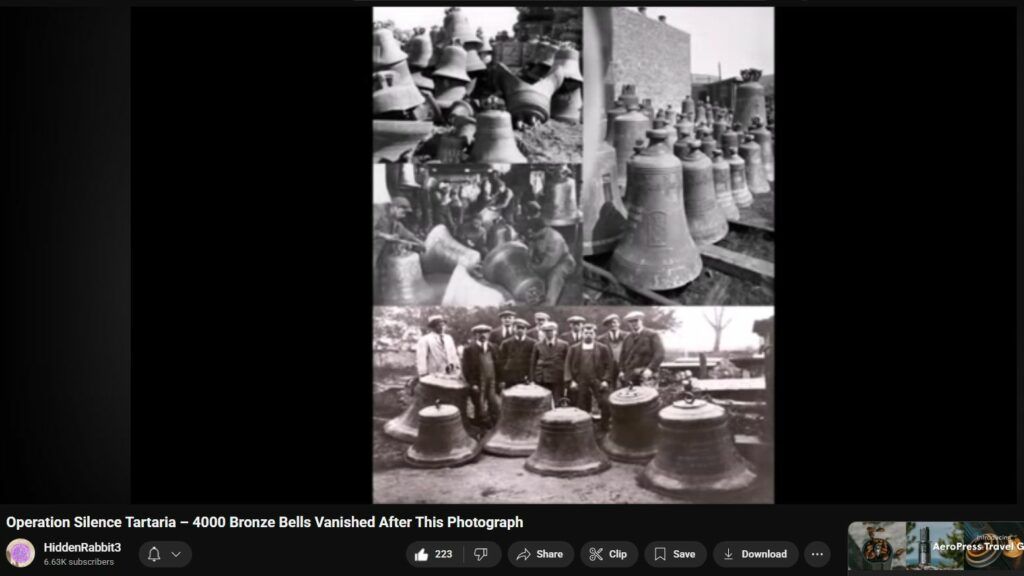
era, I noticed that the stacks of bells are almost ritualistically organized,
8:35
grouped by size, orientation, and engraving style. Some appear to have
8:41
strange symbols etched into the sides. Not Christian or traditional secular
8:47
symbols, but geometric patterns eerily similar to Tartarian motifs I had seen
8:55
in old architectural plans. It was like someone wanted to record them but not
9:01
use them. Maybe they were studying them. Maybe they were storing them. Maybe they
9:06
were erasing them. After the bells were removed, entire towns reported that the
9:12
air felt different or hollow. One town historian wrote in 1947, "The silence
9:20
was not natural. It weighed on the streets, in the homes, in the squares."
9:26
Some claim that even the local wildlife changed behavior, avoiding certain areas
9:33
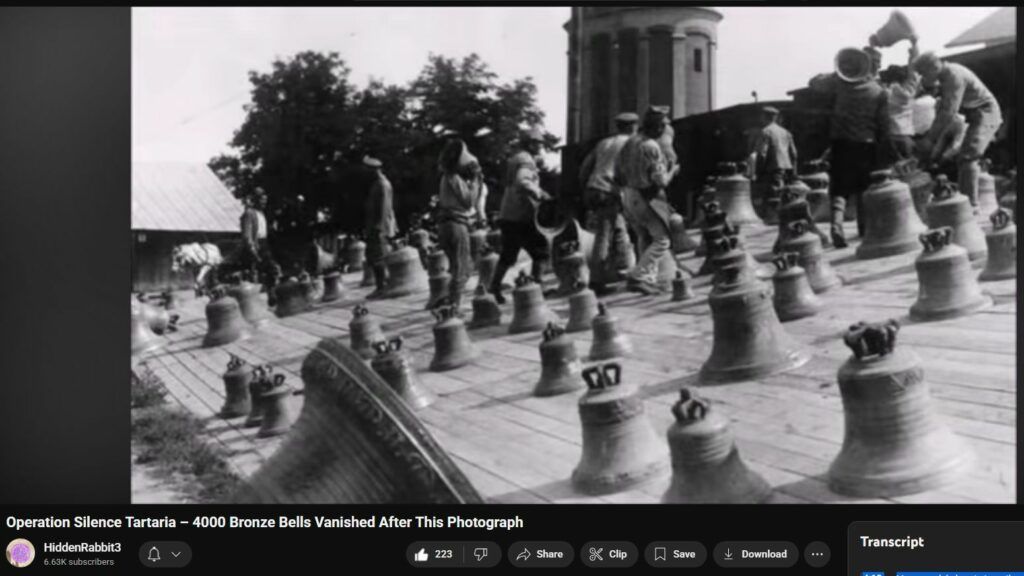
that once thrmed with sound. Then there's the logistical side. To move
9:38
thousands of massive bronze bells in one field required extraordinary manpower,
9:45
machinery, and coordination, train cars, cranes, teams of men, documentation.
9:52
And yet, there are barely any surviving records to explain what ultimately became of these bells. Only
9:59
fragmentaryary letters, photographs, and eyewitness accounts. Why would such an
10:05
operation be so meticulous, but the results so secretive?
10:11
My conclusion is that this wasn't just a wartime measure. There was no need to
10:17
remove bells from remote villages in such large quantities if it were merely
10:22
for metal. It's the pattern, the scale, and the specificity that suggests
10:28
intention. Silence the bells. Disrupt the network. Erase the resonance.
10:43
[Music]
10:57
[Music]
11:12
When I first started digging into the story behind that photograph, it became
11:18
immediately clear that the logistics alone were staggering, far beyond what
11:24
any ordinary wartime operation would require, especially if it were only
11:29
about reclaiming metal. Thousands of bronze bells, some taller than a man,
11:36
some wider than entire doorways, were stacked in a field that stretched to the
11:42
horizon. Each bell weighed hundreds, sometimes thousands of pounds,
11:48
transporting them, coordinating the men to move them safely, cataloging them.
11:55
This was not a simple requisition. This was a massive, highly organized
12:01
operation. I began to trace railway records from the mid 1940s, looking for
12:07
shipments that could have accommodated such enormous loads. Freight manifests
12:15
show that numerous trains departed from regions with dense bell populations
12:21
heading to industrial hubs, but there are massive gaps in documentation. Some
12:26
entries list metal shipments or industrial
12:31
requisitions, but the specific number of bells, their size, or their origin is
12:37
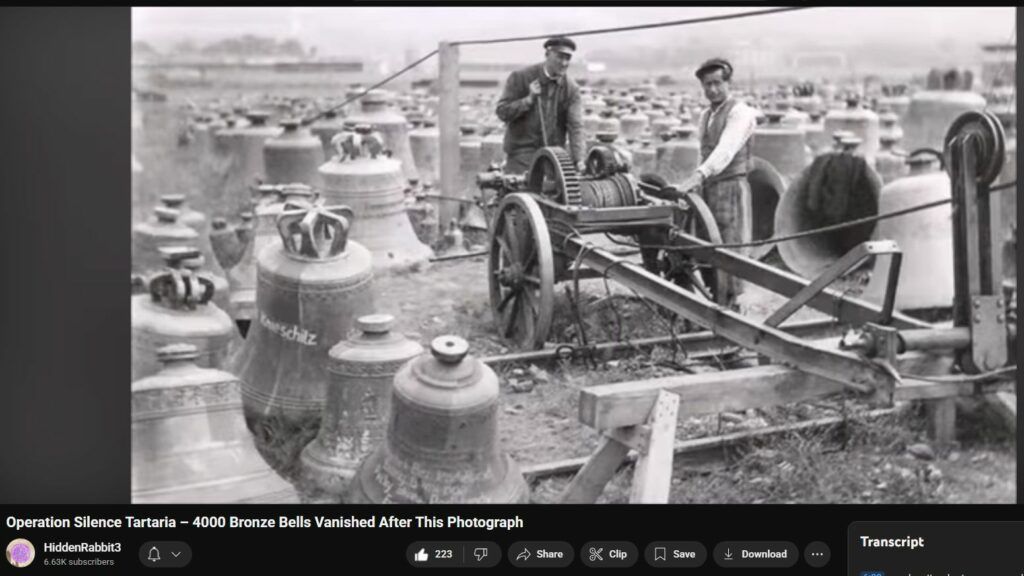
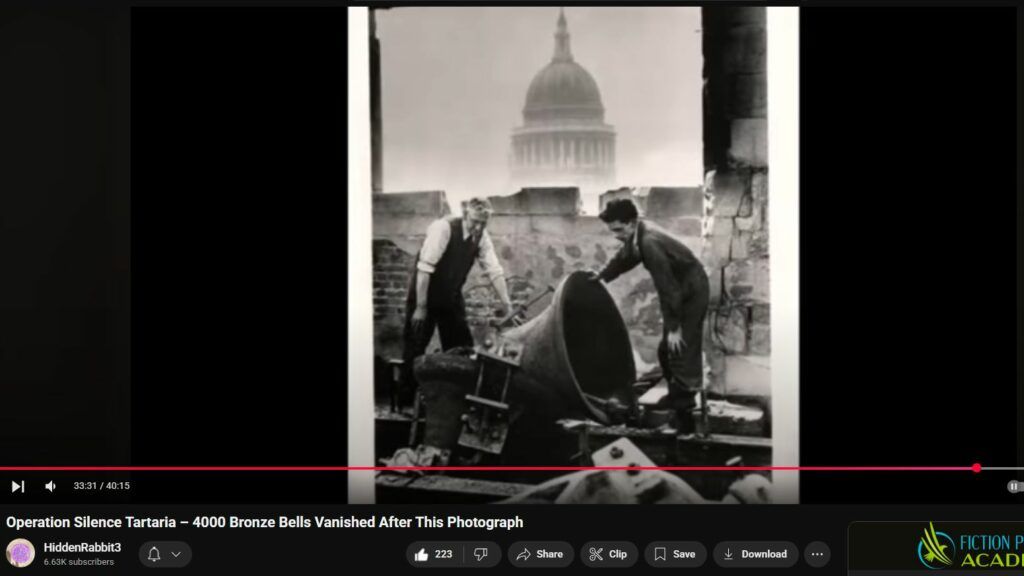
left out. From what I could piece together, moving just one of the largest bells required at least six men
12:45
operating heavy pulleys and cranes. Now, multiply that by thousands across dozens
12:51
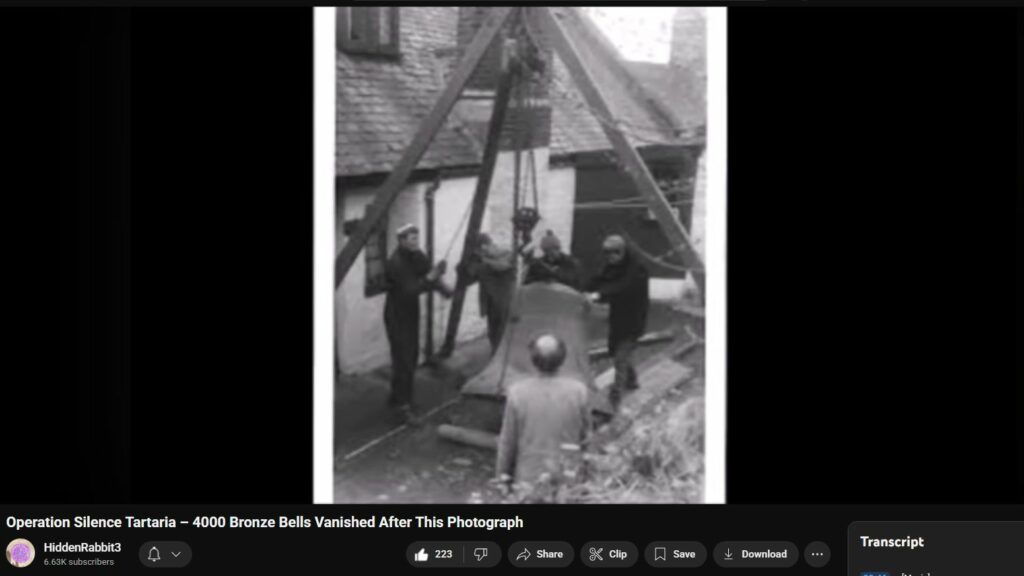
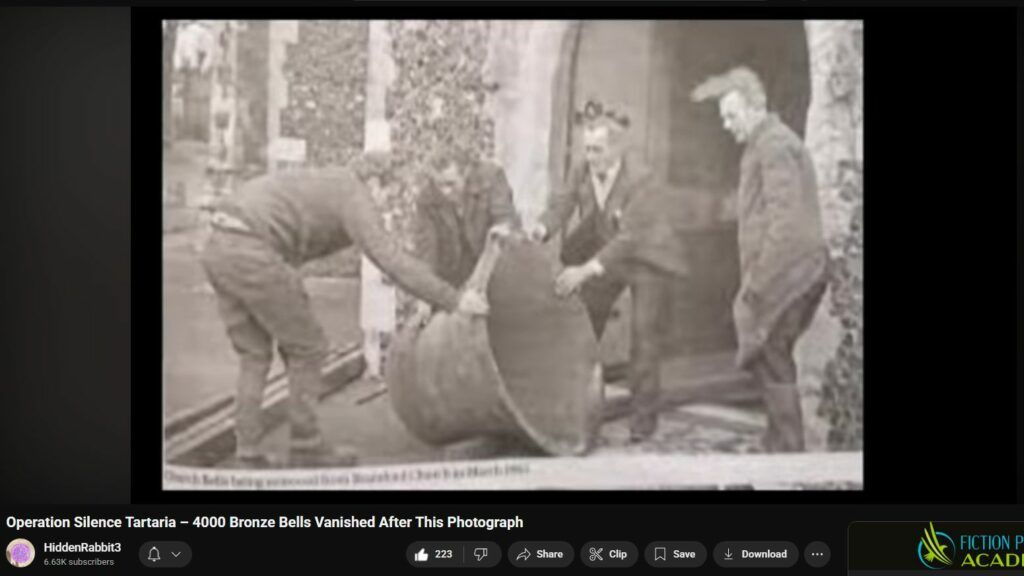
of villages and towns. Some photographs from small towns show horses and carts
12:57
struggling to lift a single bell onto a wagon. These were not objects that could
13:02
be casually packed and shipped. This was an operation requiring careful planning
13:09
and coordination at an unprecedented scale. And yet the official narrative is
13:16
blunt. They were collected for the war effort, melted down as needed. But if
13:22
this were true, why is there virtually no record of them being recycled into
13:27
wartime production? Factories that needed bronze have logs, ledgers, and
13:34
accounts of incoming raw materials. Yet these bells, the largest and most ornate
13:40
of the era, vanish from all records postolction. Some eyewitness letters and
13:47
diary entries, which are only now resurfacing, describe trains filled with
13:52
bells leaving towns, but the men tasked with guarding them reportedly said the
13:58
bells were not to be melted. In other towns, local officials documented that
14:04
the bells were cataloged, numbered, and stored in warehouses. One diary even
14:10
mentions cryptically that some were sealed in underground chambers awaiting
14:15
a later purpose, but that purpose is never clarified. The more I examine these accounts, the more the official
14:23
explanation began to unravel. The number of bells removed simply does not align
14:29
with wartime material needs. If the goal was bronze, smaller and more easily
14:36
transportable sources existed in abundance. Industrial scrap, old
14:41
machinery, coins, and other artifacts. Why risk moving the largest bells from
14:48
remote villages with immense manpower, logistical planning, and specialized
14:53
equipment for no apparent gain. Something else seems to have been at play. I also looked into the engineering
15:00
challenges. Bells are not easy to move. They are topheavy, fragile in terms of
15:07
resonance, and prone to cracking under stress. Each bell required careful
15:13
handling, padding, and a slow, methodical lifting process. Many were
15:18
lifted using wooden scaffolds in pulley systems that could barely hold the
15:24
weight of a single bell. The fact that the operation succeeded at all on such a
15:31
massive scale implies extraordinary planning and supervision. Moreover, I
15:37
discovered a strange pattern in the types of bells removed. Not just the
15:43
largest, but the most historically and acoustically significant were prioritized. bells from tartarianstyle
15:52
cathedrals, ones with the deepest resonance with architectural engravings
15:57
that match domes and arches in the city were among the first to be collected.
16:03
Smaller, less significant bells were left behind or ignored entirely. This
16:09
points to intention, not necessity. There is also evidence suggesting that
16:14
some of these bells were deliberately taken to obscure locations, sometimes hundreds of miles away, and stored in
16:21
warehouses or factories that have since disappeared or were destroyed. In one
16:26
surviving letter from a warehouse overseer, he notes, "The bells are
16:32
stacked and the instructions are clear. Do not ring. Do not disturb. Do not
16:37
mark." Such language is peculiar for a requisition process focused on metal. It
16:45
implies secrecy and careful preservation rather than destruction. I began
16:51
cross-referencing old maps with shipment routes and some led to curious results.
16:57
Several of the warehouses supposedly holding bells are in areas previously
17:02
uninhabited or far from industrial centers. Even more intriguing, a few of
17:09
these warehouses were built into hillsides, partially underground. This
17:15
would make sense if the bells were being hidden for preservation rather than
17:20
being prepared for melting. Some records suggest that at one point engineers tried to experiment with the acoustic
17:28
properties of these bells while in storage. They noted that even when stacked, the sound waves from one bell
17:35
would resonate with others, creating harmonic effects that could be felt
17:40
across the floor and walls. This could explain why instructions were strict
17:47
about not ringing them, not even for testing. These were not ordinary
17:52
instruments, and their resonance was clearly recognized. Then there's the human element. Moving
18:00
and supervising thousands of massive bells required hundreds of men.
18:06
Testimonies from train engineers, dock workers, and local villagers describe
18:11
unusual orders. Handle them carefully. Do not strike. Watch the inscriptions.
18:18
And in one report, a foreman was reprimanded for accidentally tapping a
18:24
bell while unloading, noting that it echoed through the valley in a way that
18:29
frightened the horses. The more I read, the more it seemed that these bells were
18:35
understood to carry more than mere sound. They carried history, energy, and
18:41
possibly power. And someone wanted to ensure that it remained contained and
18:47
silent. The scale, secrecy, and attention to detail all point to a
18:52
deliberate, coordinated effort to remove these instruments from public life. Not
18:58
for metal, not for ordinary wartime use, but to erase their presence, to break
19:05
the acoustic network they formed across cities, and to silence the power that
19:11
Tartarian folklore attributed to them. This realization fundamentally changes
19:18
how we interpret that one haunting photograph. The field is not just a
19:24
staging ground for collected metal. It is a snapshot of Operation Silence
19:29
Tartaria in progress. A massive coordinated removal of cultural and
19:35
acoustic heritage under the guise of necessity. My investigation continues,
19:41
tracing shipment routes, comparing eyewitness accounts, and analyzing the
19:47
surviving bells that escaped the operation. Each layer of research uncovers more
19:53
anomalies and strange coincidences, pointing to an operation far more
19:59
deliberate and secretive than history books ever acknowledged. And so as we
20:06
dive into the next episodes, we will explore not only where these bells might
20:12
have gone, but why they were considered too important to remain in place. What
20:17
Tartarian folklore says about their significance, and how the world's acoustic and architectural history was
20:25
irreversibly altered by this silent removal.
20:39
[Music]
20:46
[Music]
20:56
[Music]
21:06
These were not simply instruments of sound. They were monuments, guardians,
21:12
and symbols of the civilization's very essence. The first layer of
21:18
understanding comes from the sheer scale of these bells themselves. Tartarian
21:24
bells, unlike ordinary church or municipal bells, were enormous,
21:30
often weighing multiple tons, with resonant qualities that could be felt as
21:35
much as heard. Reports from the era along with surviving inscriptions
21:41
describe tones that carried for miles capable of interacting with the natural
21:46
environment in ways that seemed almost magical. Some chronicles claimed that
21:52
the largest bells could influence weather patterns or amplify the earth's
21:58
vibrations to harmonize with the human spirit. When looking at the photograph
22:03
of thousands of bells stacked in a field, the realization dawns this was
22:09
more than a confiscation of property. This was a silencing of power. Tartarian
22:16
folklore is rich with tales of bells functioning as both protective and
22:22
communicative devices. One story recounts how the bell of Novagrad, a
22:28
massive city in Tartaria, would ring at the approach of invading forces. Its
22:34
deep resonance alerting the population days before any soldier arrived. Another
22:42
tale from an ancient manuscript describes the bell of Voligrad, which
22:47
when rung in ceremonial ritual could unify the energy of the city's inhabitants, enhancing their mental
22:54
focus, health, and even collective decisionmaking. These stories were often
23:00
dismissed in mainstream narratives as exaggerations or myth, but consistent themes across
23:08
multiple regions suggest that the bell's function was understood and respected in
23:14
a society that valued harmonics and resonance. Scholars in Tartaria placed
23:21
enormous importance on the inscriptions found on bells, which often contained
23:27
not just decorative motifs, but coded information, mathematical sequences,
23:32
astronomical data, or references to the movement of celestial bodies. These
23:39
inscriptions were believed to be part of the bell's functional power, tuning it
23:45
to specific vibrational frequencies that could interact with both human
23:51
consciousness and the environment. For example, one bell in the city of Crash
23:57
Noy reportedly contained a sequence corresponding to the cycles of the moon
24:03
and sun. and local folklore suggested that ringing it in a particular pattern
24:08
could predict seasonal changes or even avert natural disasters. The sheer
24:14
precision of these inscriptions suggests a level of engineering and understanding
24:20
that modern historians struggle to explain. There are anecdotes of people
24:26
attempting to ring surviving Tartarian bells in later centuries and reporting
24:32
strange phenomena, animals behaving differently, subtle tremors in the ground or feelings of vertigo and
24:40
euphoria. While skeptics argue these are psychological or coincidental effects,
24:45
the consistency of these reports across continents and centuries is striking.
24:51
Some of the most intriguing stories involve what are sometimes called networked bells,
24:57
groups of bells arranged in particular geometric patterns across cities or
25:03
regions. Tartarian manuscripts describe these as harmonic grids where each bell's tone
25:11
would resonate with others at a distance, creating a network of sound
25:16
and energy that extended across entire urban landscapes. In theory, these grids
25:24
could have been used to communicate, to maintain social cohesion, or even to
25:30
influence the physical environment in ways that remain mysterious.
25:35
This could explain why the removal of thousands of bells in 1945, as seen in that haunting photograph, was so
25:43
meticulously executed. It was not about metal. It was about severing an
25:48
energetic and cultural network that had existed for centuries. Some surviving
25:55
documents even hint at the use of bells in ceremonial warfare. Tartarian leaders
26:02
would allegedly coordinate the ringing of multiple bells to disrupt enemy
26:07
formations or to enhance the strategic acuity of their own forces. These
26:14
accounts, while often sensationalized, underline a broader reality. Bells were
26:20
considered instruments of power, integral to the functioning of cities and society itself. Additionally,
26:28
folklore emphasizes the spiritual significance of the bells. Certain bells
26:34
were believed to house protective spirits or ancient entities acting as
26:39
guardians over cities, bridges, or temples. In the city of St. Petersburg,
26:45
a bell once told to signal the beginning of the harvest season, and villagers
26:51
believed that ringing it incorrectly would anger the spirits and bring
26:56
misfortune. Similarly, a bell in the mountainous region of Ufffer was rumored to contain
27:03
the essence of the river that flowed beneath the city, and its sound was said
27:09
to purify water and soil. ensuring the fertility of fields. These narratives,
27:17
while folkloric, show a remarkable depth of understanding about the relationship between
27:24
resonance, environment, and human activity. The disappearance of the bells
27:30
in 1945, therefore, represents not just a physical loss, but a metaphysical
27:37
silencing. By removing these instruments from their towers and fields, those behind the
27:43
operation disrupted centuries old traditions, severed connections to
27:49
Tartarian knowledge, and effectively erased a dimension of history that
27:54
extended beyond mere architecture or craftsmanship. In my research, I encountered
28:02
testimonies of bell tuners, engineers, and craftsmen who had been involved in
28:08
the movement of these instruments. They described the bells as alive in subtle
28:14
ways, vibrations that lingered in their hands, feelings that seemed to extend
28:20
beyond the physical weight of the metal, an awareness that handling them carried
28:26
responsibility beyond simple transportation. These accounts suggest that even those
28:33
not steeped in Tartarian law recognized the extraordinary nature of these bells,
28:40
which further supports the theory that their disappearance was deliberate and not simply utilitarian.
28:48
One particularly striking story comes from a village near the Carpathian
28:54
Mountains where an elder described how the removal of the local bell left the
29:00
city feeling hollow. He claimed that after the bell was taken, strange
29:06
accidents increased. The weather seemed unpredictable and the natural
29:12
environment no longer responded as it had before. While this may sound
29:18
anecdotal, it aligns with the broader idea that these bells were deeply
29:23
integrated into the physical, social, and spiritual fabric of Tartarian
29:30
society. Many researchers and enthusiasts have speculated about the true power of these
29:36
bells, that they were not merely ornamental or communicative, but
29:42
instruments of resonance capable of influencing the human mind and
29:47
environment. Some suggest that Tartaria at its height achieved technological and
29:54
spiritual advancements based on their mastery of acoustics and harmonic
29:59
principles of which the bells were a key component. Heat. Heat.
30:06
[Music]
30:41
As I dug deeper into the events surrounding the photograph of thousands
30:47
of bronze bells stacked in a field in 1945,
30:52
the questions kept piling up. each one more perplexing than the last. Why were
30:58
so many bells collected at once in such a methodical way, and yet no
31:04
corresponding effort appears to have been made to replace them afterwards? The mainstream explanation that the
31:11
metal was requisitioned for wartime purposes seems increasingly flimsy when
31:17
one examines the logistics, the quantities involved and the fact that
31:22
tens of thousands of bells simply vanished from public record after that
31:28
year. In my research, I traced the movement of bells through official transportation records, photographs,
31:36
and surviving correspondence from towns and municipalities.
31:42
Entire cities reported missing bells from small villages in central Europe to
31:48
major cities with grand cathedrals. The numbers are staggering. In some regions,
31:54
80 to 90% of all documented bells disappeared in a remarkably short
32:01
period. This was not a slow, gradual process. It was systematic and
32:07
coordinated. The photograph itself, a chilling visual of thousands of bronze
32:13
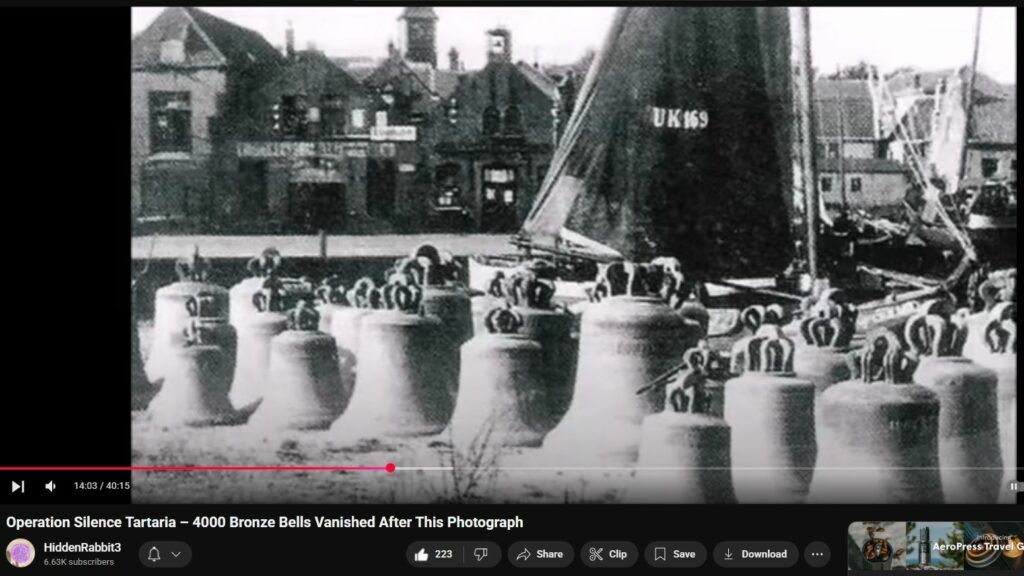
instruments stacked like crates in a barren field, seems to capture a moment in this operation that was orchestrated
32:19
with precision. Looking at the photo, I noticed that the bells were arranged in rows organized by size, weight, and
32:27
possibly tonal frequency. This was not random. The handlers clearly knew what
32:33
they were doing and perhaps understood which bells were the most valuable or
32:39
significant. From a logistical standpoint, moving and storing bells of
32:45
this size requires heavy machinery, manpower, and coordination. These bells
32:51
are not trivial objects. Some weigh multiple tons. Coordinating the removal
32:57
of thousands of such massive instruments across entire regions would have been an
33:04
enormous operation. Yet there is almost no public record of the planning, the
33:09
transportation or the personnel involved. This lack of documentation is
33:14
in itself highly suspicious and suggests that there was an intention to keep the
33:21
operation secret. In interviewing a few surviving bell tuners and metallurgists,
33:27
I discovered that many of them could not understand why certain bells were taken
33:33
and others left behind. One Masterbell founder, now elderly, recalled his
33:39
father mentioning that the biggest, the most resonant, were always taken first.
33:45
They said they needed the bronze, but no one ever replaced them. and the sound of
33:51
the city was never the same again. This anecdote fits with a recurring
33:57
theory among researchers that what was being removed was more than metal. It
34:03
was the instruments themselves which were thought to carry cultural, spiritual, and perhaps even
34:10
technological significance. Bells in Tatarian folklore were never just functional objects. They were
34:17
instruments of power. Some scholars suggest that large bronze bells were tuned to frequencies that
34:24
could influence human consciousness or even the environment. In Tartarian
34:30
cities, coordinated networks of bells, created harmonic grids across urban
34:37
landscapes, transmitting energy, and potentially serving as early forms of
34:42
information networks. Removing thousands of bells at once could have been a
34:48
deliberate attempt to silence these networks. The pattern of removal seems
34:54
to support this. Bells that were smaller, less resonant, or considered
34:59
less important were frequently left behind, while the largest, most
35:04
intricate, and most harmonically tuned bells were systematically confiscated.
35:11
Towns lost their largest civic bells. Cathedrals were left silent and entire
35:18
regions were left with a significantly diminished capacity for the sonic power
35:24
these instruments represented. My research into the folklore surrounding
35:29
these bells adds another layer of intrigue. In many Tartarian legends,
35:35
bells were used to protect cities from disasters, to summon aid, and even to
35:42
maintain harmony within society. One tale tells of a bell that could be rung
35:47
to influence rainfall or protect against storms. Another describes a bell network
35:54
that synchronized the efforts of a city's inhabitants, improving coordination, agriculture, and social
36:01
stability. Removing these bells on mass could have been an intentional act to
36:07
suppress these cultural and spiritual capacities, ensuring that the knowledge
36:12
of their power would be lost. Another important question that arises is why
36:17
the operation occurred at precisely this time. 1945 marks the end of a global
36:25
conflict, a period of immense political and social upheaval. It was also a
36:31
moment when many governments were rebuilding, repurposing, and consolidating power. Some researchers
36:37
argue that the bells, being both valuable and symbolically powerful, were
36:42
seized under the pretext of material necessity. But in reality, the objective
36:49
may have been to erase a part of history and culture that was inconvenient or
36:56
potentially threatening to the dominant narratives being established. There are
37:02
reports of surviving bells that were hidden, stored, or transported to
37:07
unknown locations, never to be publicly displayed again. In some cases, local
37:14
communities recall that bells were taken by truckloads, some disappearing into
37:19
rail yards or warehouses only to vanish from public knowledge entirely. This
37:26
secrecy coupled with the simultaneous disappearance of thousands of
37:32
instruments suggests a coordinated effort to control not just the physical
37:37
objects but the cultural memory associated with them. One of the most
37:43
baffling aspects is the lack of records about what ultimately happened to the bronze. Official accounts claim it was
37:51
melted down for industrial use, but there is no documentation showing the
37:56
metal being reused and no new bells of comparable size were ever cast to
38:03
replace those lost. If the primary motivation was metal reclamation, this
38:09
seems like an incredibly inefficient and wasteful operation. My own investigation
38:16
led me to look at surviving photographs and personal accounts from the time. In
38:22
these sources, there are subtle clues, bells arranged in specific patterns,
38:28
inscriptions left intact, and towns recording the loss of their most resonant instruments.
38:35
These details suggest that the operation may have had additional motivations
38:41
beyond mere material collection. Could it be that the removal of these
38:46
bells was part of a broader attempt to suppress knowledge of Tartarian
38:52
civilization and its acoustic technologies? was the global network of
38:58
harmonic bells intentionally dismantled to erase a connection to a lost world of
39:05
sound and power. The more I looked, the more the evidence seemed to point toward
39:11
this possibility.
39:22
[Music]
Visited 9 times, 1 visit(s) today