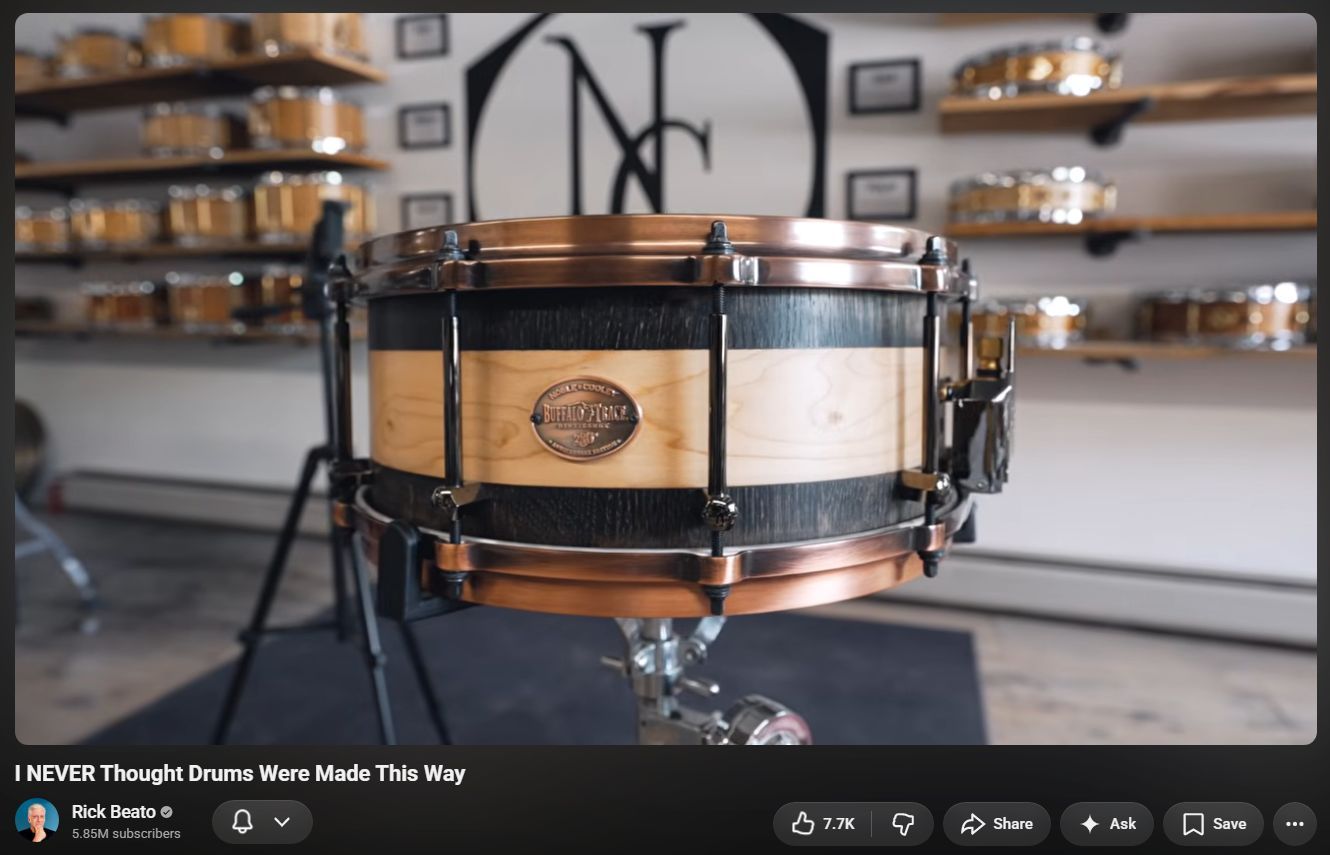
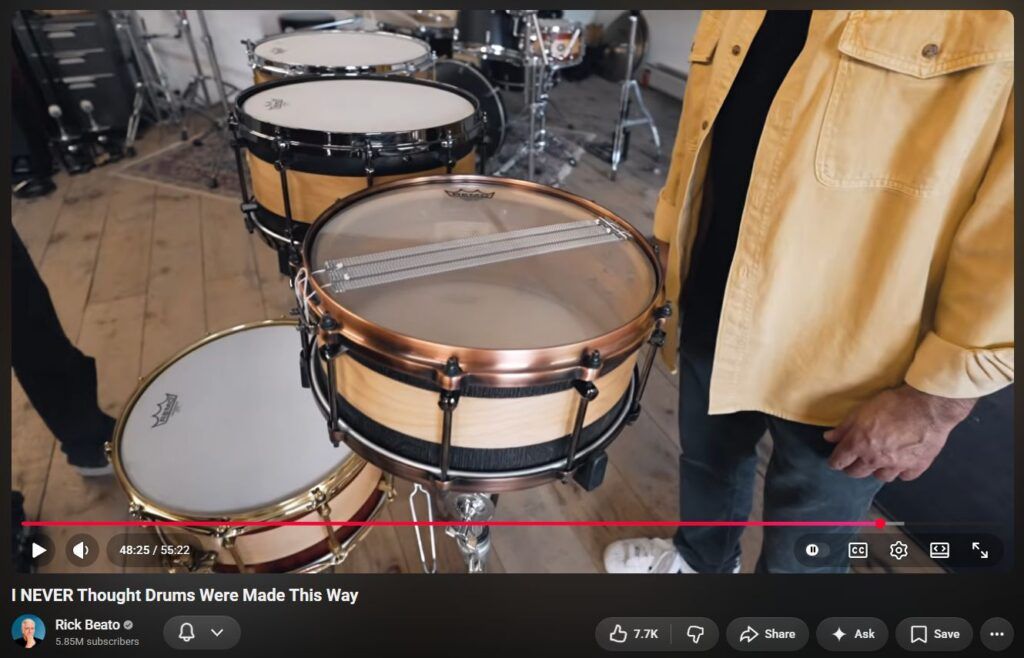
Famous for steam-bent single-ply snare drums. Watch this. Here is true craftsmanship. “The copper-finished die-cast hoop / oak whiskey barrel staved / steam bent maple outer band is by far the best sounding drum; it is shockingly good sounding. It has the Right Amount of meat, the Right Amount of tang and sass — it is like the Perfect barbecue.”
Surprised there wasn’t a path thru a covered bridge to get into dat jointe
Their marketing is horrendous. I’ve been playing drums for over 50 years and never knew any of this, never even heard of it.
I grew up 20 miles from this shop and was never even aware of its existence- absolutely sinfull. This is so awesomely old-school New England hand craftsmanship- no CNC’s or other ultra modern machinery. Ricardo is a true master whounderstands tthe soul of the materials he works with.
This guy has to be the coolest mad scientist I have ever seen.
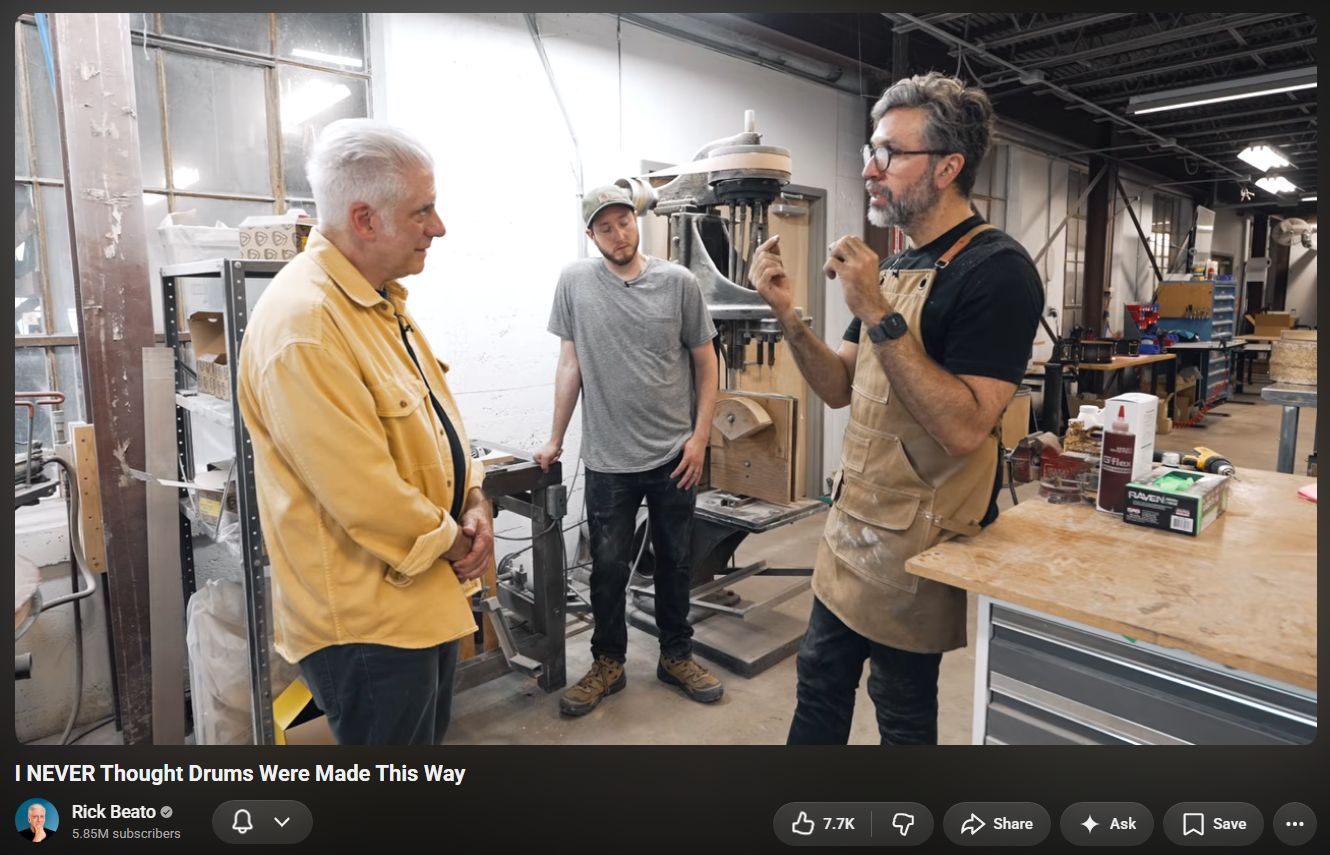
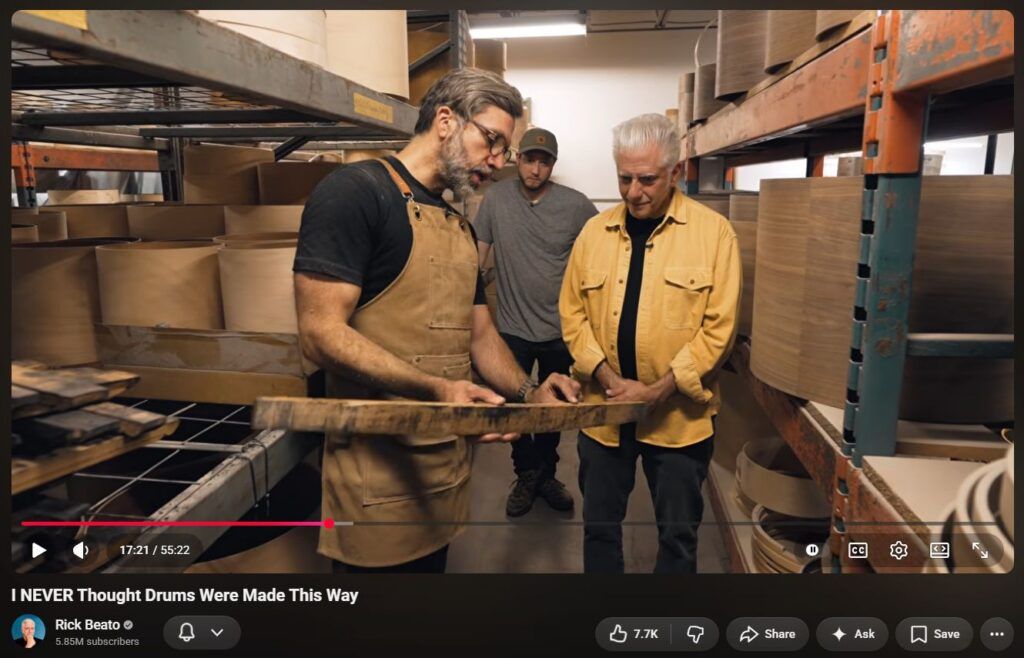
New “StaVent” drums use old whiskey-barrels (from Buffalo Trace, oldest distillery in US). “It has a strong relationship with your taste…sugar content…” 17:00 in — SUPER KUDOS I’ve never heard anyone mention tone and taste but myself and their head drum craftsman.
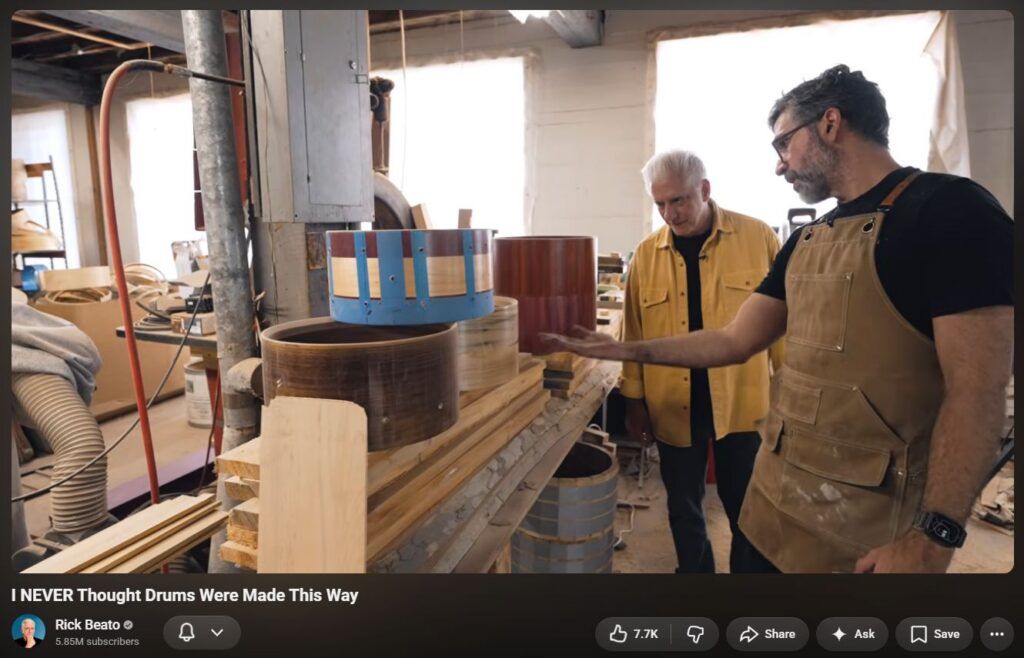
Oak and Maple are the two woods having vertical and horizontal ring / growth structures inherent to the wood — caused by growth vs trauma. ~35:00
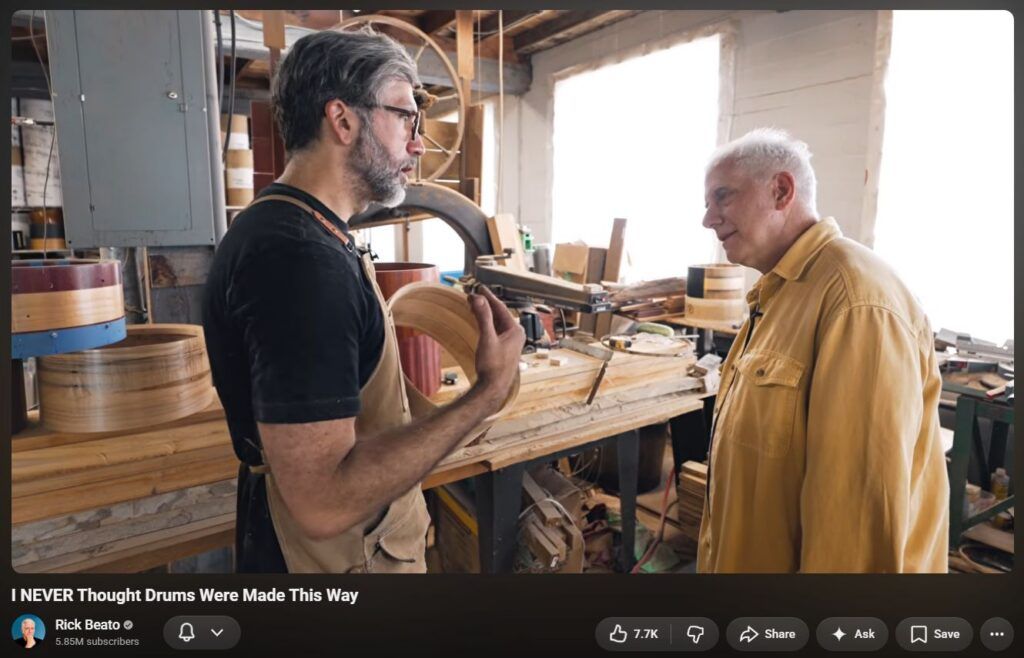
Tension in the shell (due to lugs) very important to tone. Type of glue matters also.
“A New Drum Architecture”
Around 52:30 in. Talking about hard, thin-staves precisely mated to steam-bent single-ply outer central band / ring. Essentially unlimited tonal palette due to ability to use unyielding / unbendable woods instead as stavings.
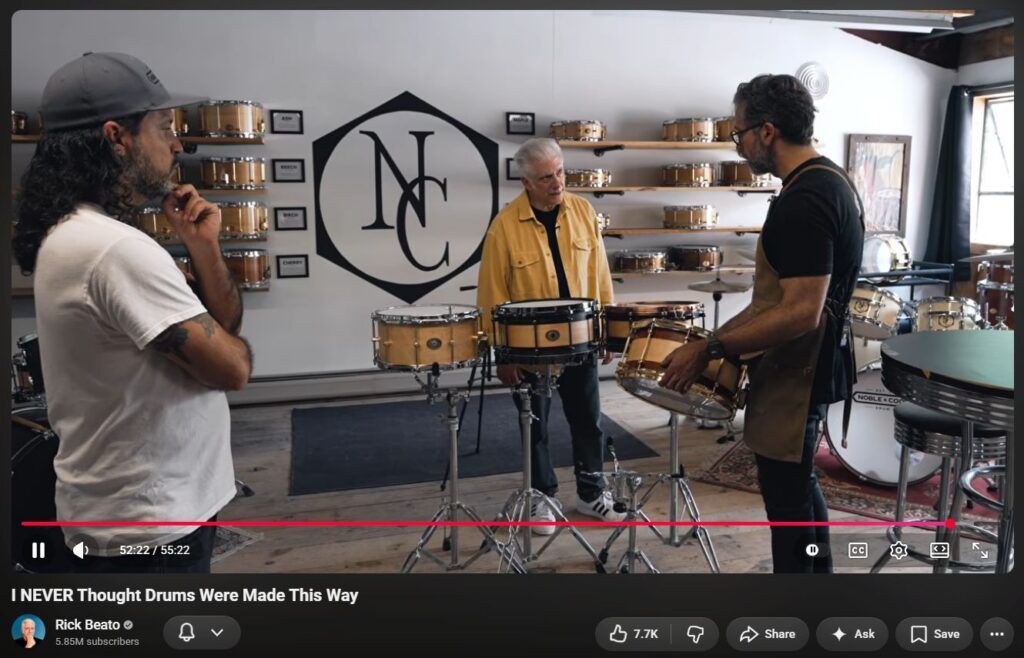
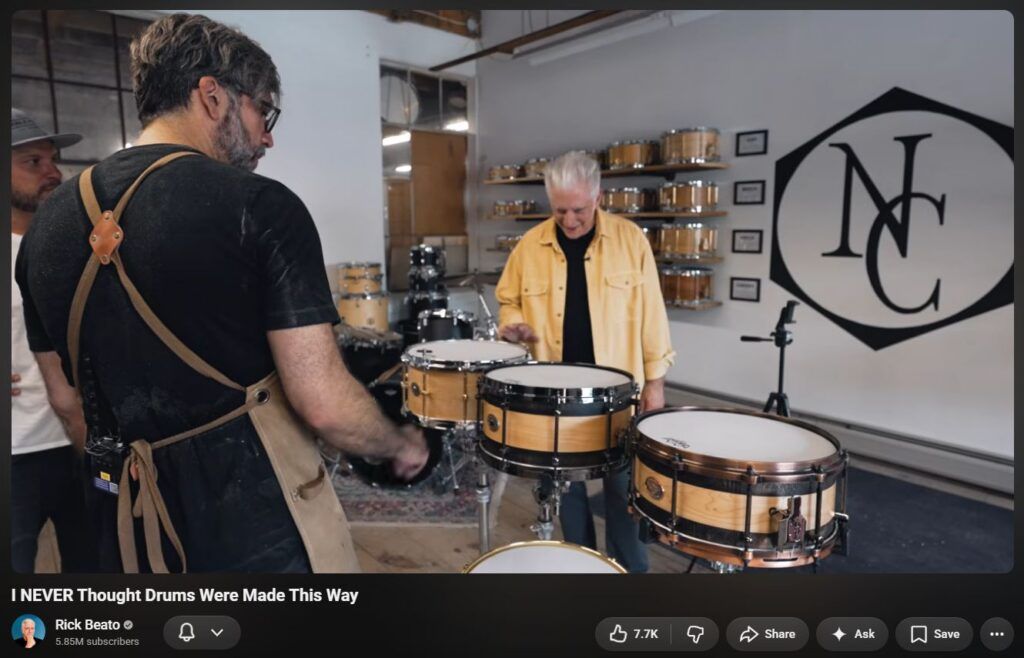
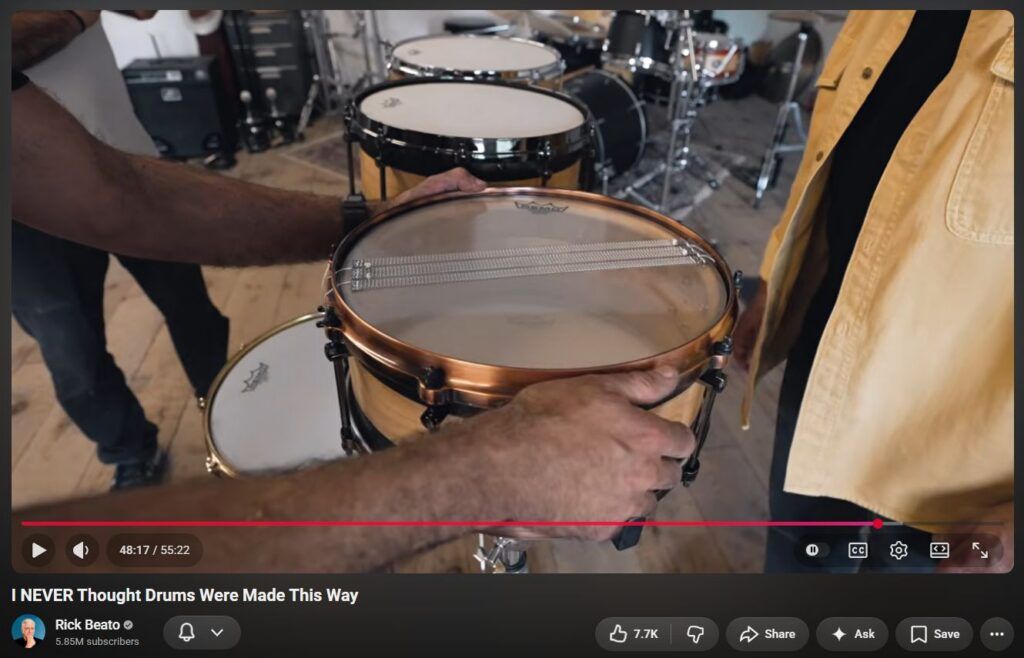
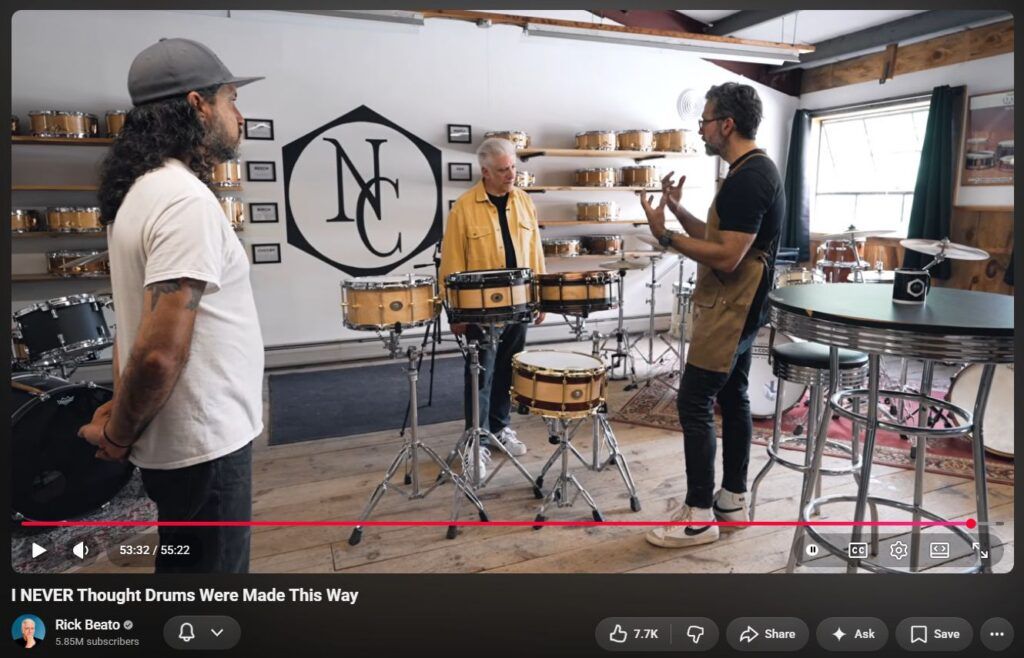
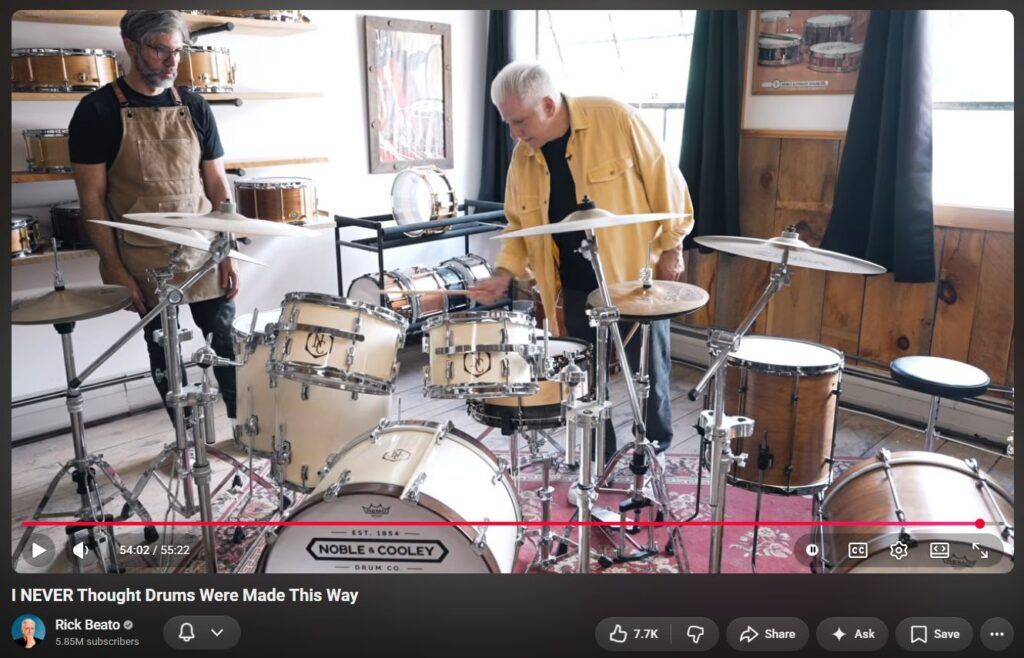
Zildjian alloy snare shell. Collectible. Intro 1989; second run 1993. $6k resale in 2026.
The copper-finished die-cast hoop / oak whiskey barrel staved / steam bent maple outer band is by far the best sounding drum; it is shockingly good sounding. It has the Right Amount of meat, the Right Amount of tang and sass — it is like the Perfect barbecue.
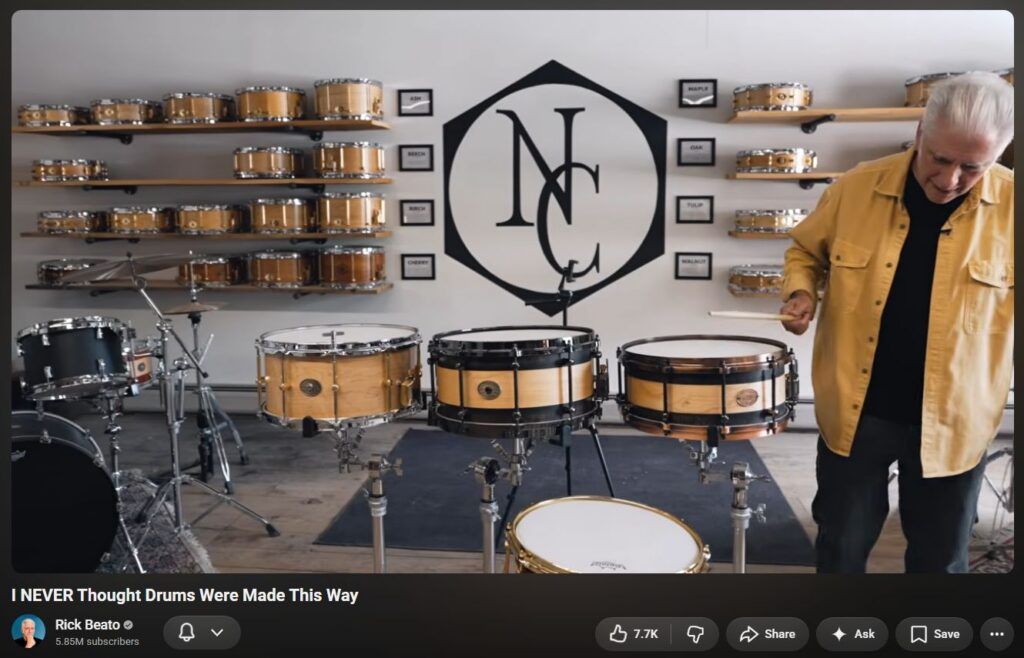
Transcript
Click to reveal
0:00Hey everybody, I’m Rick Bat. I’m here in Granville, Massachusetts at Noble and the first drum company in the
0:06United States established in 1854. I’m here with Ian.
0:12Ian’s going to show us around. Let’s head inside. Yeah, sounds good.
0:17I’ll follow you. You follow me.
0:23All right. Right this way. Okay.
0:38Then right up these stairs here. Okay.
0:50All right. So, here I am at Noble and We’re going to learn how Noble
0:56and drums are made today. And with me, I have my name is Luke. I am the general
1:02manager at Noble and And then Ricardo.
1:08He’s our master craftsman. He’s pretty humble and he doesn’t want to share that title. It’s difficult to [laughter] say.
1:14All right, guys. Where do we go first? Let’s go on into the wood shop. Great. We have a few things we want to show
1:20you. Okay, so what I’m what am I looking at here? What is this? All right. So, this is where we do all of the steam bending
1:27uh to make our solid shell snare drum. Okay. So, solid shell single ply piece of wood that’s bent into a shape.
1:33Um so, we have a mill next door where we mill all the wood. The guys do all the shaping in here. And then depending on
1:39the species of wood, it’s going to be in this uh steaming chamber for anywhere from 4 to 6 hours. Okay. Um, after that it’s softened up
1:46the wood enough to where they’ll be able to bend it into a cylinder. Pop it into one of these forms. Um, put the core in
1:52the middle to expand it and keep it nice and in shape. And then from there, it’s going to go through the rest of the
1:57parts of the process to be able to make a snare drum for you. When you put it in there, do you glue the seam right then or no? Do you
2:03Not yet. When it’s first in there, it is just about drying and keeping shape. Okay. So, that’s just the single piece.
2:10Um from there it can hang out and dry in one of these sono tubes and then every drum is made to order. So based on the
2:17order we’ll cut it to size and then that’s when they start all those um next processes to make the shell the the
2:23gluing of the lap, the gluing of the reinforcement rings in there and then all the shaping to get it. Okay. So if you have a 6 and 1/2 in
2:30snare drum uh how big is it when it goes in there? Is the piece of wood that big or is it
2:35slightly bigger because it’s going to have the bearing edges cut? Exactly. we’re always going to lose a little bit of it. So, we try to bend
2:42every piece at 9 in. Okay. Now, in reality, some boards you’re choosing based on the the wood grain
2:49pattern. So, we we do bend some smaller. Um, but we’ll always choose a board
2:54that’s a little bit bigger than the order and then that way we can lose the top and bottom and then cut the edges into. And how thick is the is the board? Does
3:00it depend? Are the shells with a steam bent? Yeah, the drama changes during the different parts of the process. You can
3:07imag
3:17some off um and and make it a perfect cylinder at the end of the day and steaming it. How how much water
3:23actually goes into the uh steaming process? A lot. Um is it different for each type of wood?
3:30It really depends um on whether it’s greenwood or whether it’s kil dried wood
3:35that we’re drying. So greenwood is just fresh wood, right? Greenwood is fresh wood. And because we
3:40have a mill and because all of the eight woods that we use in our standard line are domestic to New England.
3:45Okay. Uh it’s easier for us to get logs that are green and fresh. But that doesn’t mean every now and then that we don’t
3:50pick out something special like a curly maple, a bird’s eye maple, or we import something that is a little bit more
3:57exotic and try to bend it. So, it depends on how the wood uh begins that process, but ultimately it’s got to be
4:04saturated enough to be able to um have it, you know, soften up the the
4:09structure of the wood to be able to get it to bend right into that circle. And do you have uh places, mills that
4:14you get the wood from around town, around the town? We do. Luckily, we have a mill right next door um run run by the the family
4:21and um you know, every now and then we’ll source something special from a different logging company, but it tends
4:27to all be companies from this area. Okay. Um transporting wood is difficult. Uh and so, um to kind of keep things true
4:35to how we’ve always done it, the idea is to be able to get it within, you know, a mile or a few miles from the factory um
4:41and and keep it, you know, true to how we’ve always done it. And Luke, how old is this building that we’re in right now? Do you know?
4:47As you can tell, the buildings have gone through a lot of different eras. Um, some buildings on the campus are from
4:54the 1800s. Um, this one, the front part of the building is original. Then some of these back ones were kind of built on
5:00as the company was scaling and evolving from the late 1800s all the way to where
5:05we are now to be able to make various types of drums, military drums, toy drums, um, and now the professional line
5:11of drums. You got you guys started 1854. Is part of the building from then? Uh, absolutely. The the the front part
5:18there and then there’s two buildings over there on the side that are from the late 1800s as well. Um, yeah, we’re the
5:24oldest operating drum company in America. Still doing it the oldfashioned way as you can feel it in this room. You
5:29can’t tell on camera, but it’s it’s nice and steamy in here cuz we’re literally about to show Rick how to uh how we do
5:35our steam bending process. And so, we have it all fired up and ready to go.
5:55Nice.
6:37So you have this little gap. Yeah. But it will if it have a extra. So we will
6:45put it out in the lake. But it have to sit here like a you can touch barely touch the
6:52wood. Still warm. No, it’s not going to burn you. Yeah. Yeah.
6:58So So how long does it have to stay in here? Uh weeks. Wow. So the the the steam uh have a natural
7:07property into the wood that convert the wood uh bring the wood plastic properties. So be for this reason the
7:14the wood have to be uh fresh as Luke was saying. Um and it is happening here. We
7:20control uh through the machine there the pressure everything. And yeah you will see this machine is
7:27one like how many years is that’s hundreds. Yeah. Like a And these are molds, right? Is that what
7:33you call this? Yep. When it gets in there, it does it start expanding in there or do you have to put
7:38something inside it? Those guys right behind you. Yeah, it makes the pressure. It’s a very in a very old way.
7:44And you use the hammer and Yeah, the hammer and and this sheer willpower. It’s like a
7:50wow amazing receive some shots in their in their life. Nice. So you put this
7:56get open and make the pressure inside. It’s like a positive and negative. Okay. And how hot is this thing right
8:02now? Because it feels hot from right now. Oh, yeah. It’s very hot. Uh it’s a high pressure stop because you need pressure
8:09uh to get the steam into the wood to affect the whole thing. And the the wood
8:15normally is living in the water. Yeah.
8:21We can get in there. So, so we we have a a very nice trustability of the product
8:26because we have a direct rel relationship with the forest guy.
8:33Yeah. So, so we keep any step as Luke was saying you can see the a maple tree
8:39there. Yeah. And you and you can touch that and you can feel fresh. Yes. Oh, absolutely.
8:44So, we we from this point we select the best grain. Okay. Okay. And we cut that and we shape
8:51that. We make the angles. We make the the proper thickness and then we put
8:56into this chamber. But before to keep the wood to to safe in the same shape,
9:02we have to keep the humidity. If if we let this wood outside or getting dry, the wood will will bend
9:09definitely. So we we we save the wood even if it’s fresh. We we keep the wood
9:14in water. So we do most of our hardware inhouse. Okay. Okay. Um
9:19from our our hex’s to the components of our throwoffs. Yep. So we have all of our our punch presses
9:25here. These old die presses. Um does each machine make a certain part? Yep. Yeah. So for example, this one here
9:32is where our triple flanging. This is for our our butt ends actually. So comes out just in one piece here and
9:38then it goes to the one a few down and then gets bent into its its proper shape.
9:43Okay. This is just brass recycling. Okay. Um,
9:48and then from there it just gets buffed and lacquered. Wow. These are our throwoff components fully
9:54put together. So, it’s all just just raw brass. Um, it’s a simple mechanism, but it’s
10:01sort of a timeless design. That’s cool. Yeah. Um, over here we have our lathe. This is
10:07where we’ll cut our tubes. So depending on whatever depth of a drum people want
10:12um they can customize and and we can do it in house. Um and then buffing wheel
10:18here. Pretty pretty straightforward science to it, but um I don’t know. Hold. So how old are some of these machines?
10:25They look like they’re from the 50s or something. Yeah. Yeah. Probably around around them actually. Um the tricky part is
10:31maintenance. You know, if anything goes wrong, it becomes a So who knows how to fix all that? It’s
10:37every situation becomes a research, you know, uh stick in my my You guys probably have pretty good uh
10:43resources now. You probably have a book with everything in it, right? Yeah. And we have connections in the area. Um you know, people who make the
10:50die presses or or or these pieces here. Um amazing. So, yeah, we’ve we’ve got a phone phone
10:56book full of people to call, you know. This is where we store our pied shells. So, we have
11:02four different ply drum set series. Okay. We have our union series which is tulip ply.
11:08Okay. Um and how many ply is that? It depends on the shell. It varies. Okay. Um tulip is similar to popppler in its
11:17lightness. It’s sort of like popppler’s cousin. Um the design behind the union series. It’s
11:24its role was to pay homage to the history of the company. So when Noble and first started in 1854, they
11:30were building the drums for the Civil War. Um they wanted to make those drums as light as possible because it was
11:37typically children who were carrying them. Okay. Um so they used tulip wood. So when they brought this kit uh to
11:43fruition, it just so happened that tulip sounds amazing. It’s it’s got
11:49Was that just randomly that I think so I light and it’s and happens to sound good
11:54too. Probably because of that, right? Yeah. It’s just there’s a lot of air flow through the wood, you know. Um,
12:00so if you’re playing anything like country or folk or softer rock kind of
12:08stuff, it’s just got that that warmth and that body. Um, just generally pretty tones.
12:14Down on the right here, we have our CD Maples. That’s the I would say like the flagship Noble and um ply drum
12:21set series. It was the first professional drum set series that came out of this company. Um so for that
12:28reason it’s you know special in many ways. And then a little closer to us we have a Horizon series which is maple and
12:35mahogany. Okay. Um so the design behind that one was to
12:40imitate as best as we could um a solid shell but in a ply form. So the all of
12:47that horizontal ply um configuration sort of tensions the drum similarly.
12:53Now, are the plies glued together flat and then bent?
12:59Um, sort of somewhat. They’re the glue is laid onto them flat and then they’re put
13:06into a punch press. Got it. Um, yeah. Not not in-house here, but
13:12we’ve we’ve been to the factories that we sourced these from, and you know, they’ve done their spiel and showed us how it works and
13:18Yeah. So, it’s six of one, half dozen the other. Got it. Yep. Further down this way, we have our
13:24fourth um ply drum set series, which is our walnut ply. Walnut is the one drum
13:29set that I have the least experience with here, to be honest, like playing wise. Um but yeah, it’s gorgeous stuff.
13:36Anytime somebody gets a sparkle finish on these, I’m like, are you sure? You sure about that? Beautiful.
13:41Yeah, the quality of these shells, too, are I’ve I’ve never needed to return
13:47anything or call out any quality concerns. Great. So, we love love working with these guys.
13:52That’s like a full four to Ricardo. What’s the That’s right.
13:57What is the the uh sound properties of walnut versus tulip for example?
14:04Well, it’s it’s a very nice question. Uh tulip is a softer wood than walnut.
14:10Okay. But walnut is softer than maple. You are not asking about maple but I would like
14:15to bring the maple being the hardest of the three
14:20because because uh and maple is culturally the wood that we are been
14:25hearing right so uh walnut is warmer uh curiously if
14:32you can attach the sound um to the color of the
14:37wood in some it sounds like a like a livea the tannins play a very
14:43good um character in the sound, the tannins of the wood, also the oil content, but also
14:50uh walnut have less density than maple for example.
14:56And the sound it will be lower end. But I I hate a little bit um defined sounds
15:05as lower, higher uh because it’s more complex than this. It’s like foot. It’s
15:11like a your taste is is but yeah it’s a softer wood. It should
15:17have more base frequencies because have more empty spaces in the cell uh
15:23composition of the tree. Tulip is very interesting because it’s even softer
15:29than walnuts uh but have some clarity in the sound
15:35some definition than sometimes sometimes the walnut don’t have this interesting. So, so tulip is a very
15:42interesting wood. But talk about sound is is very abstract, you know, is a is a
15:49a sort of poetry or when you talk about sound, you talk about colors, you talk
15:55about flavors, you talk about textures because you are perceiving with all your senses. So is what we are doing now in a
16:04conceptually uh in the concept of our next designs.
16:10uh they are based in our sense all of our senses. So we have here for example
16:16the oak wood and if it looks like a barrel a whiskey barrel is because it
16:21is. So it is um it is oak from Buffalo Trace uh uh
16:28whiskey cast. Yeah. And this wood Oh, it is a long story.
16:33What are you going to use that for? What will that become? Oh, it’s a it’s a new design. It’s a new
16:40drum architect that we want to call is it like a stave drum or something like that?
16:45A stave vent. Okay. Is that because a stave is already exist already exist
16:51but we are develop combination of those two. Yes. But but is um
16:57is a is a very curious uh source the the the concept of this because it’s
17:04attached to the in this specific project with buffalo trays. Yeah.
17:09Uh you have an relationship with your taste.
17:15Uh with the sugar content with the mineral content inside the wood. This
17:20what you see here Yeah. is the liquids that getting into the wood.
17:26Yeah. And getting trapped into the the piece of wood. So um we are trying to keep this inside
17:34the drum too. Okay. So the different of the sound of a as a normal uh if you compare with a normal
17:43white oak drum is like a the different of the flavor in
17:48between a berry John whiskey with a berry H1. Okay. Like a you have crispiness, but you also
17:55have a a huge deepness. Uh and you have a sweet flavors and you can try the
18:02wood. Uh in sounds wise is something like that now. Have you made any of these drums
18:07yet or you’re just in the process? Yes, we are in the process now. So you’re arriving today and I I literally
18:14was cutting them there to make the the special edition. Uh it’s like uh 250
18:21anniversary. Yeah. So that was that was the concept behind this collaboration. Um Buffalo
18:27Trace is the oldest distillery in the United States. Okay. And Noble and is the oldest drum company. So it was sort of a
18:33celebration. I like it. Yeah. That’s cool. For the big 250. Yeah. No, you you’re going to see Oh, great.
18:39We are in the middle of this. Excellent. Yeah. Cool. So, we offer a few different types of
18:45badges or branding on the drums. One of them is a painted logo. So, our NC with the hex around it can be
18:51painted right on on the drum in any color. Okay. Uh, so our painter Nick has one all queued up so you guys can see how we
18:56paint it.
19:09Wow. Look at that. Wow. That’ll get cleaned up with a bit
19:16of sanding and then top coated once it’s fully dried. Awesome. How long does it take for this
19:21to dry? That dries really quick. Um
19:27it it takes about a day to cure, but it’s dry to the touch probably right
19:32now. Are you painting drums all day? That’s all I do here is paint drums. Yeah. Love it.
19:38That’s so fun, man. Yeah. I’m really lucky. That’s cool. Where to next? this section here where we do there’s a various
19:46various amount of things that happen here. Okay. This is sort of our prep sanding area. Okay. Um we’ve got our our rotator so that
19:52you know we can do this type of uh orientation of sanding. We have an
19:58orbital as well but there’s a lot of different needs that we have in in the sanding department. Um moving right
20:04along we have our router tables. This is where we do our bearing edges. Um, in
20:10the other room we have our shaper table, which is where we cut uh the basic shape of our reinforcement rings,
20:16but our finishes on the edges all happen here. Um, and what what is the angle of these
20:21bearing edges here? How’s this work? These ones are just 45s. We offer standard 45s. Uh, we have 30° bearing
20:27edges on our bass drums. And then our Union series, we do a vintage round over. So, it’s a round over on the
20:33outside for one or two plies and then 30 uh on the inside.
20:38Um, got our downdraft table for more sanding. Over. Actually, I’ll grab one
20:44of these. Over this way, we have our micro flat. Okay. So, this is where
20:52we actually test our bearing edges to make sure they’re nice and level. So, for example, I haven’t done anything
20:58to this bearing edge besides just cut it on the shapers in the other room. Okay. You’re going to shine a bright light and
21:04see if it you can see it inside or I guarantee you there’s going to be some gaps. So, if you look underneath here,
21:12wow, I don’t see any there. Not too bad. Means less work for me.
21:18Maybe this side. Okay. Yeah. So, a little bit there. Okay.
21:23This is a pecan. This snare right here. This will be a special edition. Yeah. The grain on these.
21:29So, that’s gonna take very little sanding to get that. Yeah, it’s I’m just gonna basically even though one of the
21:34sides was fine, I’m still just going to give it a quick little level [snorts] just because it can’t hurt. That’s
21:40literally how you do it. Yeah. Yeah. [snorts] So, it’s a lot of hands-on processes, one drum at a time.
21:49And then we’d go over to our router table to cut our counter cut there.
21:54Okay.
22:24So that’s where I just gave it that outside 45. Now I’m going to bring it back over to
22:29the microflat. Okay. Check to see that it’s still nice and
22:35flat, nice and level. And then
22:43basically what I’m doing now is I’m just checking this top edge right
22:48here. Yeah. To make sure that there’s no inconsistencies. Um, if there’s any spot that’s not that
22:55doesn’t come together to a point, I’m going to make sure I want to scrape that out. Like you can see right there is a
23:01little bit of a flat. Just little by little
23:09just bring that together. And then little bit of finish sanding
23:14and it’ll go into drilling. [snorts]
23:23That’s basically it. This is where we drill our throw off and butt end. Okay. Um, this machine was designed
23:30specifically for that role. It’s this type of a a drilling layout could
23:35be switched up to do, you know, various other tasks, but
23:40for what we need, it it stays just like this and it’s it’s just a workhorse. So, if you push it up against it, it’s
23:46going to put them right in the right spot then, right? Uh yeah, we put mark in the shell and we
23:51align this. It’s very it’s not like quantit physics this like.
23:56So we we align something in the shell with this and we get the the holes in
24:02the right spot. Yep. But it’s something very interesting in that precise step that is it could
24:10define a good part of the quality of the drum because the the edge of the drum is
24:16one of the more important things because it define the tuning. It define the way
24:22that the head sits in the drum. Right? So the edge is is crucial in the design
24:28of a drum. um it’s create the join between the shell and and the head. So
24:36um heads are very particular because because they are very thin film. So if
24:45the edge have like has a little defect,
24:50it will copy this in the in the head and then in the sound. So the quality of the
24:57edge is crucial. So it is not whatever stone it is a calibrated stone.
25:02Yes. Designed in a lab. Yes. It’s for for for it’s a we can
25:09guaranty
25:16little short step but it’s very important. Super important. Yeah.
25:21Awesome. Yeah. This is where we do our snare beds. Okay. Uh similar to this one. It was designed just for this role. And it
25:28that’s all it does. It’s just up and over.
25:33And then you flip the drum around and you do it once more to make sure it’s level on both sides or even on both
25:39sides rather. Jay built both of these things and they haven’t really needed much work since. Just make sure they’re
25:44oiled and treat them with care. Um what is this right here? This is just our layout mat. So
25:52depending on how many lugs are on the drum, uh it’s clearly got some love, but
25:58uh the green lines are 6 to 12 lug, red is eight lug, blue is 10 lug. So it just
26:03helps us line things up and figure out, you know, where our center is, where the badge is going to go, where the floor
26:09tom leg mounts and spurs are going to go, various things like that. Cool. Yeah.
26:14Yeah. So then behind us over here, this is where a lot of the work gets done to
26:20our solid shells. Okay. So I sort of prepared a couple things. These are all for production. Anyways,
26:26um so after the drum is steam bent and dries in the sauna tube for two or so
26:31months, um then as orders come in, I’ll pick the shells based on those. So this
26:37is just a cherry here. It’s going to be a 7 by14 cherry and and they’re overlapped almost like a
26:43like an angle cut there, right? Yeah. And they’re glued that way so there’s more surface area. Yep. Yeah. Scarf joint, right?
26:49Scarf joint. So the first thing I’ll do is I’ll just lightly sand this to feather it out. Get it nice and thin so it’s gonna have
26:55even contact. And then basically I’m just going to apply glue, pop them in these forms,
27:01and then stack them up and insert this bladder and inflate it. And it just pushes them out to the
27:07How long for the glue dry to dry? 24 hours. So, it’s something I’ll do at the end of the day and then the next day
27:12I’ll be able to work on these shells. Um, once they’re glued up, they come out of the forms. Um, I’ll bring them into
27:19the wood shop and then it’s a lot of sanding and just cutting them to the right depth. So, these ones Oh, that looks like popppler. Is that
27:26tulip? What is that? Exactly. It’s tulip. Tulip. Yeah. But it looks kind of like popppler. Yeah, they’re like cousins. Tulip and
27:32popppler. Um, tulip’s got some more vibrant colors sometimes. just more greens and purples.
27:39Um it’s also just a local tree, so it’s a good one for us to work with because the arborists are like, “Yeah,
27:46please take it.” You know? Um but these ones here are 6 12 by 14s.
27:51They’re actually going to be uh collaboration drum with Lwig. Um, we’ve done this one
27:58for since before I started here, but it’s it’s always been a really fun project to do because basically we build
28:04the solid shell to their very specific specs and then send it to them and they
28:09paint it, put their hardware on it and then it’s got, you know, featuring a Noble and solid shell badge. Um,
28:16we were finished up with these, but then this year when Green Day played the Super Bowl, uh, Trey Cool used one of
28:22those drums. So DCP started talking about it again and I think everyone was kind of like, “Oh, we’ll do one more
28:28batch. Why not?” So very psyched about this. And then what else do I got going? Got a
28:36Piccolo black gloss solid shell maple. This is like the Phil Collins um signature snare. So some very standard
28:44Noble and solid shells in the works right here. Awesome. But basically what happens at this phase is I’m just gluing in the
28:52reinforcement rings, right? So, okay. Lot of clamp scarf joint for those two.
28:57Same exact thing. Yeah, we bend these a little bit thicker than the shells. Okay. Um because we’re going to add those
29:03clamps and then take a bunch of material off essentially. But pretty much just cover it with glue
29:09on the outside. Fit it in nicely. Make sure there’s no major gaps or cracks or anything like
29:16that. And then it’s just a process of one by one clamping all the way around
29:23the outside. Each drum takes about 25 clamps per side depending on how the
29:29wood wants to sit. I’m not going to apply too much pressure right now because I don’t want to. And once again, the glue needs to set
29:36for 24 hours or longer for this. Yes. Yeah. Yeah. So, the rule of thumb is just any empty forms is not a good
29:42thing. You know, when I leave at the end of the day, I want everything to be clamped up. I want the bladder to be full.
29:47Uh so that I know that the next day when I come in to work, everything’s ready for the next step, you know. And once you glue this side, do you wait
29:54till the next day to glue the other hoop on it or no? It depends on the size of the drum. So, our piccolo, we don’t have we don’t have
30:00a 4-in form. So, I’ll do one side and then the next day I’ll do the other. Or, you know, if I start the day gluing
30:07things up, I can do one side of this and then by the end of the day, I’ll flip it over and I’ll do the other side. And it’s just like,
30:13even though it hasn’t been 24 hours, you can still take the clamps off. I just wouldn’t manipulate it too much. Wouldn’t wouldn’t try to put it on the
30:19shaper table or really do anything besides let it sit. At one point in time, we had it set up
30:24so that we could have two people assembling one drum at a time. And in the more recent years, we were
30:29like, hold on, let’s think about this. we could lay out, you know, 11 to 15
30:35drums and have one person assemble those in a day and then it takes one person.
30:40It’s just much more efficient. And uh after we’ve implemented that, it’s been like a how how did we ever not do it
30:46that way, you know? Um but yeah, pretty standard setup over here. Nothing too too special. Okay. Um
30:53and then things come over here and get boxed up and go right out the door. I will briefly show you an example of what
31:01our solid shells look like finished. Okay, this is one of the Lwing uh ones.
31:07So, it’s completely ready for them. 6 1/2 by 14.
31:133/32 of a flat along that bearing edge. Amazing. Yeah, I I love doing larger
31:19batches of these because it just it helps me really hone into the every little detail of the process and reveals
31:25any inconsistencies in the wood itself. So, I feel like I become like more connected to the process and the
31:31materials working with that many at a time, especially the same species. Yeah. Yeah. Um we recently did a special edition
31:38ash, which Luke is holding over there. Okay. And again, it was pretty large batch of those. So, similar experience. First and
31:45foremost, we want to make great sounding drums. That’s what we do. Our mantra is sound above above all else. Um, but when we’re making great sounding
31:52drums, we can also make them look really cool, too. And a lot of people want a natural looking drum, but every now and
31:57then, you know, somebody wants something with a little bit more flare to it. So, beautiful. All of our sparkle finishes are sprayed
32:04on. You know, we don’t do wraps. Um, so this is all painstakingly sprayed on, layers of polyester, base coat color,
32:12uh, sparkles, more polyester, then finally a UV top coat that we cure under lights. So it gives you that nice depth
32:18as you can see. And because we do all that in-house, we can fully customize any sparkle finish to a customer’s very
32:25specific um, you know, desire. And then this is one we did recently as a special edition batch, like a limited
32:31edition batch of drums. This is ash wood. So ash is part of our core line. But we wanted to come up with a
32:38special process that gives it this very distinct
32:44look that almost looks like a wrap. Um, essentially we’re blackening the grain cuz ash So that’s actually the grain of the
32:50drum. That’s actually the grain of the drum. Wow, that looks amazing. Similar to oak, ash has nice deep grain,
32:55so you can fill it in with color. Um, and then we put a white over top and then basically or sorry, we did the
33:01white and then the black over top to fill it in and then sanded it back to kind of reveal what the actual true
33:07pattern of the grain looks like. And it has this very cool almost like comic book style effect to it.
33:13And each drum is different, you know, and a lot of people have looked at these and thought it was a drawing or print or
33:19something like that, but that is the actual grain of the of the drum. And yeah, like I said, everyone came out different.
33:25Some have nice tight grain like this. Other ones had a little bit more spread out grain. Um, but yeah, we we do fully
33:31custom finishes here. So, if somebody can dream something up, chances are we can try it. Cool. Awesome.
33:37That leader case here, uh, it is a new concept. It is one of the prototypes.
33:44Um, it’s not the final design. Final design is into the room. Uh, but it’s a
33:50combination between a stave and steam bed. But part of the process uh of the
33:59concept of the design is about structure like translate structures wood
34:04structures in sounds. What is that relationship? Um, oak is a very
34:10interesting wood because I have the rings that they are invertical,
34:16but also the oak, the white American oak. It’s an American endemic wood and
34:24is actually the wood for the barrels for the to make the the whiskey and wine.
34:31uh structurally have the grain the natural grain of any wood that is uh
34:37attached to the rings. Mhm. But also have an opposite one because the oak uh is because the
34:45lifetime is because uh the the tree needs develop a new structure uh more a
34:55stronger structure to support the wings to support the weather in the in the
35:00places where it grew. but also is attached to the way to um
35:08distribute the nutrients into the tree. So you can you can see here they are all
35:16you can start to smell the Oh yeah. Yeah. So so they are wood barrels but
35:23you can see the rings in that way but you also can see that structure in the
35:29opposite way. Yeah. So that that thing it it was a
35:34joint point structural in vibrational way to attach the horizontal grain steam
35:42bend that you to bend a wood have to be or horizontal grain but as you see for
35:49example in the maple is a kind of the same property but you can see vertical
35:55lines right. Yes. Yeah. They are traumas of the tree. Yeah. So it’s the curly effect but basically
36:01is the wood having traumas is the tree having traumas. So develop a new
36:06structure to support different forces around the tree. So maple and oak share
36:14this property in very different way. The maple not always is curly. The maple
36:20not always develop the curlininess but the oak always develop the white oak
36:25always developed this different grain different structure. So it was one of
36:31the ways that I found to communicate the vertical structure with a horizontal one
36:37naturally. So it it should be like a secret but I love to share that because
36:42I feel that that sounds have a lot of science behind have a lot of um natural
36:49nature con connection with the nature to explain the sound too. Um so the other
36:56part it was create a um a structural
37:02like tension structure something like that like a bridge that is supporting
37:08with uh wires and this stuff because a drum have to be in a constant movement
37:14right but have to be um always in their elasticity range be what is what I mean
37:23elasticity range that if you move the shell because you are tuning the shell have to move
37:30the shell. We don’t want the shell being in a exact position. We want the shell changing the
37:38tension with the tuning and it’s make more responsive the tuning the relationship what you’re doing in the
37:45head with the relationship with the structural tension in the
37:50shell. So tension in the shell, no so many people talk about that, but it’s crucial
37:56for the sound. Um, some shells designs want to be in a very specific tension
38:05spot. So it’s create uh in drone sound that when you tune in a very specific
38:11point you will get like a bigger sound in the in the place where the shell want
38:19to be right but in this design is very responsive the structural tension of the shell.
38:27So the range the tuning is has a much bigger range because of that. Yes. as a result. So, so is a like an
38:34smart shell in tuning wise. Got it. So, how to solve that? It was a a lot of
38:42structural solutions like a gluing solutions like a glue glue technology is
38:49not whatever glue. So, the glue have to be attached have to be attached with um
38:56properties the mechanical properties of the wood. The glue cannot be um more
39:02rigid or more or softer than than the wood. Have to be in similar ranges.
39:09And how do you know that? How do you formulate the glue to do that? I I I don’t create the glue. I research
39:16and I found the specific glue in the whole industry. Normally the glues that I’m finding they are not for musical
39:24instrument industry. that they are coming from um like a big production
39:31stuff like boats or whatever but uh it’s a lot of research it is my
39:37passion and the uh when you put these things together how many pieces make up the shell
39:42it’s important but it’s not crucial right it depend of the dimensions yeah
39:48of the of the for example it is one of them
39:53okay but some of them are thicker. I don’t have a sample here, but some of a
39:59barrel, a cask is not made with the every piece is not the same size.
40:04Got it. So, I have to make a first selection. So, separate per sizes uh and
40:12then cut them and it’s depending of the the size of them. So, you have to figure out how what each
40:19size is every single piece. So, those drums is going to be 20 pieces each. Got it. Right.
40:25Yeah. Um so because they are coming from the biggest part of the par I don’t want a
40:32drum being made with 40 pieces. I don’t want this. Yeah. So we have a range
40:38and and how are these the most difficult ones to make the most time consuming?
40:44The statement. Yes. It’s a very complex design and because there’s a lot seems like there’s a lot of steps to that.
40:51Yes. So the first step uh is the stave. So the from the stave result something
40:57like that. Yeah. So then uh is going to a lathe. Um but
41:04I don’t like to use a a normal lathe for state. Okay. So I had to develop my own machinery.
41:11Okay. To make the that process because I want to play with the thickness. I want an
41:17shell being like very thin, you know. Uh so but we start in that in that point
41:25then we cut the pieces uh and then we join with a
41:30yeah we we have the that sample here. So we we make the join with the steam band
41:36part. Initially it was the re-rerins it was part of the same state but I
41:43discovered that if I use uh curly maple as a support I will relate structurally
41:50too and the structure will be more supportive and we can guarant
41:59that that it will be um so it’s more reliable and and the the
42:06the sweet spot But is in the curlininess of the maple rings in relationship with
42:12the oak that already have a horizontal structure to be communicate.
42:17Totally understand with a with a center part and the join is very important and also part of the
42:25secret is in the proportions in the relationship between the thickness of
42:30the st part related with the thickness with the steam band part.
42:37uh it’s like a harmonic structural relationship the where no one want to be
42:43the main character and everyone support one to each other um and create a system
42:52as any system have to work right so if you you want to smell the wood yeah it’s
42:59um yeah it’s it’s oh wow yeah it’s a it’s
43:06Uh sometimes I get I get dizzy. No, because some alcohol inside the wood. Yeah.
43:11And when the with the heat Yeah. Yeah. It’s going out
43:19and that part is very Is that charred or is that just because of the of the
43:24the whiskey process? Whiskey is doing that. No. No. They burn. They char it. Yeah. To give it flavor,
43:30right? Yes. But also to open the grain. Okay. When when you put heat in the wood is
43:36what we are doing that but with a steam. Got it. You open the the grain but and the
43:41liquids go in as you can see here. Yeah. They go deep into the wood too. Yeah. Yeah. And and it’s very a deep uh
43:48a very deep um pore. Yeah. So remember that wood is about
43:55capillarity. Yeah. So any liquids going into the wood is an sponge. So um the alcohol is leaving
44:03into into the barrel and then the flavor. But when you burn the wood, you
44:08also create new elements into the wood because it’s a chemical reaction when
44:15when with the heat and the minerals relationship, you change chemically some
44:21properties of the wood. And I can guarantee that the sound is very different with the normal um American.
44:32Yeah. So after this we we are going to that part
44:38that this lake is good for a for a steam band drums.
44:44Okay. It is an oak steam band. It’s not a whiskey barrel drum. But basically the
44:52lading process is a normal one. Okay. That we rectify the the cylinder. So we
44:59make a perfect cylinders with the lake. So we work this outside and inside
45:06also the rear rings we calibrate them and then the final product. But with the
45:12statement I make here the joint in between the the stave and the steam
45:19bend. So I have to be perfect joint cut. You have to put them together as like a
45:26weak pressure, not too high, not low pressure. They have to be in the sweet
45:31spot because it’s a system. They have to be the the joint quality. It defines the
45:38quality of the oak. Yeah. This wood actually is a very
45:43America should be very proud of this wood too because it is. Is that like a mahogany or something?
45:49What is this? No, it is um also a shorange. So this wood it was
45:56used for the the indigenous okay from the ni native American to make the arch
46:03because it’s it’s a very hard wood very very hard wood but it’s flexible okay
46:08and and the wood return to the initial point when you change the shape and uh
46:14the indigenous arts the most expensive ones or the higher value ones what was
46:21made with this wood yeah and in sounds properties is amazing because we want
46:26the wood being flexible but the hardness it brings
46:33certain specs to the sound. Yeah. Let’s go and try the drums.
46:38Right. So this is curly. This is the maple, right? It is maple. Yeah. It is it was the first stem uh steam
46:46bench shell. I put also my meat logo of my brand because it was the first
46:53collaboration that we get. Um and it was the first baby. So it it is very
47:00important for us. Actually it is white oak but not from whiskey barrels. It is
47:07white oak from whiskey barrels. So this is one of the whiskey barrel ones then.
47:13Yes. [music] Is this like a a a copper
47:20copper finish? Copper. Yeah. Yeah. Triple flange or No, it’s a This is a die cast.
47:25Yeah. Wow. Do you make a lot of copper? Do you sell a lot of copper D hoops? This is the first drum that we’ve put
47:32the copper finish on a hoop. Um, looks really good. It’s a tribute to the uh casks that
47:39Buffalo Trace uses in their distilling process. So, one of the one of the design asks for it was to figure out how
47:46to incorporate copper into it um in a way that fit the the collaboration. So,
47:51two brands. Yeah. Both the oldest in their categories, the oldest operating companies in their categories. Um so, creating a look that
47:59was timeless, but also uh had some sort of connection to the materials we both use in our processes.
48:04Yeah, this is beautiful. I want you inside the drum. Let’s see.
48:10Wow. So, see the reing? Yes, with curly maple. That’s amazing. So, see the curlininess here.
48:15Yes. How to communicate with the vertical grain. That’s beautiful. And yes, and see how thin is the st.
48:25It’s very thin. Yes. Almost the same thickness of the steam band part.
48:31Okay. There’s so many parts to this process with uh after you make the shell, then
48:36you have to drill through it to put all the lugs put all the Yes. all those parts in place.
48:41Mhm. And if you screw up anything, everything that what you did is is
48:48so you have to So the more the further along the process gets, the more Yeah. You have to really be careful, right?
48:55Yeah. The drilling is uh like I would I would be so nervous to drill into this.
49:01I’m still being [laughter] Yeah. Yeah. What can I say? Yeah. And we still damaging drums.
49:07Yeah. And and damage. Is this the first time you guys have used copper for a for for
49:12uh to make the uh the finish? Yeah. For a drum that was done in a
49:19batch. Yeah. That’s the first time we’ve used copper. Yeah. I mean, it’s it’s really I think it looks phenomenal.
49:26Yeah. The look really captures what the collaboration is. Yes. You know, a timeless quality. Um the way
49:33that the finish is done on the oak parts kind of paying tribute to the barrel that’s charred before it’s used in the
49:40distilling process. Yeah. Uh the the the contrast between the nice clean looking maple and the dark and
49:46blacken barrels. Um yeah, this one is uh one we’re extremely proud of.
49:52Now, is this for uh are these going to be for sale or when when are these for sale? He’s so ready. Yeah, we
49:59did this um for America 250. Okay. So, we announced it the week before.
50:06So, about one week leading up to July 4th, and we’re in a pre-order phase now.
50:11Okay. So, from now through July 24th, people can still pre-order it through a dealer
50:16of ours. Okay. Um and then we’re going to make the full batch together. Probably going to take 3 to four months to make all the drums.
50:24And we’re we’re doing a quantity, not as a set number. We’re doing a quantity uh to maximize all the oak staves that we
50:31have. So, we don’t know the final quantity of what it’ll be yet, but we’re going to try to maximize all the materials we have to make as many as
50:36And once you run out of them, once we run out, that’s it. Um, and we’ve had a lot of interest. Um,
50:42probably the most interested in any drum we’ve come out with in the company’s modern history. So, we’re really excited
50:47about it. And not only is it just a cool collaboration between two companies that
50:53have been doing what they do for a very long time. Yeah. Um but it also opens up a whole new
50:59world of possibilities for us because we’re taking this thing that we’re known for which is a steam bent shell where combining that with a a
51:06different medium. Not to just be gimmicky or whatever. really is to be able to capture aspects of both both
51:13sounds of a stave shell and a steamboat shell to create this new sound profile for drummers because we’re we’re we’re
51:19all drummers. We’re we always want a new sound, something new to um just ex experiment with. And this for us is very
51:28unique. It’s opening a door very wide for us because if you look at the design
51:33of the shell, you could picture that could be a lot of different types of, you know, and so we’ve made several
51:39prototypes, you know, a few we have here um to show how different woods can come together. It also allows us to
51:45experiment with types of wood that maybe we can’t get big enough to steam bend or maybe
51:51because it’s coming from across the world, it’s going to be in a state where it’s not going to bend as well as a domestic wood. Got it. But since it’s
51:58used in a stave part of the drum, we can use any types of wood. So you have this example here.
52:03And Ricardo, I don’t know if you want to speak to this one, but this is an example of mixing an exotic wood with a
52:08domestic wood. It is a paduk. Um, now puruk is a very hard wood too. Oh yeah. But we can make this with eony.
52:16We can make this with even lignon vite that is harder than the paduk. Yeah. So
52:22the the statements possibilities are
52:27I don’t want to say unlimited but very close to be unlimited like uh it’s open
52:33a huge color pallet for sounds. Yeah. In the industry in general.
52:38Yeah. So for this reason I’m um I prefer call this like a new drum architecture
52:44you know is a is a is it’s completely new uh where we was researching that no
52:51anyone tried this before or or not released that before um so we are very
52:58proud about that awesome it’s becoming maybe to be the new line
53:04so so and novel and kulie is always I I grew as a maker uh as a musician to see
53:12novel and Cury drums as a reference and always was uh defining the
53:18the next step in the modern drum sound in in certain way. Bodcats and like uh
53:24people like this like the the Jones family like bringing uh that kind of
53:31approaches that the industry then follow you know uh so yeah we are very proud
53:38about that if you want to try it’s another one it’s a modern version of the
53:45this one don’t have the copper rings uh the copper rings but if you want to play
53:50this feel free [music] Sounds great.
53:58[music] These are beautiful, too.
54:04So, this is the coveted Ziljen Noble and collaboration. Uh, believe it or not, over 30 years
54:11later, we still get a ton of calls, people asking if we have any available, which we obviously don’t. Um, if you do
54:17have one of those, you are one of the lucky ones. I know people pay upwards of 6,000 bucks for one of those. Um, yeah,
54:25the first one was done in 1989 and then a second batch was done in 1993,
54:31uh, using this the Ziljen alloy. And, uh, yeah, it’s it’s a nice nice sounding
54:38drum. It actually paved the way for us to have our own alloy classic, which is, you know, using our own alloy mix um,
54:44similar shell style. People are rapidly looking for that one. So yeah, if you let them know that we have one here they
54:50can play. Maybe we’ll get a whole bunch of people lining up to uh try that one out. Cool.
54:57[music]
55:04Yeah. Yeah. Holds up. [music] That sounds amazing.
55:12That’s fat. Yeah. Different tuning. That is fat.
55:18Okay, I’m sold. [laughter] It’s all yours. Just take it off.