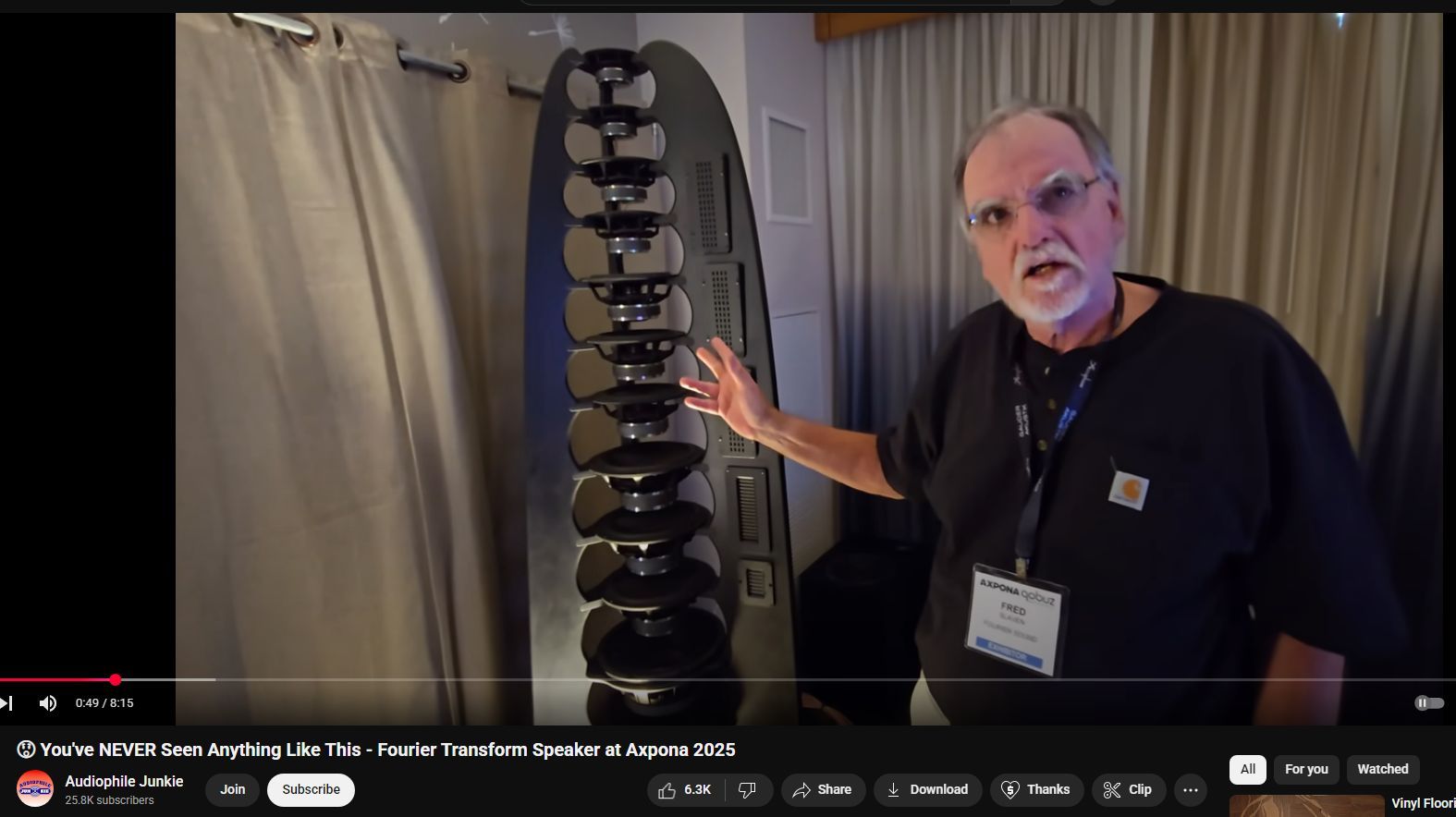
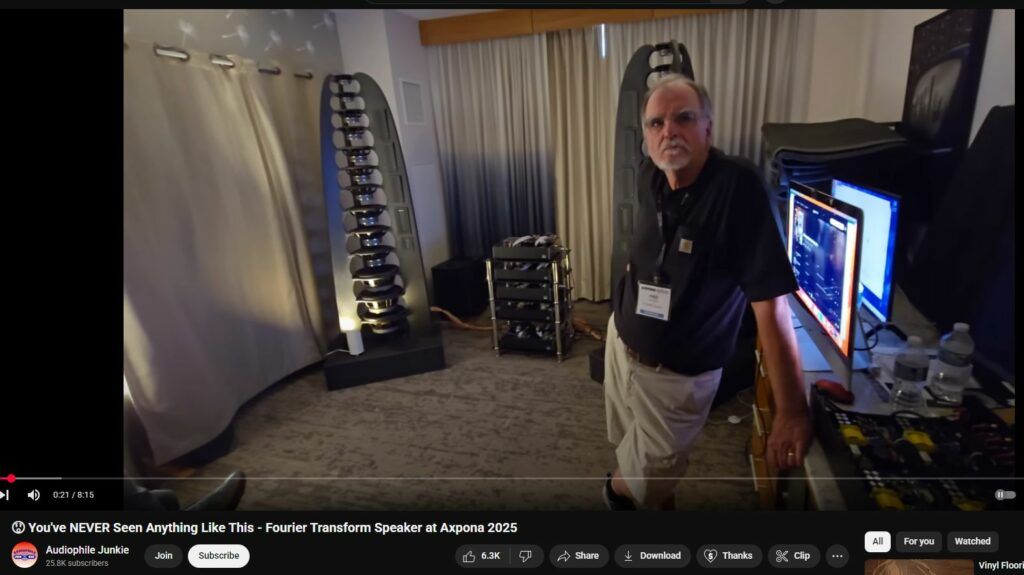
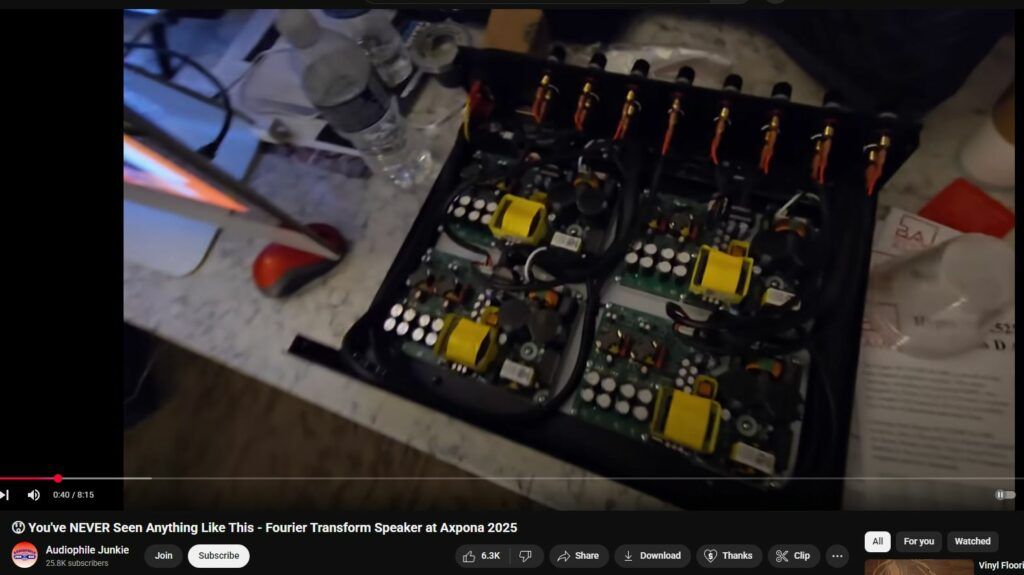
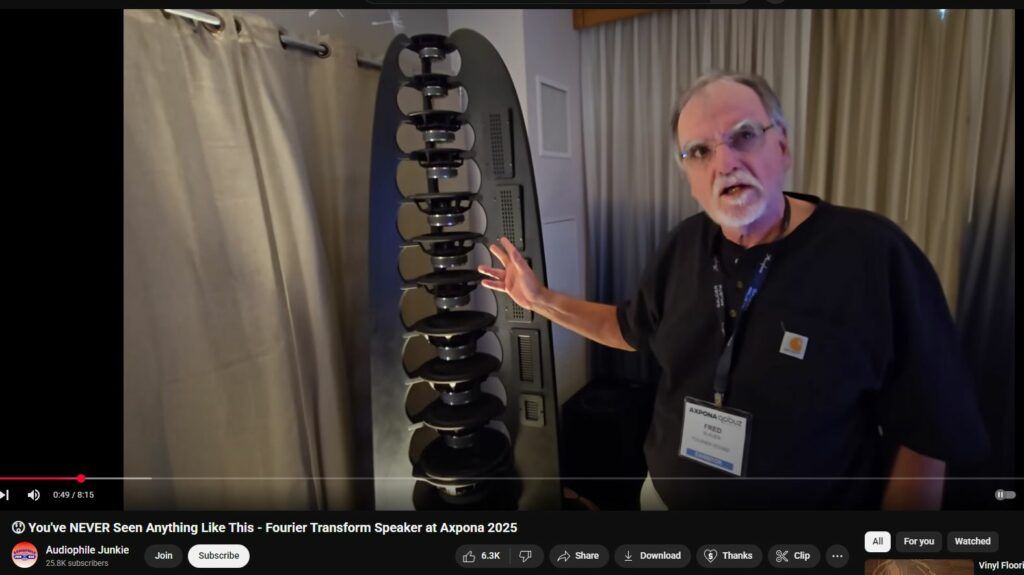
Fourer Transform Speaker – DSP and Amp per Driver
“When it reaches 88 decibels, it will take you back in time.”
This feels something like when Cardas started…the Fibonacci approach, but here applied to DSP, amps, drivers. This is Very Smart. It removes drivers’ need to also amplify more frequency-distant signals, which are often swamped / blurred by inertial momentum. “No matter how much you spend on a woofer, you’re not going to defeat the laws of physics.” 4:00 in
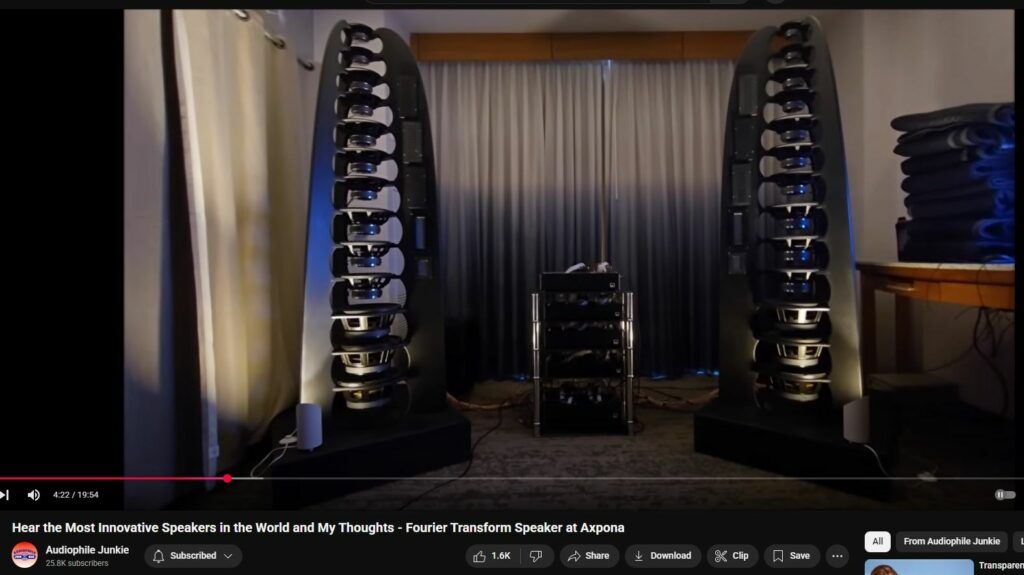
Each driver is reproducing a small portion of the harmonic sequence, of the frequency spectrum. It’s not a 2-way or 3-way or 4-way or 5-way, but instead a 20-way speaker.
I like this guy, and i like his spirit and energy. I get it also, you decompose a time domain signal into the frequency domain and bin it into 20 frequency divisions and then drive each speaker with a sine wave with that associated bins amplitude. You may need to run a sliding window at 44khz in order to get high fidelity output, in which case the amplitude is also varying every 1/44khz second. And well, varying the amplitude of any fundamental wave that fast is… what a single speaker already does. So the resulting sound will actually be summation of 20 bandpass filters (but spatially distributed in height). This how MP3 compression works btw, but it uses 20,000 bins. I’m not sure it’s audiophile but I would sure love to hear it!
The main problem is that the drivers are not co-located, so phases are still messy. The drivers location in space can be accounted for by DSP, but only for a single (fixed) listener position. It would be interesting to track the position of the (single) listener and change the phases accordingly and in real time. Alternatively, the drivers should be placed on a spherical surface centered on the listener
As an Electrical Engineer I’ve done many Fourier transforms on paper. This is very unique to see an implementation in physical form. Very innovative and creative approach.
This is the way. Different drivers for different sections of the frequency spectrum. I’ve been saying it for a while. Glad someone got around to putting it into practice and I can’t wait until it catches on.
Looking forward to seeing more of this; multi-channel DSP is a direction I have interest in. And they look great, too. Thank you!
No doubt ! a real boon, soon, for “driver rolling”
I can’t see that it would improve “phase response” in a meaningful way, esp. if you consider the size of it. What it actually might do is dealing better with the speaker non linearities, with distortion, which, of course also has some effect on the phase response. But this makes the most sense for low frequencies below a few 100 Hz, so having one sub-woofer for that possibly doesn’t make sense. Maybe a similar thing could also be achieved by having a 20-way classic frequency band split speaker? Could just be solving a meaningless or invented problem, esp. when you show people time domain waveforms to praise it, which are next to meaningless for human perception, the ear is a lot of resonators triggering nerves, basically a spectrum analyzer, but you can feel cool spending a lot of money for it.
He’s discovered the principle of the mitigation of transient intermodulation distortion — I want to see this IRL and discuss the principles with him. I was intimately involved in the development and launch of several of the best selling (if not highly regarded) studio monitors for several of the leading manufacturers. I see a group of folded ribbons for the higher frequencies? I could imagine that, with a clever waveguide and / or electrostatic wave diffusion control, you could really bend the laws of physics pretty hard. A very clever approach, I would definitely like to hear it.
It might need One point Twenty-One Jiggawatts
The build is quite cool, however i think you should incorporate the golden ratio in the driver placement. Similar to the design of the Buddhist Pagodas. It should improve the sound quality.
“The most important thing: Because each driver is only reproducing sine waves, they [all] stay in-phase with the original signal [and each other].” 3:45 in
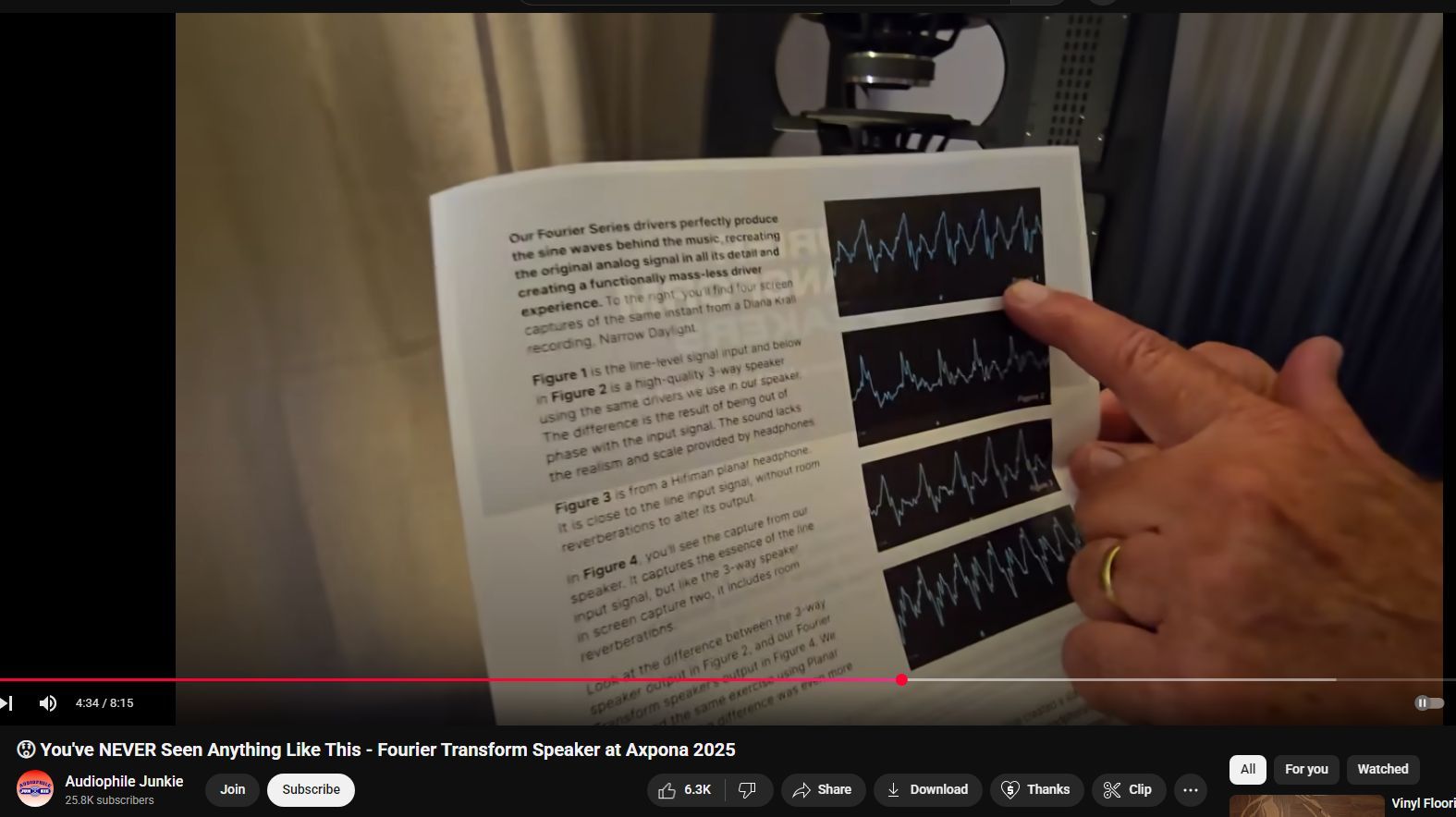
Osci 1 is the original signal
Osci 2 is high-end 3-way speaker — note distortions galore.
Osci 3 is high-end headphones, “looks a lot more like the original signal”
Osci 4 is this speaker – quite accurate, plus room resonances.
“You can tell it’s good because on a phone, it sounds like a song playing from a phone, not like a recording of a song playing from speakers playing from a phone.”
Great, so all of a sudden — ceiling materials and construction matter. The kind of paint, the color of course! The application method of said paint. The kind of drywall compound; those pesky nails or screws (and is that steel or stainless 808 or 316)……you have single-handedly opened up another infinitude of musically-impactful situational affect. High-end Drywall … a whole new market.
I purposely suppress the 150 hz to 250hz range to reduce room resonance at those frequencies in rooms about that size. But as Jason said, these issues are easily solved with DSP. One last note: Absolute Sound not only gave us the award for most innovative speaker at Axpona but best midrange and treble at show.