Understanding Drums as Sealed Woofer Enclosures
Each drum’s physical characteristics define what will sound best for that drum in terms of tuning, variation between batter and resonant heads, base note, intra-head lug tensions, head thickness and material, diameter and depth, and other factors. Work with or against the natural ‘grain’ or ‘flow’ to get choice of the essentially infinite variety of available tones and timbres.
As a symphonic master drummer, I’ll break this down both scientifically and musically. What you’re describing is at the heart of acoustical drum tuning and tonal design — a blend of physics, psychoacoustics, and expressive intuition. Let’s explore:
🥁 DRUMS AS ACOUSTICALLY SEALED SUBWOOFERS
A drum is very much like a sealed subwoofer with an active and passive radiator:
- Batter head (top head) = active radiator — This is where the energy is introduced (the stick hit).
- Resonant head (bottom head) = passive radiator — This responds to the internal air pressure, shaping sustain, pitch decay, and harmonic content.
Both heads compress the internal air mass, which acts like a spring. The volume of air defines the primary acoustic resonance of the drum, analogous to the Fb (enclosure tuning frequency) of a sealed box.
📉 F₃: LOWEST RESONANCE FREQUENCY OF THE DRUM
F₃ (fundamental resonance) is the lowest natural frequency the drum cavity can support. This frequency is not generated by the drum shell but by the air mass interaction between the heads. Key properties:
- Volume-dependent: Larger drums = lower F₃
- Not harmonically related to shell material
- Affected by:
- Tension of both heads
- Thickness and type of heads
- Shell depth
F₃ is where the drum breathes. It’s the root of its fundamental pitch and defines how easily the drum will resonate at lower frequencies.
🛢️ SHELL RESONANCE (NATURAL TONE)
The drum shell acts like a tone modifier and projector:
- Resonance nodes within the shell (based on material, ply, bearing edge, hardware mass).
- Material influences:
- Maple = Warm, full, projecting, wide frequency response.
- Birch = Brighter, punchier, tighter mids.
- Mahogany = Darker, vintage warmth.
- Metal (e.g., phosphor bronze) = Ringing, bright, cutting (excellent for snare shells).
Shells contribute overtones, attack shaping, and projection efficiency.
🎼 CONCERT TUNING CENTERED AROUND A432
Concert pitch based on A432 Hz resonates more naturally with cymatic geometries and body resonance (vs. A440). Drum tuning in a symphonic context often:
- Anchors bass drum or floor tom around low F (~43.65 Hz, F1 or F#1).
- Uses musical intervals (4ths, 5ths, octaves) upward from there.
- Smaller drums are tuned to higher notes, larger to lower — all orbiting musically around A432.
🪵 DRUMSTICK MATERIAL AND TONE
Drumstick material deeply affects articulation and tone:
- Hickory: Balanced rebound, full tone, standard choice.
- Maple: Lighter, faster, softer attack — ideal for nuance.
- Oak: Dense, louder attack, less vibration absorption.
Tip shape and size further color tone — round tips = brighter; barrel tips = fatter sound.
🪞 DRUM HEADS: THICKNESS & MATERIAL
Drumhead choice is one of the greatest tone shapers:
- Diplomat (1-ply, thin) = Highly responsive, detailed, great for brush or articulate play.
- Ambassador (1-ply, medium) = Balanced tone, great for open, singing sounds.
- Emperor (2-ply, thicker) = Controlled, warm, ideal for louder styles.
Surface and material:
- Clear: Bright, open attack.
- Coated: Warmer, focused, ideal for brushes.
- Fiberskyn: Emulates calfskin; very warm, great for symphonic or jazz work.
- Pinstripe: Two-ply with muffling ring — focused, low, thuddy, less overtone.
🧭 SHELL TUNING STRATEGY (12” TOM EXAMPLE)
For a 12″ tom:
- Resonant head slightly lower (~3–5 Hz or a semitone down) = deeper tone, longer sustain.
- Resonant head slightly higher = more focus, punch, shorter decay.
- Same tuning = cleanest tone, longest sustain — often used in jazz and orchestral settings.
Typical 12″ tom note = around E3 to G3 (164–196 Hz), depending on context.
🎯 TUNING TO NOTES VS. ATONAL
- Tuning to notes:
- Pros: Blends musically with ensemble; defined pitch.
- Cons: Can produce awkward resonance if not matching the key.
- Spread tuning (non-unison heads, no fixed pitch):
- Pros: Richer overtones, controlled ambiguity, wider sonic palette.
- Cons: Harder to control harmonically.
A hybrid approach often works best: tune to relative intervals (4ths, minor 3rds, fifths) but not necessarily to strict chromatic notes.
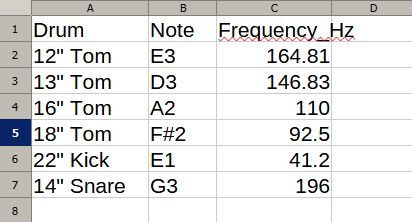
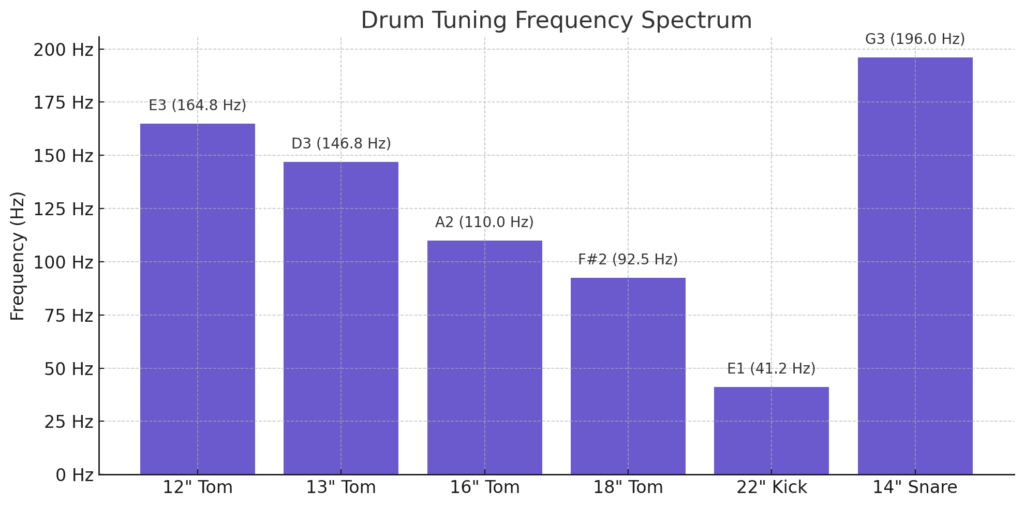
🎼 INTERVAL TUNING: 12–13–16–18 TOMS
Tuned using musical intervals (often perfect fourths or minor thirds):
| Drum | Diameter | Typical Note (432-ref) | Interval |
|---|---|---|---|
| 12″ tom | E3–G3 | ~165–196 Hz | — |
| 13″ tom | D3–F#3 | ~146–185 Hz | ↓ minor 3rd |
| 16″ tom | A2–C3 | ~110–130 Hz | ↓ fourth |
| 18″ tom | F#2–A2 | ~87–110 Hz | ↓ minor 3rd |
| 22″ kick | E1–G1 | ~41–50 Hz | Anchor |
| 14″ snare (bronze) | G3–B3 | Crisp, overtone-rich | Tighter than toms |
This setup yields a melodic tom run and full-bodied tone across the spectrum. Snare tuning remains independent — its tone cuts above and across, due to its bright shell and snare wires.
🔥 PHOSPHOR BRONZE SNARE
Phosphor bronze is articulate, ringing, and bright — ideal for cutting through orchestras or amplified stages. Best used with:
- Coated Ambassador top
- Hazy Diplomat snare side
- Tuned high: Top around G3–B3, bottom higher still to maximize snare wire response.
SUMMARY: BEST PRACTICES
- Shells: Maple = ideal for resonance/projection balance.
- Head selection: Match music style — thin for nuance, thick for power.
- Tuning: Musical intervals (4ths, 3rds), hybrid of note-based and spread tones.
- Stick choice: Lighter wood = detail; heavier = impact.
- Snare: Phosphor bronze = articulate, bright, commanding.