Shure SM57 Beta
Beyerdynamic M201
Audio Technica AE2300
Neuman KM184
Audix 15
AKG C414
Sennheiser MD421
Shure SM57
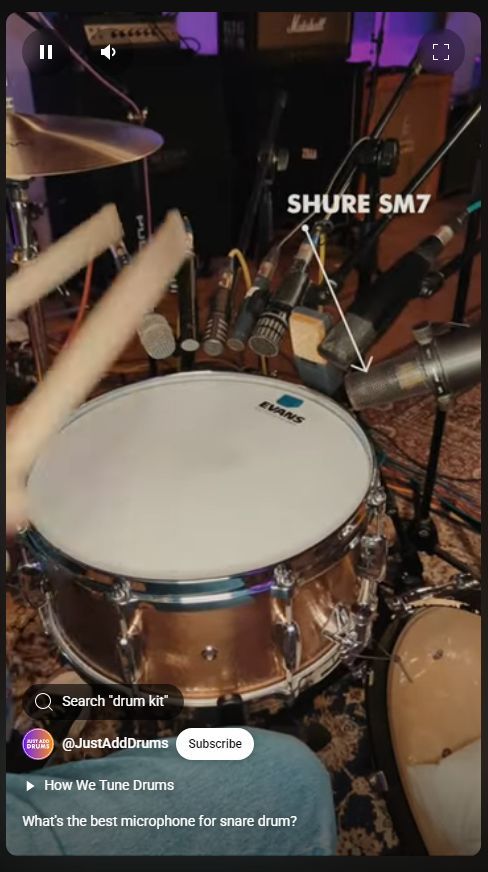
Microphone Overview & Snare Drum Applications
1. Shure SM57 / Beta (SM57)
- History & Specs
Launched in 1965, the SM57 is a rugged cardioid dynamic mic featuring the Unidyne III capsule—a design evolution from the 1959 Unidyne. It’s been a best-seller and consistently used for live and studio applications, even by U.S. presidents for speeches.(Wikipedia) - Use on Snare Drum
A classic for snare top miking—capturing tight attack and midrange “pop.” SAE recommends it for multiple kit components: snare, toms, and even kick.(Wikipedia, Sweetwater)
2. Beyerdynamic M201
- History & Design
A small-diaphragm dynamic with hypercardioid pattern, smaller and more detailed than the 57.(UAD, Apollo, and LUNA Forums, Sound on Sound) - Snare Use
Offers clearer presence and nuance—excellent for detailed snare sound though may lack low-end “thump.” Many regard it as an alternative to the 57.(Reddit, Rig-Talk, Gearspace)
“The Beyerdynamic M201: Very detailed presence and natural top end.”(Reddit)
3. Audio-Technica AE2300
- History & Design
A Japanese-made dynamic instrument mic with double-dome diaphragm for improved transient response, compact and sturdy.(Audio Media International, Amazon) - Snare Use
Praised for transient clarity and off-axis response, producing fat, punchy tone even from above the snare.(Gearspace, Sweetwater)
4. Neumann KM 184
- History & Specs
Small-diaphragm cardioid condenser, successor to KM 84 from the 1960s. Released in the mid-1980s with transformerless design.(SOUNDREF) - Snare Use
Less common close on snare; more often used as overheads for natural brightness and excellent transient capture.(SOUNDREF, DRUM! Magazine)
5. AKG C414
- History
Introduced in 1971, derived from the C12A. Evolving through multiple models (C414EB, B-ULS, etc.), offering selectable patterns, pads, and filters.(Wikipedia) - Snare Use
Extremely versatile; often used for overheads and room miking on drums. Less typical for close snare miking.
6. Sennheiser MD 421
- History & Specs
Debuted in 1960, a large-diaphragm dynamic mic with smooth response and built-in high-pass filter. Over 500,000 sold.(Wikipedia) - Snare Use
Broad frequency capture with clarity—great for toms and snares when a fuller, powerful sound is desired. Engineer Brian Tarquin called it “an SM57 on steroids.”(Wikipedia)
7. Audix (assuming Audix D6 or Audix i5?—Audix 15 unclear)
- Note: “Audix 15” isn’t a recognized model. Audix’s snare-relevant models include the i5 (dynamic) or D6 (kick). Without a clear model, details are limited.
Quick Comparison Table
| Microphone | Type / Pattern | Tone Characteristics on Snare | Ideal Use Case |
|---|---|---|---|
| Shure SM57 | Dynamic / Cardioid | Focused, punchy attack, mid-forward | Go-to for snare top, live & studio |
| Beyerdynamic M201 | Dynamic / Hypercardioid | Clear presence, nuanced high-end, less thump | Detailed snare tone, alternative to 57 |
| Audio-Technica AE2300 | Dynamic | Fat, punchy, great off-axis handling | Stage and snare top close miking |
| Neumann KM 184 | Condenser / Cardioid | Natural brightness, captures detail | Overheads, ambience, overhead snare |
| AKG C414 | Condenser / Multi | Neutral to bright depending on settings | Overheads, hi-hat, room mics |
| Sennheiser MD 421 | Dynamic / Cardioid | Full-bodied, robust, smooth high-mid | Toms, snare, full-bodied drum capture |
Tips for Snare Drum Miking
- Close Miking (Top): Shure SM57 & AE2300 give that characteristic snap; SM57 is rugged and cheap, AE2300 offers nuanced clarity.
- Alternate Tone (Presence Focus): M201 shines on high frequencies; use if more bead or detail is needed.
- Thicker Tone (Fuller Sound): MD 421 adds body and works well if you want weight.
- Overheads or Accent Miking: KM 184 or AKG C414 yield clean, clear overhead textures—KM 184 for shimmering detail, C414 for flexibility in pattern and filtering.
- Blending Strategy: A common technique is combining a close dynamic mic (for attack) with a condenser overhead for air—KM 184 or C414 excels here.
Here’s a deeper dive into the frequency response of each microphone, along with how those characteristics shape their use in snare drum recording:
Frequency Response Details & Snare Use
Shure SM57 (including Beta)
- Frequency Response: 40 Hz – 15 kHz, with a slight bass peak around 200 Hz, a dip between 300–600 Hz, a presence boost in the 3–6 kHz region, and roll-off beyond 9 kHz (SOUNDREF, Wikipedia).
- Snare Application: This curve makes the SM57 excellent for capturing the “snap” of the snare—agile mid-high attack with minimized mud and rumble.
Beyerdynamic M 201
- Frequency Response: 40 Hz – 18 kHz (Recording Hacks, Sam Ash, Front End Audio). On-axis response is neutral 150 Hz–1 kHz, with a gentle boost around 2–5 kHz (
+2 dB), peaking around 10–13 kHz (+4 dB) (Micpedia). - Snare Application: Enhanced clarity and brightness yield exceptional detail and attack—ideal when you want a more articulate, crispy snare sound.
Audio-Technica AE2300
- Frequency Response: Ranges from 60 Hz – 20 kHz (Front End Audio), though some sources specify 30 Hz – 12 kHz (possibly for related models) (Sound on Sound).
- Snare Application: Broad, clean range plus a dual-dome design supports sharp transient capture and tight off-axis control—great for capturing punch and detail in live and studio snare use.
Neumann KM 184
- Frequency Response: Smooth and linear from 20 Hz – 20 kHz, with a subtle treble enhancement around 9 kHz for added brilliance (revolution.pt, neumann.com, Vintage King).
- Snare Application: Not typically used close-up on snare, but excellent as overhead mics—delivers crispness, spacious imagery, and natural detail that complements a close dynamic mic.
AKG C414 (e.g., XLS / XL II)
- Frequency Response: 20 Hz – 20 kHz, remarkably flat across major patterns (±2 dB), with a slight dip at 1–2 kHz and gentle boost between 10–18 kHz (coutant.org, SOUNDREF, Sweetwater).
- Snare Application: Though more of an overhead or room mic, its flat and extended response captures cymbal shimmer and snare overtones clearly, especially when used in multi-mic setups.
Sennheiser MD 421 (II)
- Frequency Response: 30 Hz – 17 kHz (Sennheiser, Wikipedia).
- Variant Specifics: The MD 421 Kompakt introduces a noticeable midrange push: low roll-off (-8 dB at 40 Hz), then mid boost (+4 dB at 2.75 kHz), large presence bump (+8 dB at 4–5 kHz), and a 4.5 dB shelf from 8–12 kHz (recordingmag.com).
- Snare Application: Its pronounced mid and presence response make MD 421 great for a thick, aggressive, and powerful snare tone—especially favored for heavier styles.
Summary Table
| Microphone | Frequency Response Highlights | Snare Sound Character |
|---|---|---|
| Shure SM57 | 40 Hz–15 kHz; 200 Hz peak, 3–6 kHz presence boost | Classic punch & snap, well-rounded |
| M 201 | 40 Hz–18 kHz; airy 10–13 kHz lift | Bright, detailed, articulate |
| AE2300 | 60 Hz–20 kHz (or 30 Hz–12 kHz) | Clear, accurate transient capture |
| KM 184 | 20 Hz–20 kHz; slight 9 kHz lift | Airy, natural overhead imaging |
| AKG C414 | 20 Hz–20 kHz; flat + high-end clarity | Clean, defined overhead/snare blend |
| Sennheiser MD 421 | 30 Hz–17 kHz; strong mid/upper-mid presence (Kompakt) | Thick, aggressive mid-focused snare tone |
Practical Application Strategy
- Close Miking
- Want snap and midrange punch? → Shure SM57
- Craving brightness and detail? → M 201 or AE2300
- Desire a thick, powerful tone? → MD 421 (esp. Kompakt)
- Overheads or Accent Miking
- Natural, open sound with a touch of sheen? → Neumann KM 184
- Highly versatile with selectable polar patterns and warmth? → AKG C414
- Combining Mics (Hybrid Approach)
- e.g., SM57 close, KM 184 overhead → crisp attack with shimmering air
- e.g., M 201 close, C414 wide cardioid → bright detail plus tonal depth