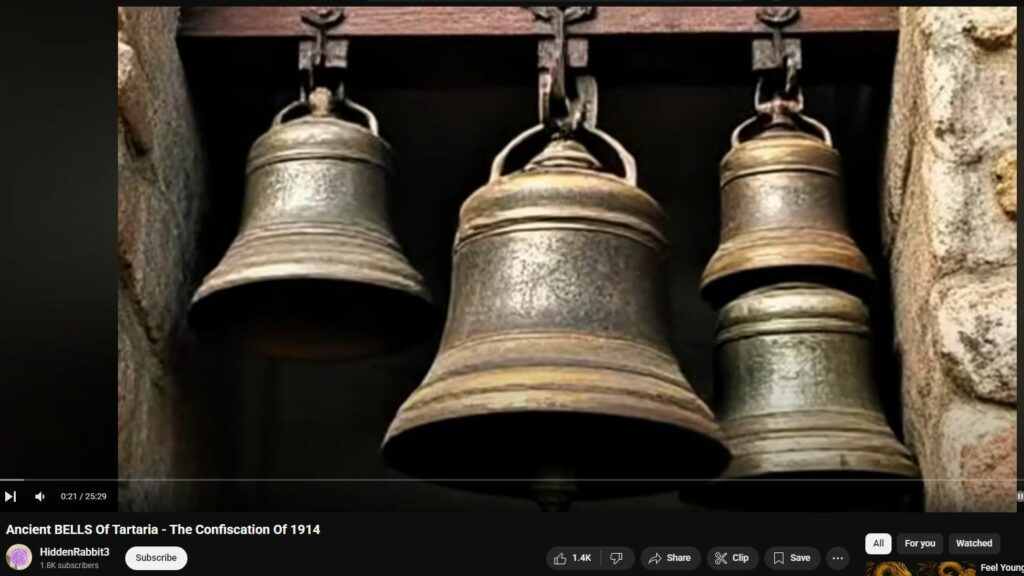
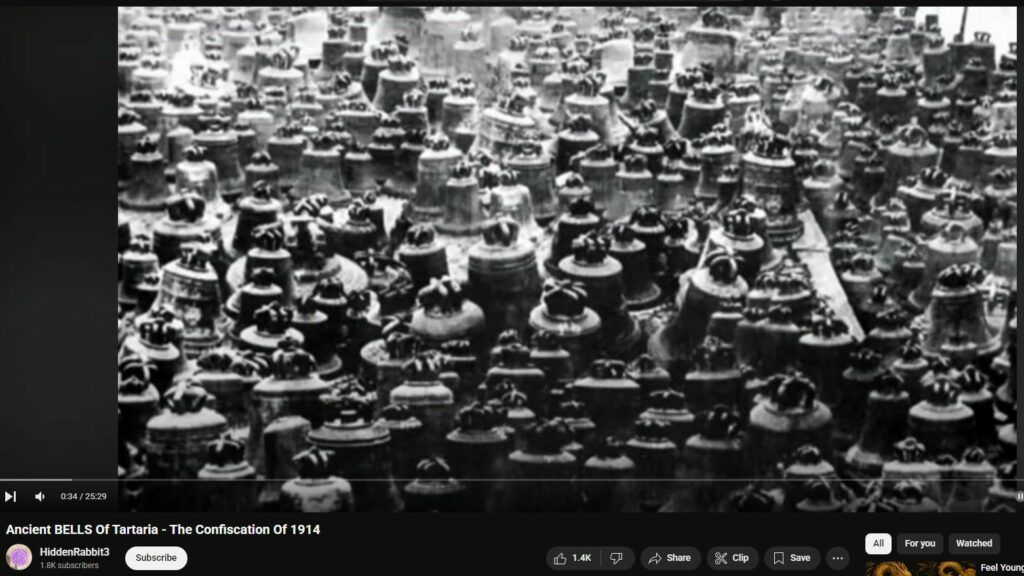
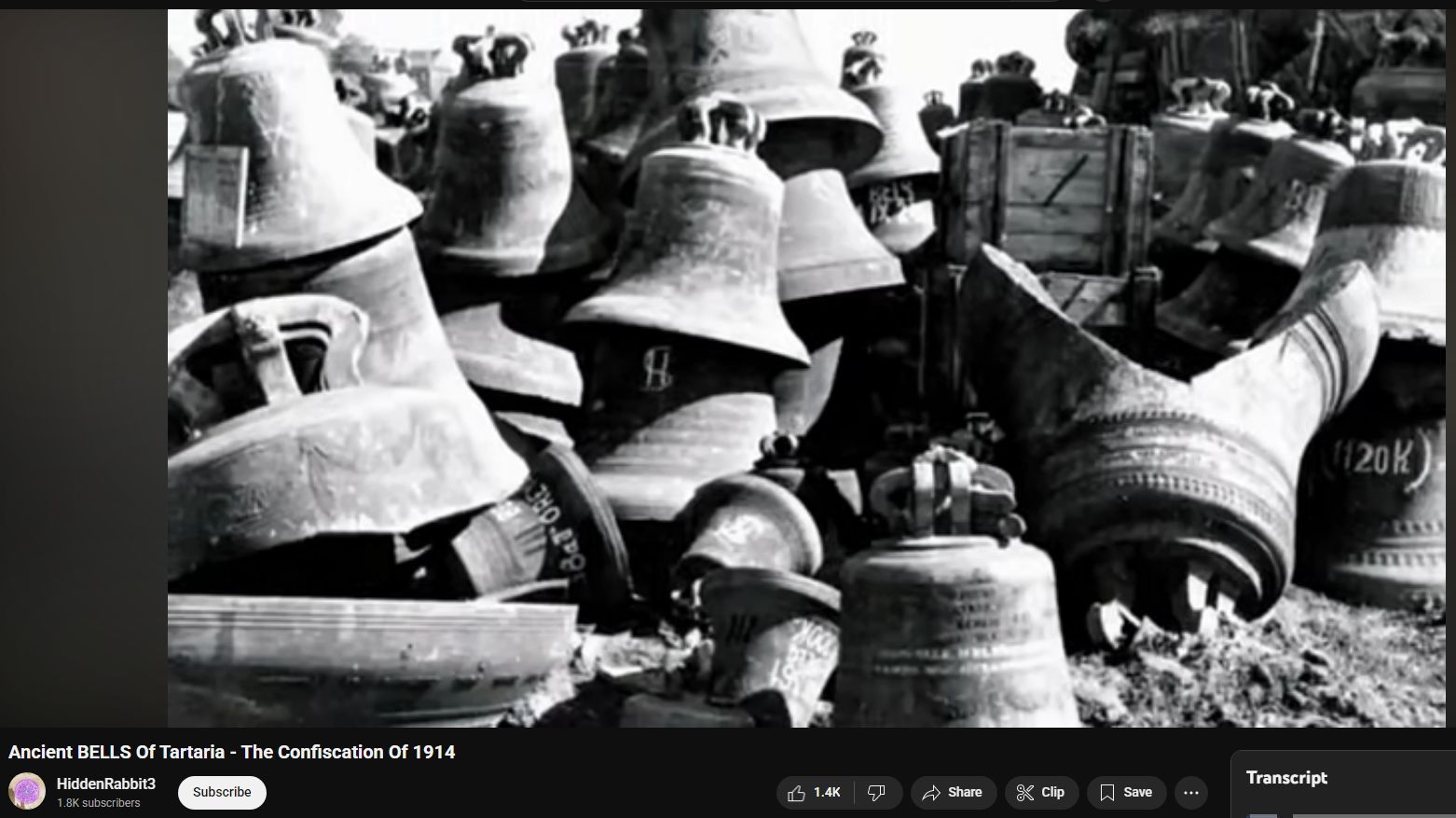
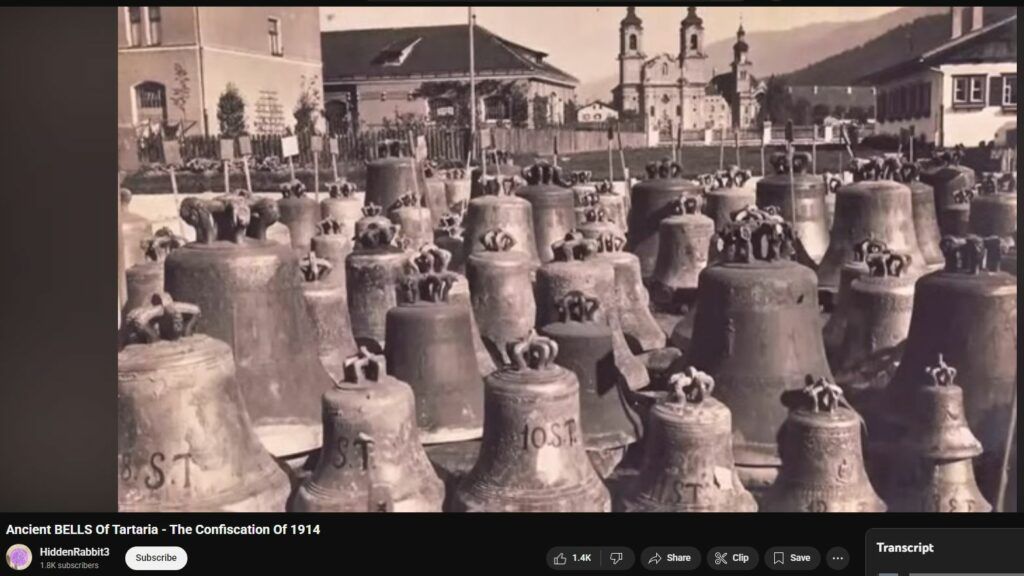
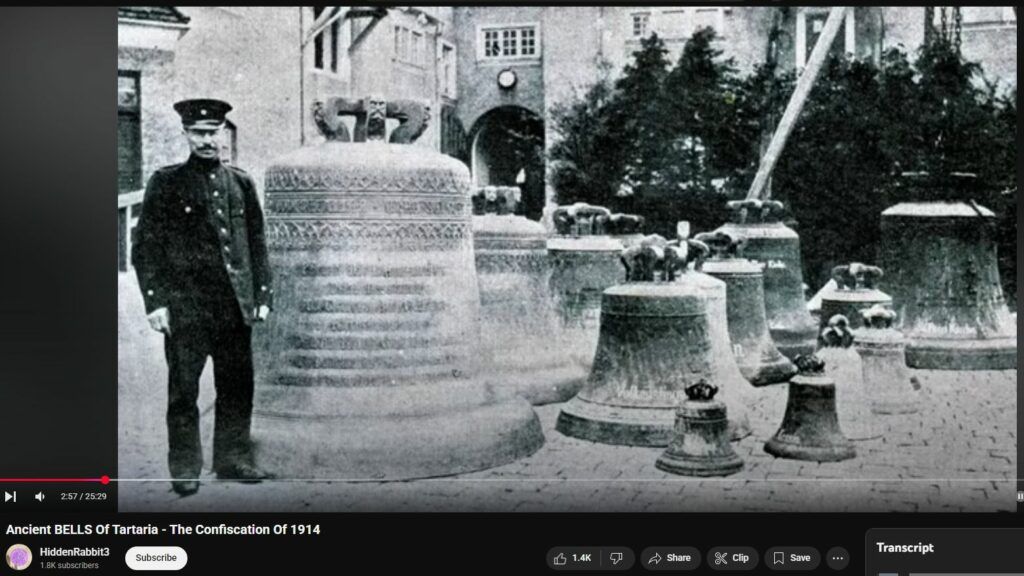
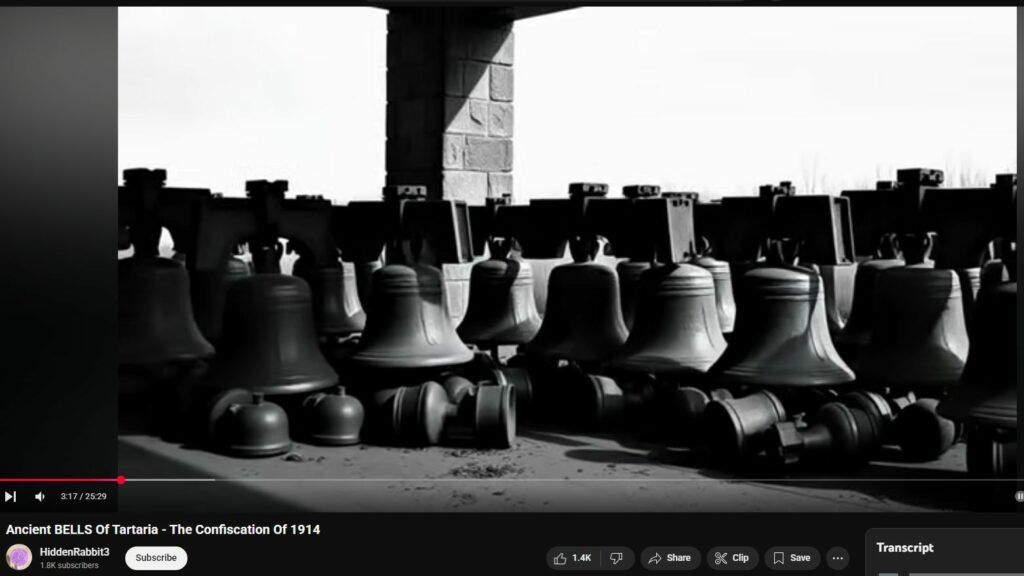
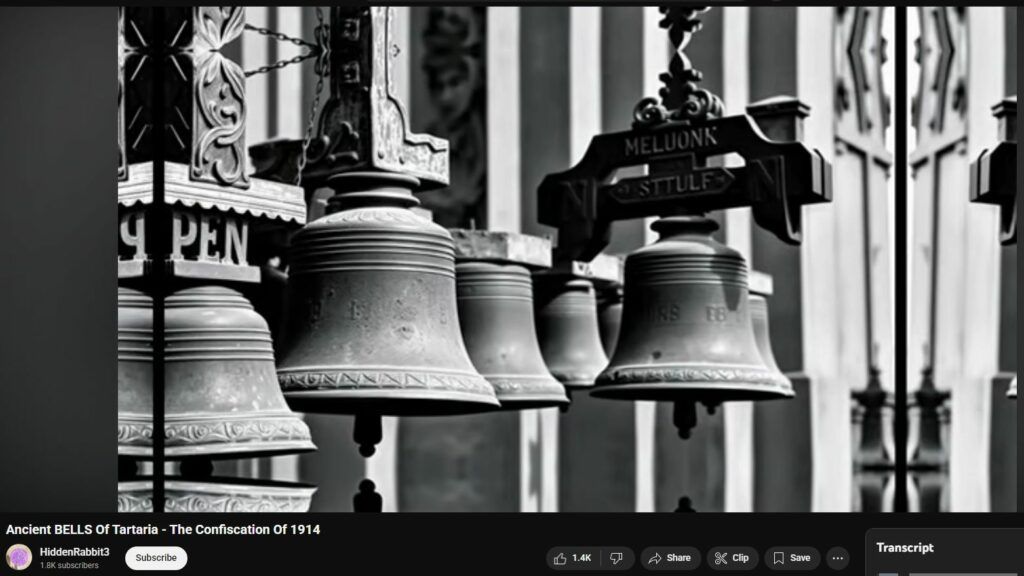
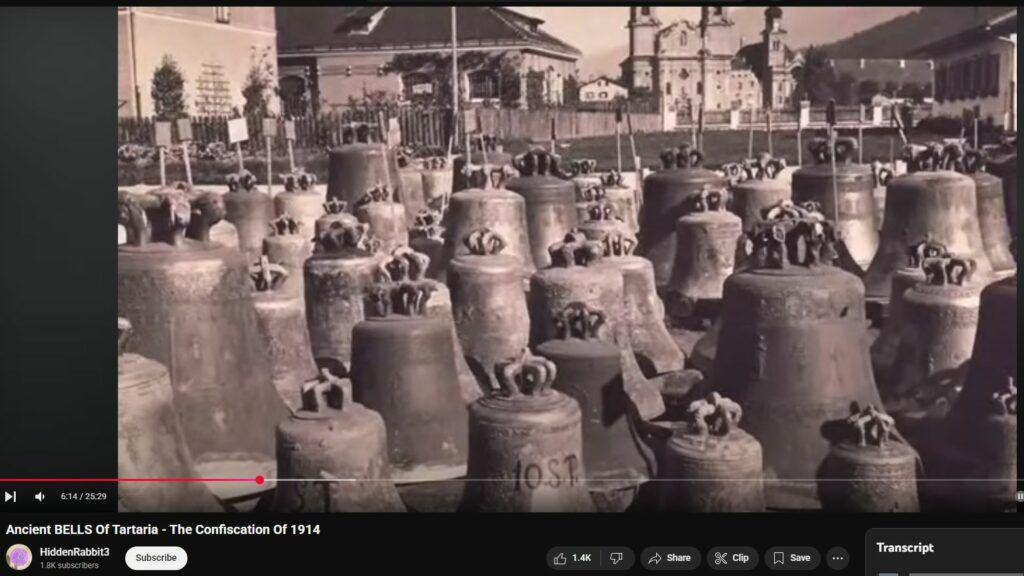
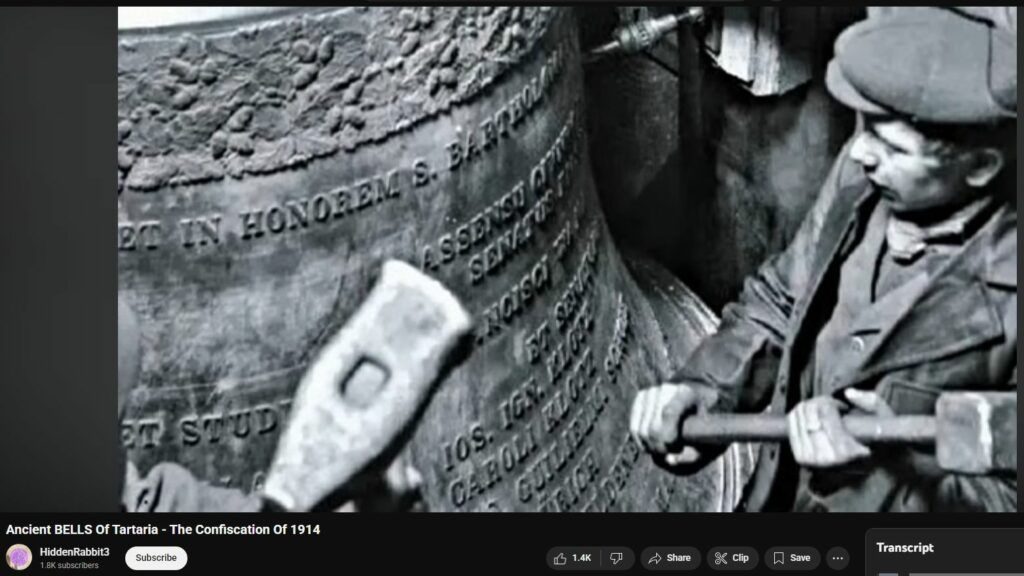
This project began with a strange discovery — the story of the Bells of Tartaria. Between 1914 and 1948, countless church bells across Europe and Asia were reportedly gathered, transported, and melted down to supply metal for the allies efforts. But what fascinated me was the mystery surrounding how and why certain bells — many said to date back centuries — disappeared without trace, their origins unclear and their craftsmanship unmatched. As I researched, I began to see a deeper pattern: the quiet erasure of history through industry, the transformation of sacred sound into machinery of pain and infliction. This documentary is my attempt to explore that lost resonance — and to ask what else might have been silenced when those bells stopped ringing.
Transcript
Click to reveal
Episode 1: War in the Bells, the
0:03
official story. The year was 1914.
0:07
Europe had plunged into a conflict that
0:09
would consume millions, redraw borders,
0:12
and reshape history. In the midst of
0:14
this chaos, an often overlooked object
0:17
became the focus of national urgency.
0:20
The church bell. Bronze, heavy,
0:23
resonant, and essential to communities.
0:25
For centuries, bells were suddenly a
0:28
commodity. Governments across Europe
0:30
decreed that all bells must be
0:32
collected, melted down, and recast into
0:36
munitions. The official explanation was
0:38
straightforward. Metal was needed for
0:40
cannons, shells, and war machines.
0:44
Communities were asked to sacrifice
0:46
their bells for the patriotic duty of
0:48
metal contribution. Historical records
0:51
confirm this. From France to Germany,
0:54
Italy to Austria Hungary, bells were
0:57
requisitioned under strict orders.
1:00
Municipalities documented the collection
1:02
and foundaries reported the melting and
1:05
recasting. Yet, even as the official
1:07
narrative unfolded, subtle anomalies
1:10
began to appear. Indeed, photographs
1:13
survived, showing rows upon rows of
1:16
bells stacked neatly in open fields,
1:19
awaiting transport. In some instances,
1:22
bills were collected, but not
1:24
immediately melted. Reports indicate
1:26
that many of these bells never reached
1:28
foundaries at all. In some towns, the
1:31
bells simply vanished, their fates
1:34
unrecorded, leaving communities bereff
1:36
of the resonant sounds that had
1:38
structured daily life for centuries.
1:41
Official historians attribute these gaps
1:43
to wartime chaos, logistical errors, and
1:46
bureaucratic inefficiency. It was a time
1:49
of total war after all, and paperwork
1:52
often did not survive the conflict. Yet,
1:56
the patterns are curious. Why were
1:59
certain regions stripped entirely of
2:01
bells only to have no replacement after
2:04
hostilities cease? Why were records of
2:07
shipment, melting, or recasting
2:09
incomplete or inconsistent? In areas
2:12
where metal collection was particularly
2:14
aggressive, entire inventories
2:17
disappeared, sometimes hundreds of bells
2:20
at a time, and there is no evidence that
2:22
they were repurposed as munitions.
2:25
This raises questions that traditional
2:28
history struggles to answer. Could
2:30
something else have been going on behind
2:32
the scenes? Some historians note that
2:35
the removal of bells profoundly
2:38
disrupted social life. Bells were more
2:41
than timekeepers. They signaled daily
2:44
routines, summoned communities for work,
2:47
and marked spiritual observances. Their
2:50
absence created a kind Their absence
2:52
created a kind of sonic vacuum, a
2:55
disruption that while subtle, altered
2:58
communal rhythms and social cohesion.
3:02
Communities reported that the absence of
3:04
bells left the town feeling off-kilter,
3:07
as if an unseen layer of protection had
3:10
been removed. By the end of World War I,
3:13
the official story had taken root. The
3:15
bells were melted for the war effort,
3:18
and any anomalies could be chocked up to
3:20
wartime confusion.
3:22
But for those willing to look closer, a
3:25
question remained. Why after the war
3:28
were these communities not provided with
3:30
replacements while other cultural
3:32
athletes were returned or rebuilt?
3:36
This small but persistent mystery would
3:38
become a central thread in the tale of
3:41
the ancient bells of Tartarin. Episode
3:44
two, anomalies in the records.
3:48
The postwar world saw Europe in ruins,
3:52
governments scrambling to rebuild and
3:55
populations mourning loss. Amid the
3:59
devastation, historians began to notice
4:02
a pattern in the record books. A pattern
4:05
that suggested a much more deliberate
4:08
and coordinated removal of bells than
4:11
the official story allowed. Field
4:13
reports, museum archives, and foundry
4:16
records indicate that large clusters of
4:19
bells were systematically collected,
4:23
then stored in central locations, often
4:26
in open fields, awaiting disposal.
4:30
Some of these bells were eventually
4:32
shipped for melting, but many
4:34
disappeared entirely. Eyewitness
4:36
accounts from the 1920s and 1930s
4:40
describe towns where entire inventories
4:42
of bells have been removed, leaving the
4:45
community silent.
4:47
Villages remembered the enormous effort
4:50
required to transport the bells, noting
4:52
that dozens of men and horses were
4:55
employed simply to move them into
4:57
storage. In several instances, these
5:00
storage fields were photographed or
5:02
sketched, showing lines of bells
5:04
stretching for hundreds of meters.
5:07
Remarkably, many of these storage fields
5:10
never led to foundaries, and the bells
5:13
themselves never appeared in munitions
5:15
records. The inconsistencies are
5:18
striking. Why would authorities go to
5:21
the trouble of moving massive bells
5:23
across hundreds of kilometers only to
5:25
let them languish in fields unmolten and
5:28
unaccounted for? And why did communities
5:31
that had lost their bells during the war
5:34
not see replacements after the conflict
5:36
ended? Some scholars argue that
5:38
logistical limitations and economic
5:40
constraints explain part of this
5:43
discrepancy. It is true that Europe was
5:46
struggling to rebuild and that
5:48
foundaries were overwhelmed with demands
5:50
for industrial and military metal. Yet
5:53
the systematic nature of the removals
5:56
combined with the failure to replace
5:58
them suggests a deeper motive, one that
6:01
goes beyond simple war necessity.
6:04
Alternative historians point to the
6:06
possibility of a hidden agenda, a
6:09
deliberate silencing of those, a removal
6:12
of an acoustic technology that serves
6:15
societal and possibly even biological
6:18
function. Records show that in some
6:20
regions bells have been aligned in
6:22
fields according to precise geographic
6:24
coordinates almost as if part of the
6:27
coordinates at level. The purpose of
6:30
this alignment is speculative, but
6:33
proponents suggest that the bells have
6:35
been more than symbolic or ritual
6:37
objects and were instruments of
6:40
environmental and social regulation.
6:43
Their frequencies interacting with
6:45
modern systems in ways that communities
6:47
had long recognized. This raises a
6:50
question that may history was largely
6:52
ignored. Could the removal of these
6:55
buildings for intentional act designed
6:58
to rekindle communities disrupt
7:00
traditional practices and arrests an
7:03
older technological knowledge? While
7:06
documentation was sparse and repeated
7:09
the non-reasoning bell movement, storage
7:12
and disappearance are too consistent to
7:15
be dismissed in time.
7:17
Episode 3, the lost civilization of
7:21
Tartaria.
7:22
To understand the full significance of
7:25
these bells,
7:27
it is necessary to turn back the clock
7:30
several centuries to a civilization
7:34
whose story is largely obscured.
7:38
Tartaria. According to architectural
7:41
records, travelers accounts, and
7:44
speculative histories,
7:46
Tartaria was a region known for
7:49
monumental structures, complex urban
7:52
planning, and most intriguingly,
7:56
its bells.
7:58
These bells were not simply decorative.
8:02
They were considered instruments of
8:04
protection and harmonization.
8:07
In Tartarian tradition, the ringing of
8:09
bells produced resonances that were
8:12
believed to cleanse spaces, harmonize
8:15
environments, and ward off disease and
8:18
negative influences.
8:21
Villagers in Tartaria reportedly
8:24
experienced fewer epidemics in areas
8:27
where bells were rung regularly, and
8:30
there were accounts of pests and harmful
8:32
insects avoiding bell told zones.
8:37
The logic, though speculative, align
8:40
with contemporary understandings of
8:43
sound. Vibrations can influence
8:46
biological systems from cellular
8:49
processes to bacterial growth patterns.
8:53
Bells were carefully tuned, often in
8:56
series, to create specific frequencies.
9:00
Large bell fields were common, placed
9:03
strategically across towns, valleys, and
9:06
ridgeel lines. The arrangement was
9:09
intended to create overlapping acoustic
9:11
fields, generating an ambient resonance
9:15
that proponents claim could influence
9:17
both health and spiritual well-being.
9:20
Scholars of folklore note that
9:22
communities perceive these bells as
9:24
protective,
9:26
referring to them as the voice of the
9:29
land or guardian tones.
9:33
The significance of these bells in
9:35
Tartaria cannot be overstated.
9:38
They were central to civic life, marking
9:41
not only hours and rituals, but also
9:44
creating a sonic architecture that
9:46
structured daily activity. Their loss,
9:49
therefore, would have represented more
9:52
than a cultural or aesthetic
9:53
deprivation.
9:55
It would have disrupted a system of
9:57
social and environmental regulation that
9:59
had evolved over centuries.
10:02
Episode 4, the silent conspiracy. As the
10:07
world entered the 20th century, a series
10:10
of events unfolded that would ultimately
10:13
silence the Tartarian bells.
10:16
While the official narrative credited
10:18
wartime metal requisitions, anomalies
10:21
suggest a more deliberate intervention.
10:25
Alternative historians argue that a
10:27
hidden cabal, elites with knowledge of
10:30
the bell's supposed powers orchestrated
10:33
their removal.
10:35
The motive control. By removing the
10:39
bells, these powers could weaken
10:41
communal cohesion, erase ancient
10:44
knowledge, and establish dominance over
10:46
both society and environments.
10:50
Evidence supporting this theory includes
10:53
the strategic selection of which
10:55
evidence supporting the bells were
10:57
taken, the manner of their storage, and
11:00
the lack of restitution. Post war, bells
11:04
were not randomly collected. Large,
11:07
highly resonant bells with specific
11:10
tunings were often prioritized.
11:13
In some regions, smaller, less effective
11:16
bells were left behind, suggesting an
11:19
understanding of acoustic impact.
11:22
Photographs of bellfields, lines of
11:25
bells stacked with precision, indicate
11:28
planning beyond mere logistical
11:30
convenience. Eyewitnesses,
11:33
archivists, and folklorists recount
11:36
stories of elite agents overseeing the
11:39
removal, sometimes using threats or
11:43
coercion to ensure compliance.
11:46
While hard documentation is scarce,
11:50
these operations were secretive by
11:52
nature. The consistency of anecdotal
11:56
evidence across countries supports the
11:59
notion of coordinated intent. The
12:03
removal of Tartarian bells was thus not
12:06
merely a wartime necessity.
12:09
It was a strategic silencing,
12:12
a deliberate effort to dismantle a
12:14
system of acoustic protection and social
12:18
harmony that had existed for centuries.
12:22
This silent conspiracy, if true,
12:25
reshaped communities, left gaps in
12:28
cultural knowledge, and contributed to a
12:32
world largely unaware of the power that
12:34
once existed in sound. Episode 5,
12:38
resonance and reality.
12:41
Modern science offers intriguing
12:44
parallels to these ancient practices.
12:47
Studies of sound in frequency show that
12:50
acoustic energy can affect biological
12:53
systems. From human physiology to
12:57
microbial growth in controlled
12:59
laboratory settings, certain frequencies
13:02
have been observed to inhibit bacterial
13:05
proliferation,
13:07
influence cell division, and alter
13:10
neural activity. While these experiments
13:13
do not directly replicate the
13:15
environment of a bell-lined valley, they
13:18
suggest that sound can have tangible
13:20
effects on living organisms. Bells, by
13:24
design, produce a range of harmonic
13:26
overtones, creating complex vibrational
13:29
patterns. Large bronze bells, especially
13:32
those tuned in series, generate
13:35
resonances that can travel considerable
13:37
distances. The proposition that
13:40
tartarian bells could influence local
13:42
microclimates, pest populations, or even
13:46
human health is therefore not inherently
13:49
implausible. Beyond biological impact,
13:52
the acoustic presence of bells shapes
13:55
social behavior. Communities respond to
13:57
auditory cues. Daily bell ringing
14:00
coordinates activity, signals danger,
14:03
and establishes temporal rhythms.
14:05
Removing these signals creates a form of
14:08
social disorientation. A quiet that
14:10
alters human interaction and perception.
14:13
In this sense, the disappearance of
14:15
Tartarian bells represents both a
14:18
physical and psychological shift, one
14:21
that may have facilitated broader social
14:23
control. Today, few communities
14:25
experience daily bell ringing. Bells are
14:28
largely ceremonial, tolling for
14:30
weddings, funerals, or religious
14:32
observances. The once ubiquitous
14:35
resonances that structured civic life
14:37
and were believed to protect, harmonize,
14:39
and cleanse have largely vanished. The
14:42
fields that once held rows of Tartarian
14:44
bells are empty, their stories
14:47
forgotten, their frequencies silenced.
14:50
The removal of bells from the wars
14:52
through the secretive efforts of
14:54
powerful actors has left a world unaware
14:57
of the full potential of sound.
14:59
Communities are quieter and knowledge of
15:01
acoustic practices has faded. The legacy
15:04
of Tartaria, its bells and the possible
15:07
intentions of those who remove them
15:09
remain subjects of debate, but the
15:11
evidence, photographic, anecdotal, and
15:15
scientific, suggests that the story is
15:17
far more complex than wartime necessity
15:20
alone.
15:22
In retracing these steps, from the chaos
15:25
of World War I to the ancient harmonies
15:27
of Tartaria, a pattern emerges. Bells
15:31
were not merely tools. They were
15:34
instruments of civilization, combining
15:36
art, science, and social cohesion.
15:40
Their silencing was not accidental. The
15:44
world may never know the full extent of
15:46
the impact, but the echoes of what was
15:49
lost persist in silence, in empty
15:51
fields, and in the cultural memory of
15:54
those who recalled the days when the
15:56
world rang with harmonics that
15:58
safeguarded body, mind, and community.
16:02
The global bell network mapping ancient
16:05
resonances.
16:07
The story of Tartaria and its bells is
16:10
only the beginning. Across continents
16:13
from Europe to Asia and even in the
16:17
Americas, historical records suggest
16:19
that large harmonically tuned bells were
16:23
central to social, spiritual, and
16:25
environmental life. In medieval Europe,
16:29
massive bell towers crowned cathedrals
16:32
aligned not only architecturally but
16:34
acoustically. Their placements carefully
16:37
considered to maximize the reach of
16:39
sound across towns and valleys. In Japan
16:43
and China, temple bells resonated daily
16:46
across cities, and monks documented
16:49
their use in both ritual and
16:51
environmental harmony. Even in the
16:54
Americas, pre-Colombian civilizations
16:56
employed large resonant instruments in
16:59
ceremonial contexts. Although the
17:02
precise frequencies and technological
17:04
sophistication remain the subject of
17:06
ongoing research, historians and
17:09
alternative researchers propose that
17:12
these bell installations were not
17:14
isolated. They were part of a global
17:17
acoustic network. According to accounts
17:20
of old travelers, bell towers across
17:23
distant regions were oriented to
17:25
interact with the natural topography,
17:28
creating overlapping fields of sound
17:30
that reinforced social cohesion and some
17:33
argue ecological balance. Lines of
17:37
sight, elevation, and spacing all
17:40
influenced how sound traveled. The
17:43
overlapping harmonics of multiple towers
17:45
might have created a protective ambient
17:48
environment, not unlike a sonic lattis
17:51
stretching across valleys, cities, and
17:53
regions. Photographic evidence from
17:56
Europe in the 18th and 19th centuries
17:58
shows meticulous planning. Bells were
18:01
stacked, tuned, and cast with incredible
18:04
precision, and foundaries kept detailed
18:06
logs of their work. In some cases, the
18:09
orientation of bell towers relative to
18:11
neighboring towns or geographic
18:13
landmarks appears deliberate. For
18:16
example, in regions of the Alps, bell
18:19
towers were placed on hilltops, forming
18:21
a network that allowed the sound to
18:23
cascade across valleys in predictable
18:26
ways.
18:28
The idea that sound was purely
18:30
decorative or ceremonial becomes
18:32
increasingly implausible when the
18:34
architectural evidence and recorded
18:36
practices are considered together.
18:38
Contemporary accounts also describe the
18:41
bell's effects on daily life. Formers
18:43
reported that pests would avoid areas
18:45
near regularly rung bells. Villages said
18:49
that diseases seemed less severe when
18:51
bell ringing was maintained. While these
18:54
reports are anecdotal, they are
18:56
remarkably consistent across multiple
18:58
regions and centuries. In modern terms,
19:01
we can speculate that regular
19:03
vibrational exposure created micro
19:06
environmental changes, dispersing
19:09
insects affecting microbial populations
19:12
and reinforcing human circadian rhythms.
19:15
The effect was both environmental and
19:18
cultural, tying communities to a shared
19:21
sonic rhythm.
19:22
When the world wars began, this global
19:25
network of bells became a target. Bells
19:28
were requisitioned, shipped, and in many
19:31
cases destroyed or lost.
19:34
[Music]
19:36
Fields of stacked bells documented in
19:38
Europe reveal the scale of removals.
19:41
Entire acoustic networks were
19:43
dismantled, leaving not just local
19:45
communities, but also regional
19:47
soundsscapes irreversibly altered. For
19:50
Tartaria and its analoges elsewhere, the
19:53
destruction of bell networks marked the
19:55
collapse of a centuries old system of
19:58
environmental and social regulation.
20:01
The implications are staggering.
20:04
If these networks were real and
20:07
functioned as described,
20:09
then their loss represents not just a
20:12
cultural erosion, but also a
20:14
technological regression.
20:17
Societies were strict of a method of
20:20
harmonizing communities and landscapes,
20:23
a system that operated without
20:25
electricity, teleporting hubs or model
20:28
instruments.
20:31
In silencing these bells, an unassene
20:34
layer of societal and environmental
20:37
control is removed and with it knowledge
20:40
of how sound will be used to protect,
20:43
cleanse and unify. Rediscovering the
20:46
power, modern science and the bell
20:49
revival.
20:51
Today, the world is beginning to catch
20:53
up to what our ancestors may have known
20:55
instinctively.
20:57
Modern science increasingly recognizes
21:00
that sound, vibration, and frequency can
21:04
have tangible effects on living
21:06
organisms from human physiology to
21:10
microbial activity.
21:12
Studies in sound therapy, music therapy,
21:16
and viro acoustic medicine demonstrate
21:19
measurable changes in blood pressure,
21:22
heart rate, cortisol levels, and even
21:25
neurological patterns when exposed to
21:28
specific frequencies.
21:31
Acoustic energy can influence cellular
21:34
processes and certain frequencies have
21:38
been shown to inhibit bacterial growth
21:40
or modify behavior in small organisms.
21:45
While controlled lab conditions differ
21:48
from open landscapes with massive bronze
21:50
bells, the principle remains sound
21:54
interacts with living systems in
21:57
measurable ways. Examples of bell-based
22:01
interventions in modern contexts are
22:04
numerous.
22:06
Tibetan singing bowls, gongs, and tomb
22:09
chimes are used in meditation centers,
22:12
hospitals, and wellness programs
22:15
worldwide.
22:16
Research has found that these
22:18
instruments can reduce stress, improve
22:21
sleep, and even aid in pain management.
22:24
In some agricultural studies, low
22:27
frequency sound exposure has affected
22:29
plant growth and pest populations,
22:32
hinting at mechanisms that mirror the
22:35
alleged effects of historical bell
22:37
networks. Though these studies are
22:40
experimental and limited in scope, they
22:43
support the possibility that ancient
22:46
societies, including Tartaria, may have
22:49
harnessed sound intentionally for health
22:52
and environmental benefits. Foundaries
22:55
today occasionally attempt to recreate
22:58
large tuned bells using historical
23:01
methods. These efforts provide insight
23:04
into the skill and knowledge required to
23:06
produce resonances that could propagate
23:09
across valleys. Historical documents
23:12
reveal that bell tuning was an art
23:14
informed by experience, acoustics, and
23:17
metallergy. The specific frequencies
23:20
used in bellcasting were not arbitrary.
23:23
They reflected a sophisticated
23:25
understanding of how sound behaves in
23:28
physical space. The loss of these
23:30
foundaries, whether through industrial
23:32
consolidation or wartime destruction,
23:35
represents a further erosion of this
23:37
knowledge. Cultural revivalists are also
23:41
exploring the reintroduction of bells
23:43
into communities. Towns in Europe,
23:46
Japan, and parts of Asia are
23:49
experimenting with daily bell ringing as
23:51
a means of reconnecting citizens to
23:53
environmental rhythms and social
23:55
cohesion. Anecdotal reports suggest that
23:59
even smallcale reintroductions of
24:01
resonant sounds can shift perceptions,
24:04
improve moods, and reinforce communal
24:07
awareness. If large networks often style
24:10
bells were ever restored, the social and
24:13
environmental impact could be
24:15
significant, offering a bridge between
24:17
ancient wisdom and modern science. The
24:20
narrative of Bell's death comes full
24:22
circle. From their prominent role in
24:24
Tartaria to their systematic removal by
24:27
wartime governments and possibly by
24:29
secretive elites who understood their
24:31
power. The Bell's history intertwines
24:33
with cultural, environmental, and
24:35
scientific dimensions. Their absence has
24:38
left silent gaps in communities
24:40
worldwide. Yet contemporary research
24:43
hints at the potential for rediscovery.
24:46
Bells are more than relics. They are
24:48
instruments of connection, health, and
24:50
harmony waiting to be understood. Once
24:53
again, the silence that followed the
24:55
removal of Tartarian bells is not merely
24:57
an absence of sound. It is the loss of a
25:00
dimension of human experience and
25:02
environmental technology and a social
25:04
regulator. By exploring the scientific
25:07
principles behind acoustic influence,
25:09
mapping historical bell networks, and
25:11
studying modern interventions,
25:13
researchers are beginning to uncover
25:15
what may have been intentionally hidden
25:17
or forgotten. The story of Tartarian
25:20
bells is not just a tale of history. It
25:22
is a call to re-evaluate how sound
25:24
shapes life itself and how ancient
25:26
knowledge might guide a more harmonious
25:28
future.