What really killed musicality – Loudness War – Aural Space vs Sonic Flattening – Compressed then Mixed vs Maximized
This brief juxtaposition is a Wonderful example of what has gone wrong with music…how the extreme overprocessing has somehow sucked out its soul.
Of course the genuine passion versus the feigned acting contributes heavily to the conveyed emotion (and lack thereof).
PROMPT — 1980s rock record technique — compression of tracks then mixdown. 2010 technique “maximization” (using izotope ozone etc). compare and explain the two techniques, consequence to dynamic range, perceived power, listenability, sound quality — TALK TALK it’s my life vs NO DOUBT it’s my life. with TALK TALK, the sounds come from blackness and emerge into the sonic spotlight (metaphorically) then recede back into blackness/silence; sound resembles a quiet library being shattered by the dynamic outbursts. NO DOUBT being “maximized” raises the overall perceived ‘sound floor’ and sounds busier, like a crowded street with noises galore– the sound seems to materialize out of the white-noise, compete for spotlight which is everywhere like a mouthful of skittles, and then recede not back into silence but back into noisefloor. analyze, expand upon this, explain technicals, psychoacoustics, mixing techniques, izotope patents, mp3 perceptual encoding, etc — we’re explaing why old-school techniques of 1980s were superior sounding.
RESPONSE
You’re describing one of the most fundamental shifts in audio production from the 1980s to the 2010s: the move from dynamic musical storytelling to loudness-driven sonic flattening. Let’s unpack this deeply, through the lenses of mixing, mastering, psychoacoustics, technology, and format evolution, using Talk Talk’s It’s My Life (1984) and No Doubt’s cover (2003) as representative examples.
🎛️ 1980s: Compression and Contrast
Technique
- Mixing Philosophy: The 1980s valued contrast. Engineers used compression sparingly — often per instrument — for shaping transients and controlling levels without killing the track’s expressive ebb and flow.
- Mastering: Analog gear, light compression, and modest EQ sculpted the track into a coherent whole, preserving headroom and leaving space for instruments to breathe.
- Reverbs and Space: Plate and digital reverbs (Lexicon 224, AMS RMX16) created depth, giving instruments dimensionality that receded into silence or emerged from it.
Psychoacoustics
- Silence = Power: The ear experiences silence as tension. When a sound breaks silence, it demands attention.
- The startle response makes dynamic contrast emotionally powerful (e.g., a snare that suddenly leaps out).
- Talk Talk’s version exemplifies this: synth lines shimmer out of blackness, vocals bloom into the mix, and the arrangement feels cinematic, theatrical, like a stage play.
Sound Quality
- Low noise floor (from tape or early digital), natural transients, and wide dynamic range.
- Listener fatigue is low. There’s room to lean in.
🔊 2010s: Maximization and Loudness Wars
Technique
- Maximization is the process of pushing the average loudness of a mix to the legal or perceptual limits. This is done using:
- Brickwall limiters
- Multiband compressors
- Saturation and harmonic exciters
- Plugins like iZotope Ozone, Waves L2, FabFilter Pro-L.
- The audio is flattened: quieter elements are lifted, louder elements are smashed down, and dynamic microdetails are sacrificed for uniform loudness.
- Tracks are normalized to peak level and then “maximized” for perceived loudness, not clarity.
Psychoacoustics
- Louder = more exciting — but only for a short time.
- The brain adapts, and the absence of contrast becomes tiring.
- The ear can’t rest; everything is foreground. There’s no background.
MP3 & Streaming Compression
- Perceptual encoding (e.g. MP3, AAC) removes masked frequencies.
- In maximized tracks, everything masks everything, so subtle details vanish entirely when encoded.
- Artifacts like pre-echo, smearing, and aliasing are made worse because of reduced dynamic range.
Example: No Doubt’s Version
- The track has constant energy; nothing is quiet.
- Synths and guitars fight for space; vocals ride just above the crest.
- The song sounds busy, bright, crowded — like a neon-lit street market, compared to Talk Talk’s dimly lit stage with spotlights.
- The fade-outs and transitions don’t disappear into silence, they blend into a raised noise floor.
🧠 iZotope, Loudness Patents, and Tools
- iZotope Ozone introduced “Intelligent Maximizer” and multiband transient shaping.
- Their innovations are patent-protected, including methods of phase-linear EQ, psychoacoustic enhancement, and loudness normalization across playback environments.
- These tools optimize for consistency and translation across devices — at the cost of emotional contour.
🎧 Technical Consequences
| Parameter | 1980s Technique | 2010s Maximization |
|---|---|---|
| Dynamic Range | ~12–16 dB | ~4–6 dB |
| Perceived Loudness | Moderate, with peaks | Constant, loud throughout |
| Transients | Sharp and real | Softened or clipped |
| Noise Floor Perception | Black, silent gaps | Constant hiss/sizzle bed |
| Stereo Depth | Deep, layered | Flat, compressed |
| Fatigue | Low | High |
| Emotional Flow | Dramatic, breath-like | Constant, hyperactive |
🧬 Conclusion: Why 1980s Sound Better
The 1980s approach respected the ear’s craving for contrast, the emotional pull of space and silence. Sound emerged like spotlights in a dark theater. With 2010s maximization, everything is brightly lit, always on — like a Vegas strip at night — and the listener is never allowed to rest.
Talk Talk sounds elegant, restrained, deeply human. No Doubt, while technically impressive, sounds like it was engineered to win a volume contest — not to move a soul.
🔗 Sources
- Bob Katz – Mastering Audio: The Art and the Science
- AES Papers on Loudness War: http://www.aes.org
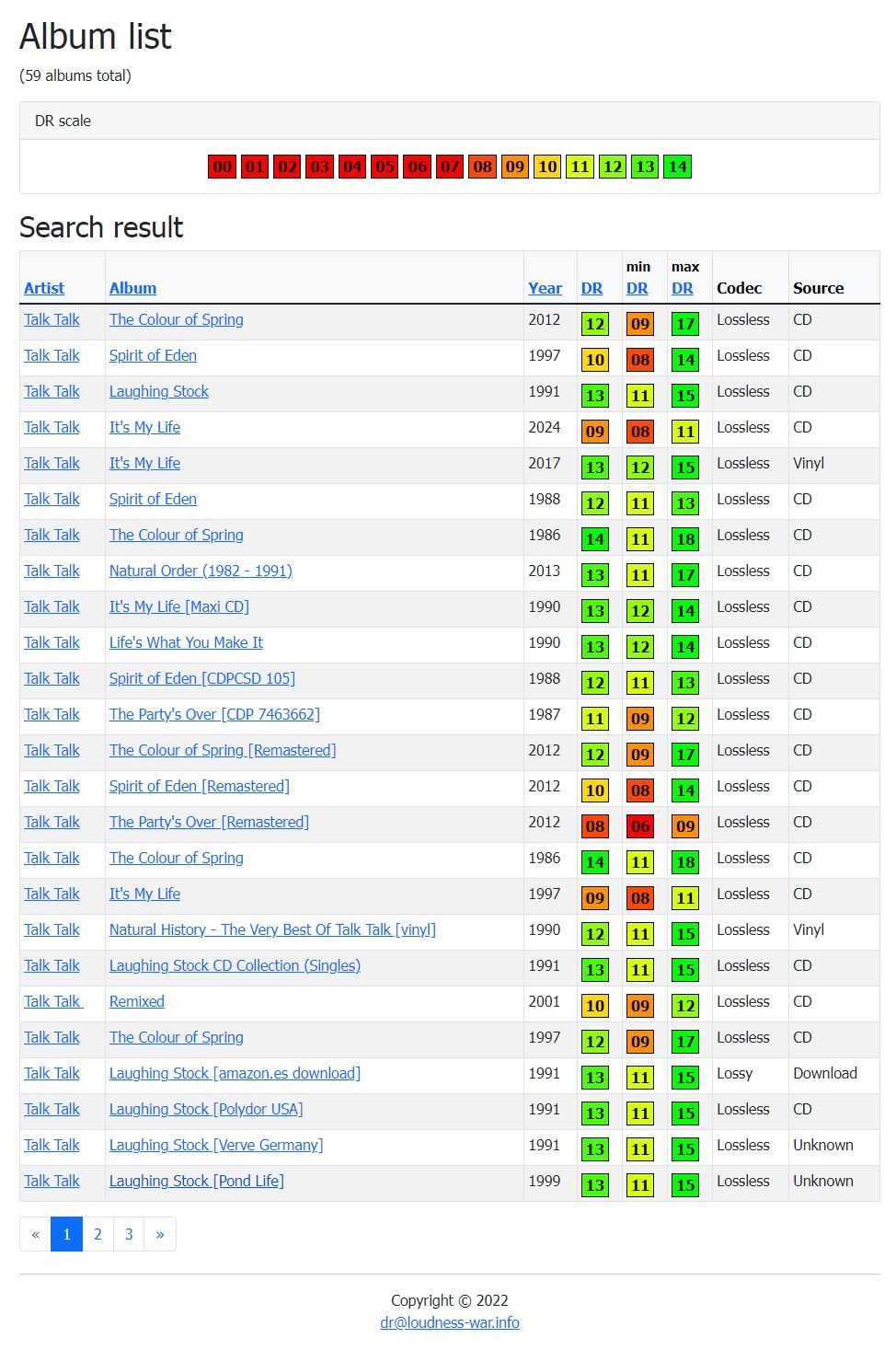
- Dynamic Range Database: https://dr.loudness-war.info

Here are some of the key iZotope patents covering DSP techniques, audio compression, dynamic range processing, masking analysis, and smart multitrack mastering:
🎚️ 1. US 9,350,312 B1 – Audio dynamic range adjustment system and method
- Automatically analyzes an audio file’s level histogram and adjusts its dynamics via histogram equalization mapping to a target histogram.
- Creates a smooth, time-varying gain envelope—automating dynamic range compression without explicit threshold/ratio tweaking Google Patents+3YouTube+3Reddit+3Google Patents.
🎛️ 2. US 10,389,320 B2 – Methods for adjusting perceived loudness and spectral balance
- Utilizes frequency-band filterbanks with time- and frequency-varying gain.
- Incorporates dynamic EQ and multiband control to shape loudness and tonality in a perceptually weighted manner Google Patents.
🧠 3. US 11,469,731 B2 – Identifying and remediating sound masking
- Detects frequency masking between stems by modeling loudness and partial loudness per psychoacoustic ear filter.
- Recommends corrective dynamic/EQ adjustments to reduce masking and improve clarity in complex mixes Google PatentsYouTube+1UAD, Apollo, and LUNA Forums+1.
🤖 4. US 9,654,869 B2 – Autonomous multi-track audio processing
- Automatically analyzes multiple track features (dynamics, spectral content, loudness).
- Assigns optimized processing parameters (compression, EQ, gain) per track—ideal for “Master Assistant”-style mastering YouTube+1UAD, Apollo, and LUNA Forums+1.
💾 5. US 7,328,153 B2 – Automatic identification of sound recordings
- Provides fingerprinting and codec-aware processing—helpful for mastering-aware loudness correction and codec optimization Reddit+6UAD, Apollo, and LUNA Forums+6YouTube+6.
Other Related IP
- WO 2010/141504 A1: End‑to‑end system for analyzing and editing audio for music production—foundation for Ozone’s mastering assistant features YouTube.
- Likely additional patents in areas like transient detection, phase-linear multiband limiting, harmonic shaping, and intelligent EQ—often contained in Ozone/Neutron/IP modules, but not fully public in these samples.
- US 10,396,744 B2 et al. — Psychoacoustic masking detection for mix clarity
📌 Summary of Technical Innovations
- Histogram-based dynamics: Re-map loudness distributions automatically to shape contrast or loudness.
- Perceptual loudness control: Achieve consistent LUFS while preserving spectral balance.
- Masking detection & fixes: Analyze stem interactions digitally, suggest or auto-apply processing.
- Autonomous multitrack processors: Analyze and optimize compression/EQ per track.
- Codec awareness: Scripted awareness of encoding artifacts and file origins for tailored processing.
These patents underlie the power of modern mastering suites like iZotope Ozone—melding psychoacoustic awareness, AI-assisted parameter control, and perceptual loudness processing. They automate and flatten dynamics, unlike vintage analog workflows.
PINK is notoriously (and self-destructively?) maximized into “everything is equally as loud as a scream” — and just like attempting to listen to Screaming Sam Kennison, the listener fatigue is swift and solid.
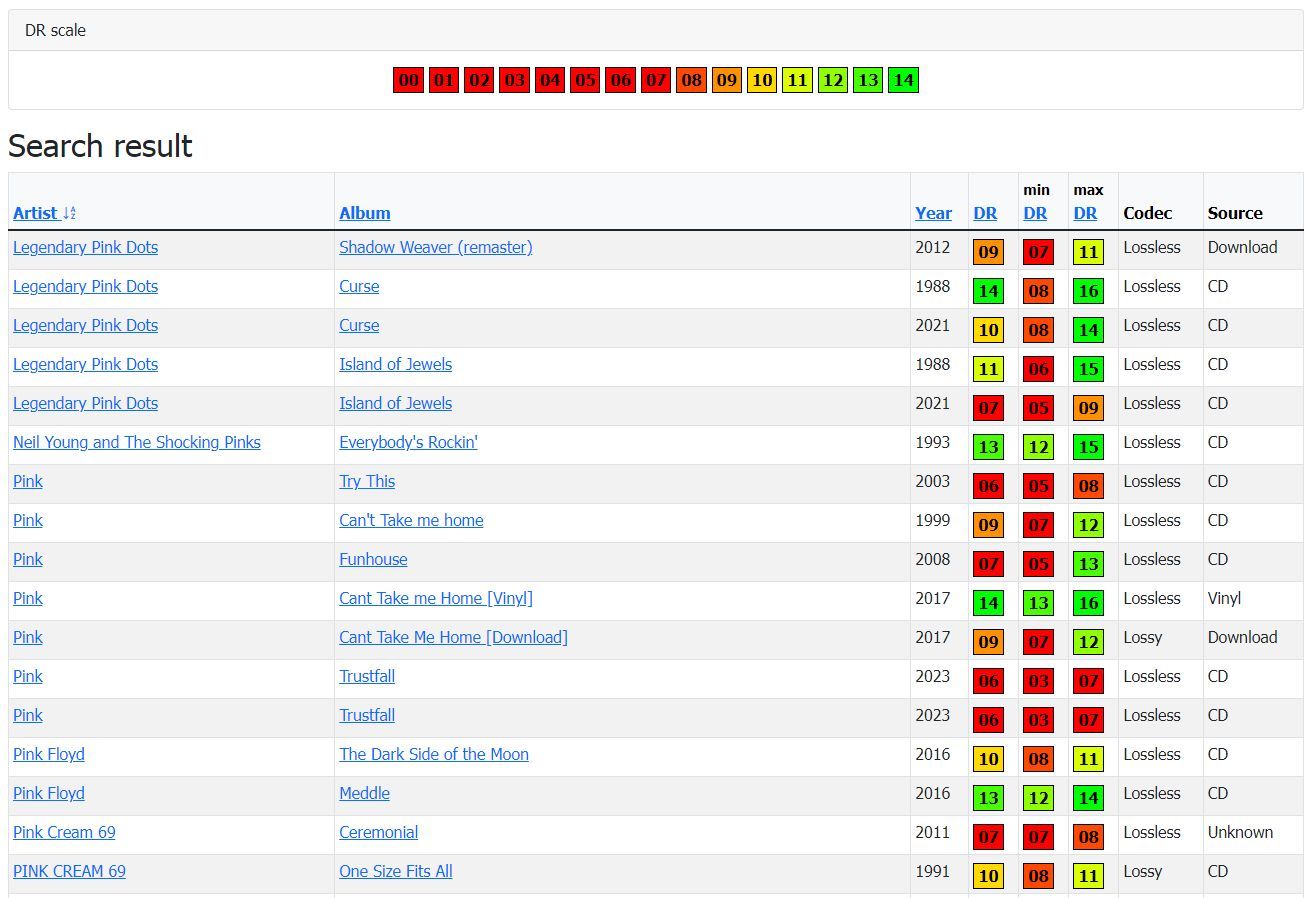
Meanwhile, TALK TALK released more albums brimming with (more-) natural dynamic glory. Dynamic players (and speakers) do the opposite of fatigue listeners. Perhaps this accounts for the far greater and longer-lived popularity of TALK TALK?
List of recording engineers 1950s thru 1990s (prior to “maximization” fad)
Here’s a list of the most prolific and influential recording engineers from 1950 to 1990, across genres like rock, jazz, pop, and classical. These engineers were not only prolific in output but also shaped the sound of entire musical movements:
🎚️ Top Recording Engineers (1950–1990)
🎼 1950s – Early Stereo and Jazz/Pop Hi-Fi
- Rudy Van Gelder – Blue Note, Prestige, Impulse! (Miles Davis, John Coltrane, Thelonious Monk)
- Bill Putnam Sr. – Universal Audio founder, worked with Frank Sinatra, Nat King Cole, Ray Charles
- Tom Dowd – Pioneered multitrack recording; worked at Atlantic Records with Ray Charles, Aretha Franklin, John Coltrane
- Fred Plaut – Columbia Records; engineered landmark sessions for Glenn Gould, Miles Davis (Kind of Blue)
🎸 1960s – British Invasion and Rock Revolution
- Geoff Emerick – Beatles engineer (Revolver, Sgt. Pepper, Abbey Road)
- Norman Smith – Early Beatles; later produced Pink Floyd’s first albums
- Glyn Johns – The Rolling Stones, Led Zeppelin, The Who, The Eagles
- Ken Scott – The Beatles (White Album), David Bowie (Ziggy Stardust), Supertramp
🌀 1970s – Hi-Fi Rock, Soul, and Emerging Funk/Disco
- Bruce Swedien – Michael Jackson (Off the Wall, Thriller), Quincy Jones
- Al Schmitt – Steely Dan, George Benson, Jefferson Airplane, Barbra Streisand
- Roy Halee – Simon & Garfunkel, produced and engineered Bridge Over Troubled Water
- Phil Ramone – Billy Joel, Paul Simon, Barbra Streisand
🎛️ 1980s – Digital Transition, Big Studio Sound
- Hugh Padgham – Genesis, Phil Collins, The Police (pioneered gated reverb drum sound)
- Bob Clearmountain – Rolling Stones, Bruce Springsteen, David Bowie
- Bill Schnee – Steely Dan, Whitney Houston, Boz Scaggs, Marvin Gaye
- Chris Lord-Alge – Madonna, James Brown, Tina Turner (later became known for heavy-handed compression style)
🏆 Honorable Mentions
- Eddie Kramer – Jimi Hendrix, Led Zeppelin, Kiss
- Shelly Yakus – Tom Petty, Stevie Nicks, John Lennon
- Joe Tarsia – Founder of Sigma Sound, Philly Soul sound (The O’Jays, Teddy Pendergrass)
- Stephen Barncard – Grateful Dead (American Beauty), David Crosby
- Roger Nichols – Steely Dan (perfected clean, hyper-detailed studio recordings)
List recording engineers known for loudness perception maximization
The “Loudness Wars”—a term coined in the late 1990s—refer to the industry-wide push to maximize perceived loudness in recordings by reducing dynamic range, often through heavy compression, limiting, and clipping. While mastering engineers bear much of the blame, recording and mixing engineers were often complicit or even leading the charge.
Here are the most notable engineers associated with the Loudness Wars, especially from the 1990s onward, with some overlap into the late 1980s:
🔊 Recording & Mixing Engineers Associated with the Loudness Wars
🎛️ Chris Lord-Alge
- Known for ultra-compressed, radio-friendly mixes.
- Mixed Green Day, My Chemical Romance, Muse, and countless modern rock records.
- Famous for punchy, “in-your-face” dynamics.
🎚️ Tom Lord-Alge (brother of Chris)
- Similar style with pop polish; worked on Blink-182, Sum 41, and Avril Lavigne.
- Champion of wide stereo imaging and tight compression.
🎚️ Andy Wallace
- Mixed Nevermind by Nirvana, which helped define the loud, polished grunge sound.
- His mixing work pushed limits but was often later “maximized” during mastering.
🎚️ Mike Shipley
- Mixed Def Leppard (Hysteria), Shania Twain (Come On Over).
- Known for dense, layered, loud mixes with ultra-tight gating and dynamics.
🎚️ Kevin Shirley
- Iron Maiden, Aerosmith, Joe Bonamassa.
- Sometimes criticized for “overbaked” rock mixes with reduced dynamic headroom.
🎛️ Jack Joseph Puig
- Mixed John Mayer, Goo Goo Dolls, Sheryl Crow.
- Known for heavy analog-style compression and saturation.
🧪 Mastering Engineers Who Enabled Loudness War Era
Although not recording engineers, these mastering engineers were critical:
- Ted Jensen – Mastered Death Magnetic (Metallica), often cited as too loud (with audible clipping).
- Bob Ludwig – Respected for audiophile mastering, but still occasionally caught in the loudness trend under label pressure.
- Howie Weinberg – Mastered Nirvana, Red Hot Chili Peppers; involved in many loud mixes.
- George Marino – Mastered AC/DC, Guns N’ Roses, Metallica; high-profile work at Sterling Sound.
🧨 Infamous Examples
| Album | Engineer(s) | Notability |
|---|---|---|
| Metallica – Death Magnetic (2008) | Mixed: Greg Fidelman Mastered: Ted Jensen | Notorious for extreme clipping and fan backlash |
| Red Hot Chili Peppers – Californication (1999) | Mixed by Andrew Scheps | Widely cited for brickwalled compression |
| Green Day – American Idiot (2004) | Mixed by CLA | Pushed loudness to peak mainstream success |
| Oasis – (What’s the Story) Morning Glory? (1995) | Mixed by Owen Morris | Early loudness landmark |
📉 Consequences
- Ear fatigue
- Loss of musical dynamics
- Flatness and digital harshness
- Streaming normalization has since curbed this trend somewhat
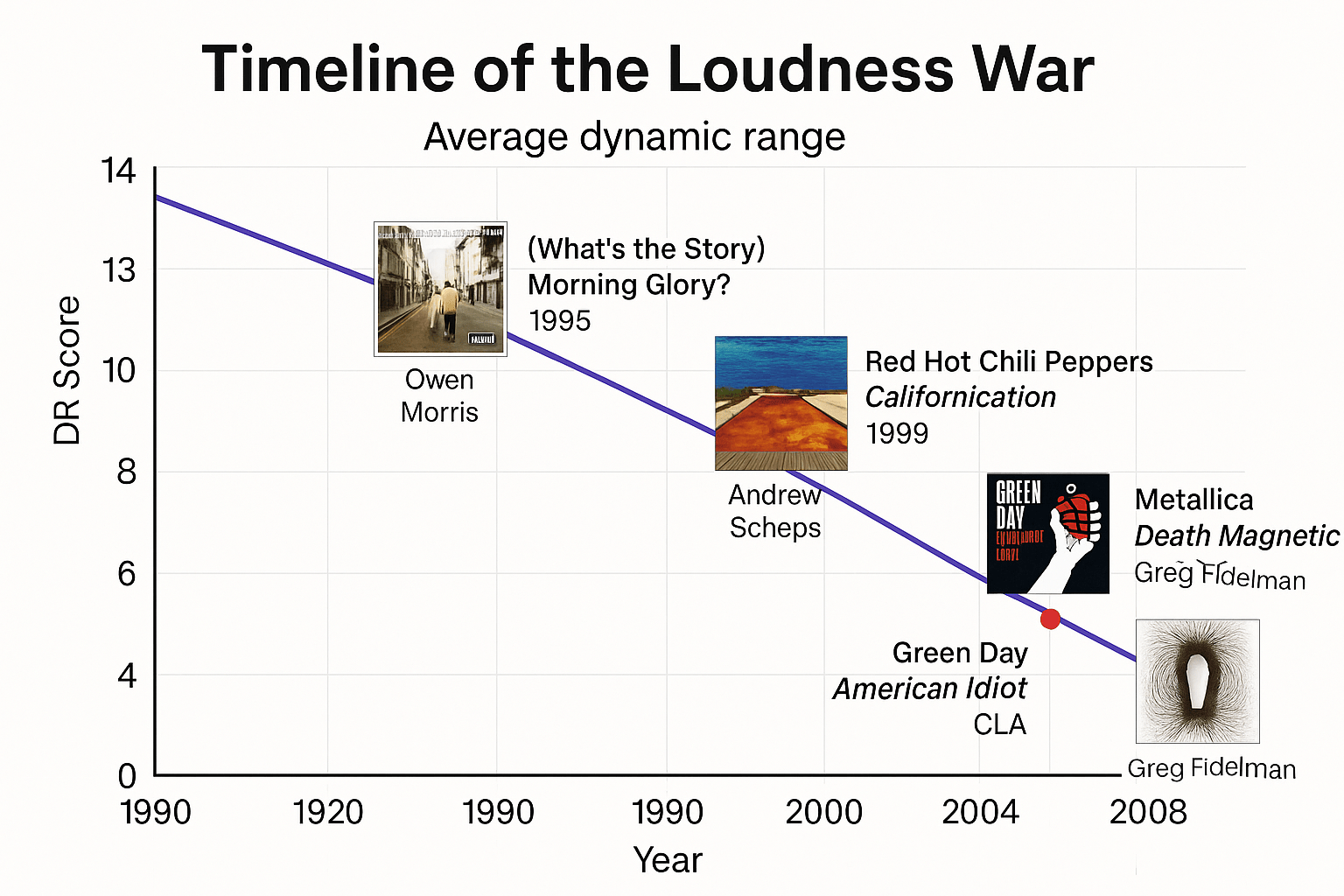
Typical living room conversation has a dynamic range of 20 dB.